


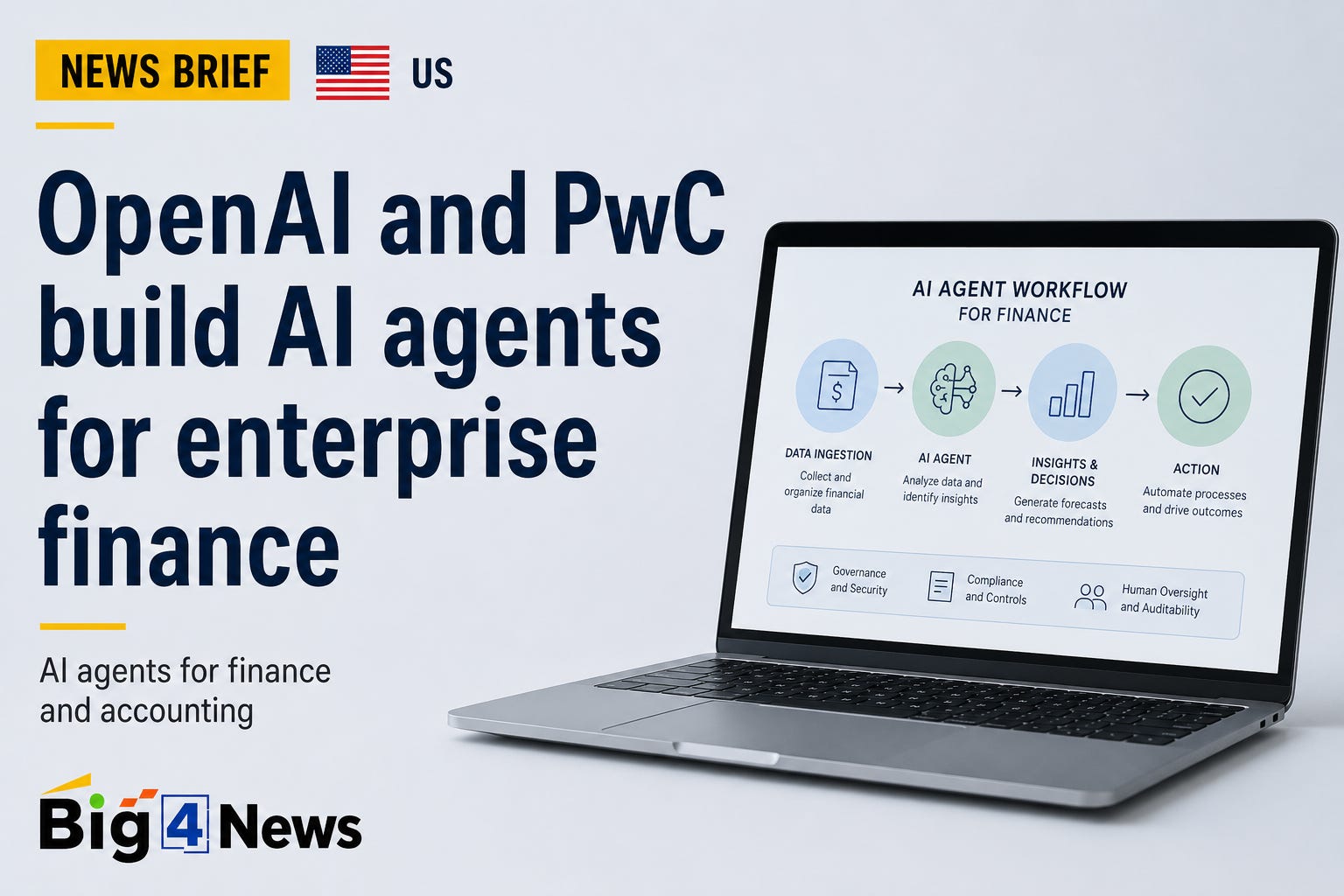
OpenAI and PwC have expanded their collaboration to develop AI agents for corporate finance departments, targeting work traditionally handled across the office of the chief financial officer.
The companies said the agents will support activities including financial planning, forecasting, reporting, procurement, payments, treasury, tax and the accounting close. The aim is to automate repeatable tasks, connect information held across different systems and identify exceptions or emerging risks while retaining human supervision and governance.
OpenAI’s own finance department is acting as what the companies call “customer zero”. PwC and OpenAI are initially building a procurement agent inside OpenAI and intend to apply the lessons from that deployment to other finance processes and client organisations.
OpenAI said its finance team already uses ChatGPT and Codex across investor relations, treasury, tax, reporting, corporate development and contract review. It reported that Codex had enabled the team to process five times as many contracts without increasing staff numbers, while a separate internal tool supported more than 200 investor interactions during a recent fundraising round.
PwC will contribute finance-transformation, controls and implementation expertise, while OpenAI provides the underlying models and products. The partnership builds on their earlier agreement, under which PwC became a major ChatGPT Enterprise customer and reseller.
The initiative also illustrates how the Big Four are positioning themselves not only as users of generative AI, but as implementation partners helping clients redesign entire business functions around AI agents.
That shift raises broader questions about verification, access permissions and accountability. In his interview on AI governance, former global CFO Wayne Banks argues that boards should demand traceable outputs, documented controls and named human responsibility. Big4News’ analysis of AI-generated errors in Big Four reports examines why verification matters in practice. Those cases concern separate reporting failures, not evidence of defects in the PwC–OpenAI finance agents.
Related coverage
OpenAI and PwC collaborate to reimagine the office of the CFO — OpenAI, 4 May 2026
The original announcement explains the planned finance workflows, OpenAI’s role as the first internal deployment environment and the emphasis on governance and human oversight.
PwC and OpenAI Build a First-of-Its-Kind OpenAI Native Finance Function — PwC, 5 May 2026
PwC’s announcement presents the collaboration as an effort to create an AI-native finance operating model that organisations can govern, improve and scale over time.
OpenAI, PwC partner to build AI agents for CFOs — CFO Dive, 6 May 2026
Provides an independent overview of the partnership and focuses on OpenAI’s finance team acting as “customer zero” for the new agents.
PwC and OpenAI deepen tie-up to deliver AI-native finance function — International Accounting Bulletin, 6 May 2026
Examines the firms’ expanded relationship and the combination of OpenAI technology with PwC’s finance, risk and transformation expertise.
PwC, OpenAI prep AI treasury agents — Global Finance, June 2026
Looks specifically at the potential use of agentic AI in treasury and other finance functions, including forecasting, payments and tax.
Trying to keep up with technology at Deloitte, PwC, EY and KPMG? Start here →
https://www.big4news.com/t/technology-and-ai
Want to stay up to date on all things Big Four around the world?
Check out the News section and subscribe to Big4News for weekly deep dives and briefings.