


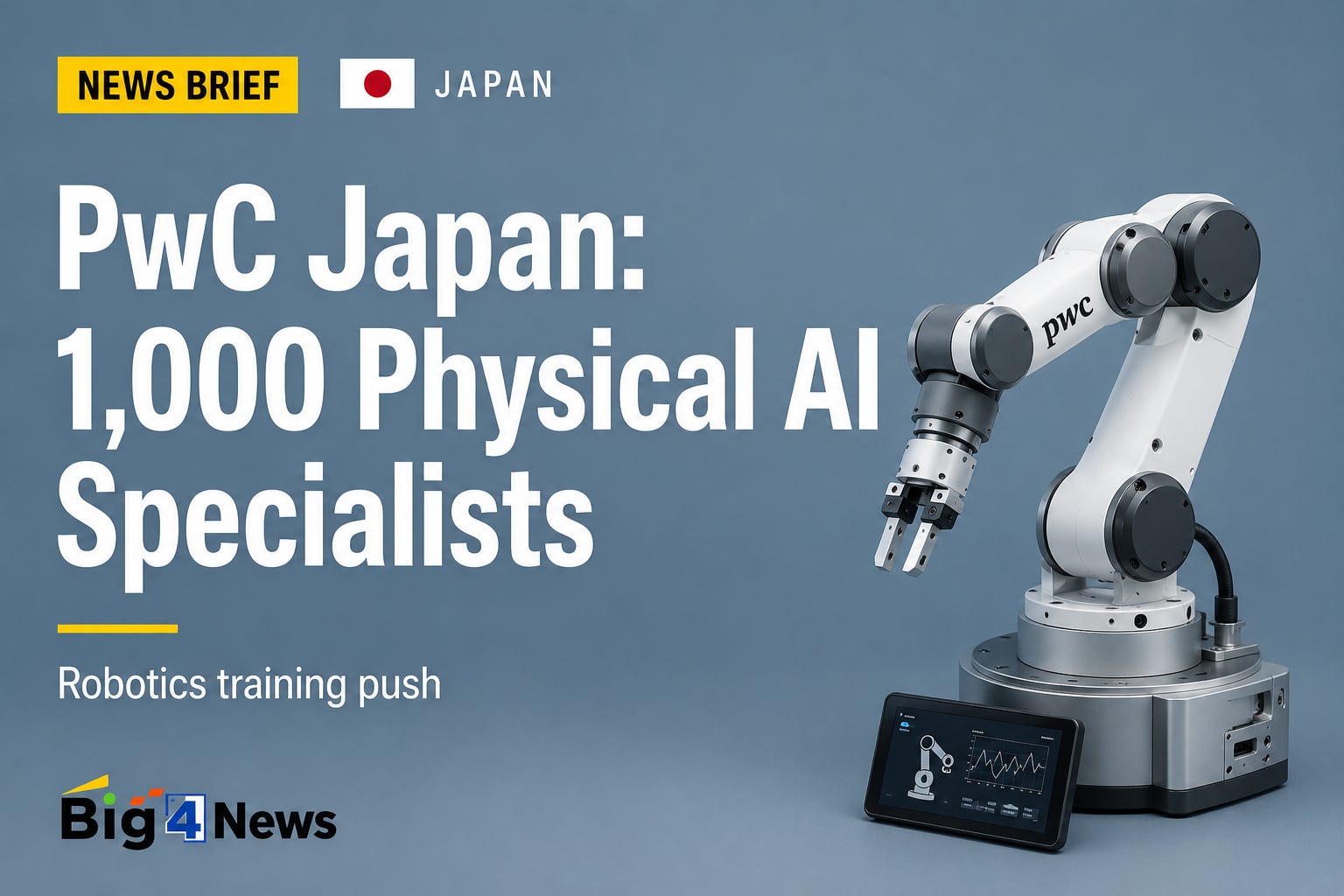
PwC Consulting Japan has launched a training programme intended to create approximately 1,000 physical AI specialists over the next year, positioning the firm to advise companies confronting Japan’s worsening shortage of workers.
The firm currently has more than 150 people working in the field, principally through its Technology Laboratory. The programme will be extended across the consulting business and will combine technical instruction with the commercial and operational skills needed to implement physical AI in client organisations.
Physical AI applies advanced artificial-intelligence models to machines operating in the real world. These can include industrial and service robots, humanoids, drones and autonomous vehicles capable of perceiving their surroundings, making decisions and carrying out physical tasks.
PwC expects the technology to be deployed across manufacturing, logistics, construction, healthcare, eldercare, retail, agriculture, infrastructure maintenance and disaster response. These are also among the areas in which Japan’s ageing population and shrinking labour force are creating particularly acute operational pressures.
Participants will study AI models, robotics, sensors, control systems and the use of data. The programme will include programming exercises and practical work with robot kits, alongside workshops on identifying client problems, assessing commercial viability and developing implementation roadmaps.
PwC said the aim is to help companies move physical AI projects beyond proof-of-concept trials and into live operation. Consultants will be trained to support the process from technology development and operational deployment through to wider business transformation and the creation of industry ecosystems.
The firm identifies the shortage of people who understand both robotics technology and commercial implementation as one of the principal obstacles to wider adoption. PwC says its physical AI business has grown to approximately three times its size a year ago.
Automation as a response to demographic decline
The scale of the programme reflects more than growing interest in robotics. PwC explicitly presents physical AI as a possible response to Japan’s declining labour population, arguing that the technology could help alleviate worker shortages, raise productivity and support the continuing operation of the country’s industrial and social infrastructure.
Japan’s demographic trajectory makes that argument commercially significant. An OECD long-term projection found that, under unchanged fertility, immigration and employment assumptions, the country’s population could fall from approximately 125 million to 96 million by 2060, while employment could decline by more than half by the end of the century. The OECD identified higher productivity, digitalisation, artificial intelligence and greater use of robotics as important elements of the response.
Technology is not a complete demographic solution. The OECD also points to increased employment among women and older people and greater use of foreign workers. But as the number of available workers declines, businesses will increasingly need to determine which parts of their operations can be performed with less human labour.
Where physical AI could fill the gaps
The most realistic applications are unlikely to involve robots replacing entire occupations. Physical AI is more likely to absorb particular tasks within jobs—especially work that is repetitive, physically demanding, hazardous, conducted in remote locations or difficult to staff at unsociable hours.
In manufacturing, robots can move materials, load machinery, inspect products and perform repetitive assembly work. More adaptive systems could take on tasks that conventional industrial robots struggle with because objects, layouts or working conditions vary. In warehouses and distribution centres, autonomous mobile robots can transport goods, while vision-enabled systems can support picking, sorting, stock checks and loading. Autonomous delivery robots are also being developed as a response to shortages in the logistics workforce.
Retail, hospitality and other service businesses offer less dramatic but potentially widespread applications. Robots can clean large premises, move supplies, scan shelves or make internal deliveries, reducing the amount of employee time devoted to routine movement and monitoring. Japan’s transport ministry already lists unattended robotic floor cleaners and autonomous baggage-handling systems among technologies intended to reduce the effect of manpower shortages at airports.
Construction and infrastructure maintenance present a different opportunity. Drones and mobile robots can survey sites, inspect tunnels, bridges and other structures, collect visual data and enter areas that are dangerous or difficult for people to reach. Semi-autonomous machinery can reduce the number of operators required for excavation, transport and other site work. In these settings, the advantage is not only labour saving but also reduced exposure to height, traffic, unstable structures and disaster zones.
Agriculture provides some of the clearest examples of task-level substitution. Robot tractors can plough and plant, drones can monitor crops and spray pesticides, automated systems can manage irrigation, and harvesting machines can reduce dependence on experienced operators. Japanese government demonstration projects reported average reductions of 61% in working time for drone pesticide spraying and 80% for automated water management in the cases examined. Other projects found that automated machinery allowed inexperienced workers to perform tasks previously dependent on skilled operators.
In eldercare, the emphasis is more likely to be on supporting workers than replacing them. Japan’s official priority areas for care technology include assisting with lifting and transferring patients, supporting mobility, monitoring residents, bathing assistance, nutrition management and dementia care. Such systems could reduce the physical burden on carers and automate monitoring or administrative work, leaving staff more time for tasks requiring judgement, reassurance and personal contact.
Many of these applications already exist in some form as conventional robotics or automation. Physical AI promises to extend their usefulness by allowing machines to interpret less predictable environments, respond to changing conditions and learn a broader range of tasks. How quickly that promise can be converted into safe, reliable and economical workplace systems remains to be seen.
The consulting opportunity
PwC is positioning itself within that transition. Its specialists will not simply advise clients on purchasing robots. They will be expected to identify the operational bottlenecks created by labour shortages, determine which individual tasks can be automated and establish whether the proposed investment is commercially viable.
Implementation may require companies to alter factory layouts, standardise processes, improve the quality of operational data and connect machines to existing software and control systems. Employers will also need safety controls, cybersecurity, maintenance arrangements, human oversight and clear accountability when autonomous systems make decisions or cause errors.
The challenge is therefore as much organisational as technological. A robot that performs successfully in a controlled demonstration may fail when exposed to variable lighting, irregular objects, crowded workplaces, legacy equipment or employees who have not been trained to work alongside it. Businesses may also discover that automating one activity merely transfers the bottleneck to another part of the operation.
This helps explain why PwC is training consultants in business-case development, implementation roadmaps and operational transformation as well as robotics. The firm is preparing to advise clients not merely on whether a machine can perform a task, but whether the surrounding workplace can be redesigned so that the technology produces sustained economic value.
Robotics is unlikely to solve all of Japan’s workforce problems, particularly in care, construction, hospitality and other sectors where technology frequently supports employees rather than replacing them. But the 1,000-person programme amounts to a strategic wager by PwC: that helping Japanese organisations maintain output and essential services with fewer available people will become a major consulting market.
Related coverage
PwC Consulting to train 1,000 physical AI professionals — PwC Japan, 22 July 2026
PwC’s official announcement provides the full curriculum, confirms that the firm already has more than 150 specialists and explains how the training will combine robotics, AI, data and implementation expertise.
PwC Consulting to develop 1,000 physical AI specialists — Digital PR Platform, 22 July 2026
An overview of the targeted industries, PwC’s university partnerships and the firm’s ambition to move client projects from experimental trials into real-world operation.
Fujitsu and leading Japanese robotics companies to use Nvidia technology in physical AI — Associated Press, 16 July 2026
Provides broader context on Japan’s physical AI push, including efforts by Fujitsu, Nvidia and major industrial-robot manufacturers to address labour shortages through more autonomous machines.
Trying to keep up with technology at Deloitte, PwC, EY and KPMG? Start here →
https://www.big4news.com/t/technology-and-ai
Want to stay up to date on all things Big Four around the world?
Check out the News section and subscribe to Big4News for weekly deep dives and briefings.