


Key Takeaways
Ethical failures are often predictable — and therefore preventable.
Incentives and targets can unintentionally reward unethical behaviour.
Under pressure, ethical considerations can fade from decision-making.
Strong governance requires real independence, accountability and challenge.
Whistleblowers and independent investigations are critical early-warning mechanisms.
Most ethical failures are not accidents.
They are predictable.
Which means they are preventable.
Yet we continue to treat every scandal — in banking, government, universities, sport, churches, professional services and the corporate world — as though it were an isolated event. We commission inquiries, write reports, express outrage, accept resignations and promise reform. Then, after a period of shame and contrition, the cycle begins again.
It does not have to be this way. My life’s work has been driven by a simple conviction: ethical failures are not inevitable. Most can be prevented if leaders know what to look for before things go wrong.
Over more than twenty-five years, I have worked with leaders, boards and executive teams across Australia. I have investigated some of the country’s most significant failures of integrity, including the Australian cricket team’s ball-tampering scandal in Cape Town and the widespread falsification of preliminary breath tests within Victoria Police.
I have advised Royal Commissions and inquiries into institutional child sexual abuse and into misconduct in banking, superannuation and financial services. I have also sat in boardrooms and leadership rooms, warning people that the conditions for ethical failure were already present, even if the scandal had not yet arrived.
Those experiences, together with my doctoral research at the University of Oxford into decision-making under pressure, have left me with one conclusion above all others: few leaders set out to do the wrong thing. But good people, working in poorly designed systems and under intense pressure, can make decisions that lead to profound harm.
That is why prevention matters.
Every Royal Commission and every investigation into breaches of integrity is a textbook written in hindsight. Leadership is about reading it before the next scandal occurs.
The Cost of Learning Too Late
The case for prevention is not abstract. Ethical failure destroys trust, damages institutions, harms the vulnerable and consumes enormous public resources.
This is the tragedy of repeated ethical failures. The insights that emerge from inquiries are usually preventive insights. They tell us what leaders could have seen, what boards could have asked, what regulators could have challenged, what whistleblowers could have been protected from, and what organisational practices could have been changed before harm occurred.
The purpose of focusing on integrity and ethics is to give leaders the practical wisdom, disciplines and courage to prevent foreseeable failure.
What My Research Taught Me About Ethical Decision-Making
When I went to Oxford to research ethics and leadership, I wanted to understand how leaders actually make decisions when the stakes are high, the information is incomplete and the pressure is relentless.
My doctoral research centred on senior leaders in a major Melbourne public hospital during the COVID pandemic. What I found was not that classical ethics was irrelevant. Virtue, duty, consequences and the common good were all present. But they were present within the reality of human psychology, institutional pressure and organisational constraint. Leaders were drawing on ethics, often implicitly, while operating under conditions in which human judgement is most vulnerable and valuable.
That is where behavioural ethics becomes so important. Behavioural ethics helps us understand why good people can do the wrong thing without recognising themselves as unethical. It explains ethical fading, bias, moral disengagement, rationalisation, group conformity, excessive loyalty, the rush to decision-making and the tendency to treat a performance target as more real than an ethical obligation.
If we know the predictable ways in which judgement fails under pressure, we can design leadership practices to interrupt those failures. Prevention begins when leaders accept that ethical failure is not merely a problem of bad individuals. It is also a problem of systems, pressures, habits and cultures.
Twelve Practices for Preventing Ethical Failure
If ethical failure is predictable, leaders need a practical discipline for prevention. The following twelve practices are a leadership framework drawn from investigations, inquiries, behavioural ethics, governance failures and the experience of working with leaders who genuinely want to do the right thing.
1. Test incentives for their unintended consequences
Organisations often design the conditions for their own failure. Remuneration schemes and incentive structures can make it rational to do the wrong thing. That does not mean people become corrupt overnight. It means the organisation quietly teaches them what will be rewarded.
The Australian cricket team in Cape Town is a powerful example. Under pressure, facing failure and conscious of the consequences of losing, players crossed a line that should never have been crossed. The issue was not simply individual weakness. It was also the pressure created by a system that prized winning and rewarded it in ways that had not been tested ethically.
Boards should hold a Royal Commission into their own incentive schemes before someone else does. They should ask: What behaviour does this scheme reward? What will people be tempted to hide? What happens at the margins? Who benefits when the wrong thing is done?
2. Check targets for perverse outcomes
Targets can clarify priorities. They can also distort judgement. The Victoria Police preliminary breath testing case showed how a target can produce conduct that undermines the very purpose it was meant to serve.
When police were required to meet a target that effectively rewarded large numbers of negative tests, they behaved rationally inside a badly designed system. The result was widespread falsification and a serious loss of trust. My advice was simple: stop the targets. Once the target was removed, the behaviour stopped quickly.
The leadership lesson is clear. Every target should be tested not only for what it measures but for what it may corrupt. If a target makes the ethical purpose harder to achieve, it is not a management tool. It is an integrity risk.
3. Make ethics explicit in decision-making
Under pressure, ethics often fades. People simply stop seeing the decision as ethical at all. It becomes a budget issue, a legal issue, a media issue, a performance issue and/or a process issue. The human consequences disappear from view.
This is ethical fading. It was visible in financial services in the Hayne Royal Commission when decisions about insurance definitions, fees and products were framed around cost reduction rather than fairness, honesty and harm.
The remedy is to make ethics explicit before decisions are made. Leaders should ask: What is the ethical issue here? Who could be harmed? What principle is at stake? Good ethical decision-making requires leaders to build habits that keep ethical reality in the room.
4. Stop bystanderism
In ethics, what you do matters. So does what you fail to do. Many scandals continue not because no one knows but because no one acts. People stand back, hoping someone else will intervene.
Bystanderism is a form of participation. In many organisations, leaders know when a colleague has crossed a line, when a complaint has been mishandled, when a conflict has been tolerated, or when a culture has become unsafe. Their silence becomes part of the failure.
Leaders must define in advance what escalation requires. They must make it clear that loyalty to the organisation never means loyalty to wrongdoing. The standard should be simple: if you see conduct that places integrity at risk, you have a responsibility to act. As one of Australia’s most senior defence chiefs put it, ‘the standard you walk past is the standard you accept’.
5. Make governance real
Many organisations have impressive governance structures. However, governance is real only when people are held accountable. Boards cannot outsource culture and then be surprised when culture fails. Executives cannot point to policies while ignoring behaviour. Committees cannot receive reports without asking hard questions. Governance is not the existence of a framework. It is the disciplined exercise of responsibility.
In the cases of KPMG and PwC in Australia, it is clear that serious weaknesses existed in the governance structures. At PwC, board members structurally reported, at least indirectly, to the CEO and his leadership team. KPMG's board included independent directors, but many of its members were also partners holding operational roles within the firm. Yet boards are responsible for the culture and ethics of the organisations they govern. That principle applies everywhere. If a board wants the privileges of authority, it must accept the burdens of accountability.
6. Ensure regulators and professional bodies act
Regulators and professional bodies exist because self-interest is not enough to protect the public good.
Recent professional services scandals have shown how dangerous it is when those who sell trust fail to practise it. Cheating in professional training, misuse of confidential information, audit failures and conflicts of interest undermine the legitimacy of professions that rely on public confidence.
Where regulators fail to act, the system of integrity fails. If regulators need more powers, responsible leaders should initiate reform. Integrity systems matter because trust cannot survive on promises alone.
7. Protect whistleblowers
Whistleblowing is often a sign that ordinary systems of listening have failed.
Too many whistleblowers are isolated and treated as the problem. KPMG in Australia will become a case study in what not to do with whistleblowers. The whistleblower is often the person giving the organisation its last chance to correct itself before the scandal becomes public.
A serious culture of integrity treats whistleblowers with respect and protects them from retaliation. Leaders should ask themselves: would a person in this organisation feel safe telling us what we most need to hear?
8. Use independent and fearless investigations
When serious concerns arise, organisations often want reassurance more than truth. They want a report that can be waved about publicly, a process that protects reputation, and findings that confirm the problem is limited. That is not integrity. It is reputation management.
Independent investigations matter because truth matters. The most useful investigators are not those who tell clients what they want to hear. They are those who follow the evidence, test explanations, listen to victims and witnesses, and refuse to confine themselves to the narrowest version of the question.
If you are afraid of an independent investigation, you are probably afraid of the truth. The organisation is already in danger. If you are afraid of producing a fearlessly independent investigation, you have already failed in your duty of care to your client.
9. Set exemplary standards
Integrity requires exemplary standards. This is especially true for leaders in public life, regulators, boards and organisations entrusted with public confidence.
The path to corruption often begins with cultivation: a meal, a gift, an invitation, a private meeting, a favour, a promise of access. Then comes compromise. Then corruption. Wise leaders understand this sequence and interrupt it early.
Integrity leaders, including those who head our anti-corruption commissions, refuse free hospitality, pay their own way, insist on note-takers, avoid private meetings that create risks of a perceived or actual conflict of interest, and apply stricter standards to themselves than the law requires.
The question for leaders is not, ‘Can I get away with this?’ It is, ‘What standard am I setting for everyone else?’ Our business leaders should hold themselves to the same standards of behaviour as the heads of integrity agencies and judges. CEOs should not attend lunches or dinners with people who are known to be ‘persons of interest’ to local anti-corruption agencies. They should not participate in legitimising dubious and unethical practices.
10. End collusion
Ethical failure often becomes possible because people protect one another. Collusion is not always a conspiracy. Sometimes it is a culture of deference, convenience, fear or misplaced loyalty. It can occur when boards overlook past misconduct in a preferred chief executive, when leaders tolerate conflicts of interest, when organisations normalise relationships with questionable associates, or when people confuse access with influence and influence with success.
The antidote is transparency. Record decisions. Declare conflicts. Ask who benefits. Avoid private arrangements that cannot be defended publicly. Do not appoint people whose past conduct contradicts the values the organisation claims to uphold. Character matters long before crisis arrives.
11. Form leaders with character
Aristotle understood something many modern leadership programmes forget: ethics is not simply a matter of rules. It is a matter of character formed through repeated action.
People become courageous by doing courageous things. They become honest by telling the truth when it is costly. They become just by acting fairly when fairness is inconvenient. They become humble by listening, learning and admitting error.
Leadership development must be character formation. Leaders need technical skill, strategic judgement and financial discipline. But they also need courage, prudence, honesty, compassion, humility and a commitment to the common good.
Many Australians practise these virtues every day as nurses, paramedics, teachers, police officers, firefighters, doctors, public servants, carers, road workers, tradespeople and volunteers. They do not call it virtue ethics. They simply serve. Leaders of organisations should follow the behaviours of those who serve on the front line.
12. Cultivate cultures of integrity
Culture is what grows when repeated practices take root. Integrity is fostered through decisions, habits, rituals, expectations and consequences.
I recently joined my local Country Fire Authority brigade. In my brigade, I see integrity in action: ordinary people doing ordinary tasks with extraordinary seriousness because community safety depends upon them. The widespread exam-cheating uncovered at KPMG Australia should itself have been a red flag well before recent events.
Organisations need the same discipline. Culture is formed by what leaders repeatedly do, tolerate, reward, ignore and punish.
From Post-Mortem to Foresight
We have become far too skilled at post-mortems. The harder task is foresight.
Foresight asks leaders to identify the conditions that make ethical failure more likely before harm occurs. It asks boards to test incentives and targets. It asks executives to slow down under pressure. It asks regulators to act with courage. It asks organisations to protect whistleblowers, commission independent investigations, end collusion, demand accountability and cultivate character. This is preventive ethics. It is well past time to take this path.
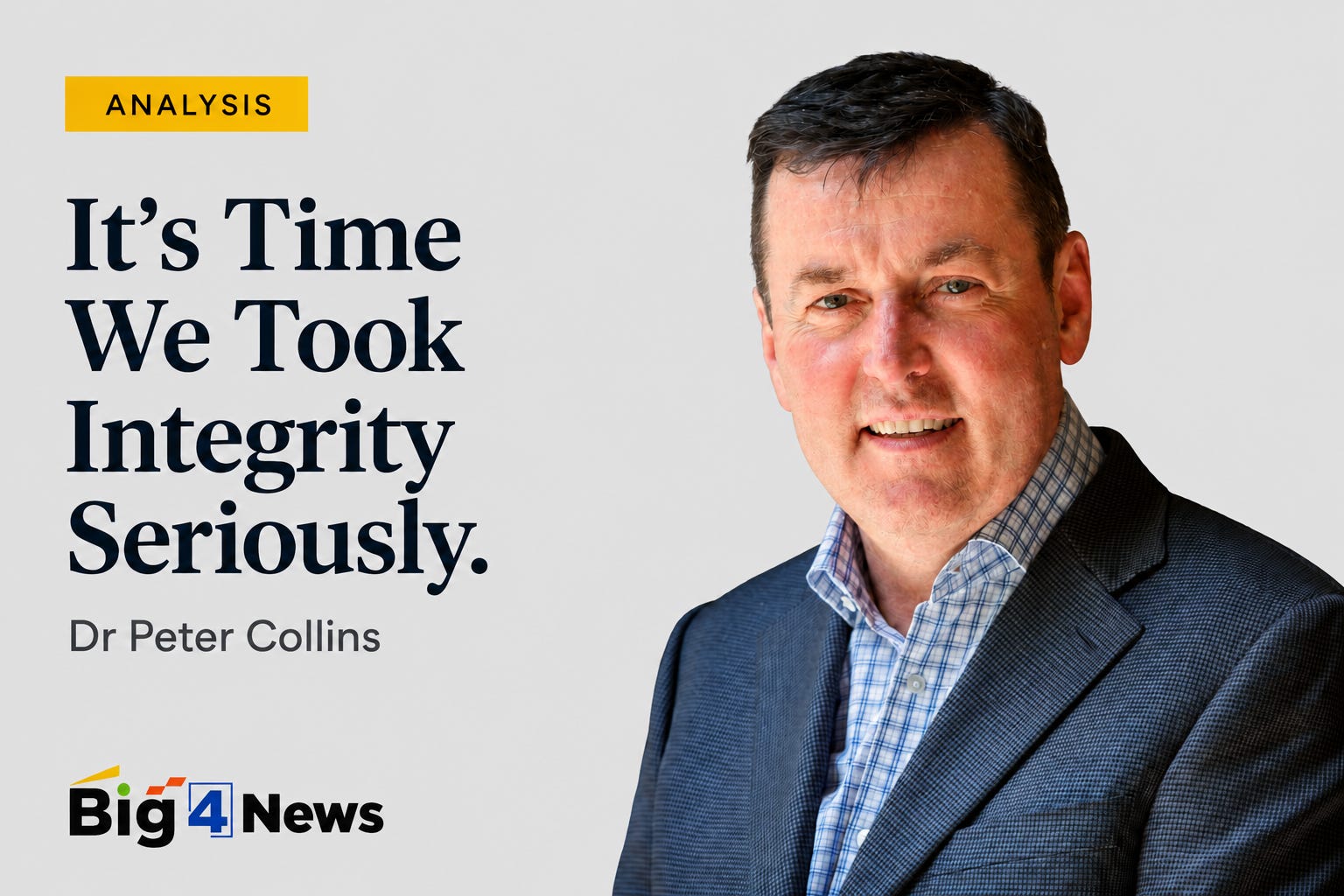
About Dr Peter Collins
Dr Peter Collins is an executive adviser specialising in ethics, integrity, governance and organisational leadership. Over more than 25 years, he has worked with governments, boards, CEOs and executive leadership teams to understand why misconduct and major integrity failures occur, and how organisations can reduce the risk of recurrence.
He is a former Executive Director of Australia’s Centre for Ethical Leadership, former Head of Ethics & Integrity at the Walter and Eliza Hall Institute of Medical Research, and a former Principal at Nous Group and consultant with McKinsey & Company. He has also advised Australian Cabinet Ministers on foreign affairs, national security and health policy.
Peter holds a DPhil in Ethics from the University of Oxford, where his doctoral research examined senior leadership decision-making and ethics under pressure. His work spans investigations, Royal Commissions, governance reform, organisational culture and the development of systems designed to prevent integrity failures rather than simply respond to them.
This article is part of the Big4News Expert Voices Series
Expert Voices

Expert Voices features interviews and guest contributions from former insiders, whistleblowers, academics, regulators and experienced practitioners. The series examines the structures, incentives and professional cultures behind events at Deloitte, PwC, EY and KPMG.

Many great quotes in here I'll want to re-use Dr Collins !! I'd like to suggest meeting with Dr Jen Fraser PhD who wrote 'The Gaslit Brain'. She has some compelling perspective on what's driving bad behavior.