


A guest post by Abdelhamid Taha, a financial regulation specialist with over a decade of operational experience in AML and compliance at HSBC, including during the bank’s US Deferred Prosecution Agreement period. He is a Member of the Secretariat Committee of the All-Party Parliamentary Group on Investment Fraud & Fairer Financial Services. Full bio at the end of the article. He writes in a personal capacity.
Key Takeaways:
Recent KPMG Australia and PwC cases (Corporate Travel Management, WHSmith) show the same pattern of internal failure
Editor’s note: This article is part of Big4News’ Expert Voices series, which publishes informed external commentary on audit, governance, regulation, and professional services.
It is Part One of a two-part series on whistleblower protection, Big Four governance, and the external architecture needed when internal systems fail.
Prologue: The Call That Changes Everything
Imagine you are a senior manager at one of the world’s most prestigious professional services firms. You have spent a decade building your career inside this institution. You know its culture, its unwritten rules, its hierarchies of loyalty. And then one day, you see something you cannot unsee.
A partner does something that crosses a line you cannot rationalise away. Maybe it is a client’s confidential board papers being used to pitch a competitor’s audit. Maybe it is billing documentation that does not survive scrutiny. Maybe it is a revenue recognition treatment you know, with absolute professional certainty, does not reflect reality.
You think about it for days. You read the firm’s whistleblower policy. It is comprehensive, professional, reassuring. There is a hotline. There is an ethics committee. There is a promise of confidentiality and non-retaliation, printed clearly in the firm’s values documentation.
So you make the call.
And that is where the story the policy tells — and the story that actually unfolds — permanently diverge.

Act One: The Architecture of Silence
What happens next is not random, even though it is not the product of individual malice or institutional bad luck. Events follow a sequence so consistent across firms, jurisdictions, and years that it can only be described as an emergent design.
Within days of the report, the caller begins to sense a change in the atmosphere. Meetings they were previously included in no longer appear in their calendar. The partner they reported stops making eye contact. A performance review that was previously positive is quietly revised.
No one says anything directly — that would create evidence. The message is delivered through the texture of daily professional life, in a hundred small signals that are individually deniable and collectively unmistakable.
Former Big Four insiders and whistleblowers have described a recurring pattern: that across multiple firms, from HR processes to investigation committees, there is often a tendency to marginalise rather than protect those who raise concerns. This is not necessarily aberrant behaviour in any single institution. It is better understood as a shadow architecture — the operational system that runs beneath the written policy, recognisable to those who have worked inside these firms, even where it is never explicitly articulated.
No partner sat in a boardroom and designed a system to silence whistleblowers. They did not need to. The shadow architecture writes itself the moment you give the investigation to the people with the most to lose from its findings.
The shunning, the marginalisation, the quiet expulsion — these are not policies. They are what happens when you remove independent oversight from a partnership that values loyalty above all else.
The written policy is the public architecture. The shadow architecture is what the public record — across parliamentary hearings, regulatory findings, and Senate inquiries on two continents — consistently shows operating in its place.
Act Two: Four Cases, One Pattern — No Effective Early Escalation
Let us be precise about what the evidence shows, because precision is what separates an argument from an allegation.
There is a difference, on paper, between a firm’s internal whistleblower hotline and its statutory audit. The former is supposed to surface misconduct inside the firm. The latter is supposed to surface misconduct at the client. But they share the same structural vulnerability: in both, the people responsible for identifying the problem are economically entangled with the people who would be harmed by its discovery.
The cases that follow illustrate a consistent pattern: the same culture and incentive structure that critics argue silences internal reporters can also weaken statutory audits, allowing serious concerns eventually surfaced by people inside the client to go undetected. The void is not identical in form, but it is similar in function.
PwC Australia — The Tax Confidentiality Breach
Concerns about the tax confidentiality breach were identifiable internally as early as 2017. PwC Australia’s own Statement of Facts, published as part of its commitment to transparency, documents missed opportunities for escalation in 2017, 2019, and through the early stages of the Tax Practitioners Board investigation.
The handling of the matter is complicated by the fact that two different CEOs were at the helm across the period in which the leaks occurred and in which the firm’s response was managed.
Tom Seymour, who led the tax practice during part of the relevant period and later became CEO, remained involved in the firm’s handling of the matter rather than fully removing himself from the process — a point that parliamentary critics argued created precisely the conflict the escalation process was meant to prevent.
When investigators sought access to relevant materials, PwC relied on claims of legal professional privilege in a manner that parliamentary critics argued slowed scrutiny significantly, making it harder to establish who knew what and when. The Senate committee and parliamentary critics characterised PwC’s approach as delaying accountability; PwC, for its part, has maintained that it was entitled to assert privilege over legally protected material.

KPMG Australia — The Audit Tender Allegations
A whistleblower raised allegations that confidential client board papers had been improperly accessed and used in connection with competitive audit tenders. This is where the public record becomes forensically instructive about how investigation architecture operates in practice.
KPMG initially engaged Ashurst in connection with the matter. However, Ashurst subsequently told a parliamentary inquiry that it had not been engaged to investigate the whistleblower’s substantive claims at all. Ashurst’s role had been limited to providing a legal opinion on an employment matter — a materially different function from an independent investigation into the underlying allegations.
This distinction matters enormously. Saying an investigation “did not substantiate” allegations implies the allegations were examined and found wanting. What the parliamentary record establishes is that the substantive allegations were never independently examined in the first round at all.
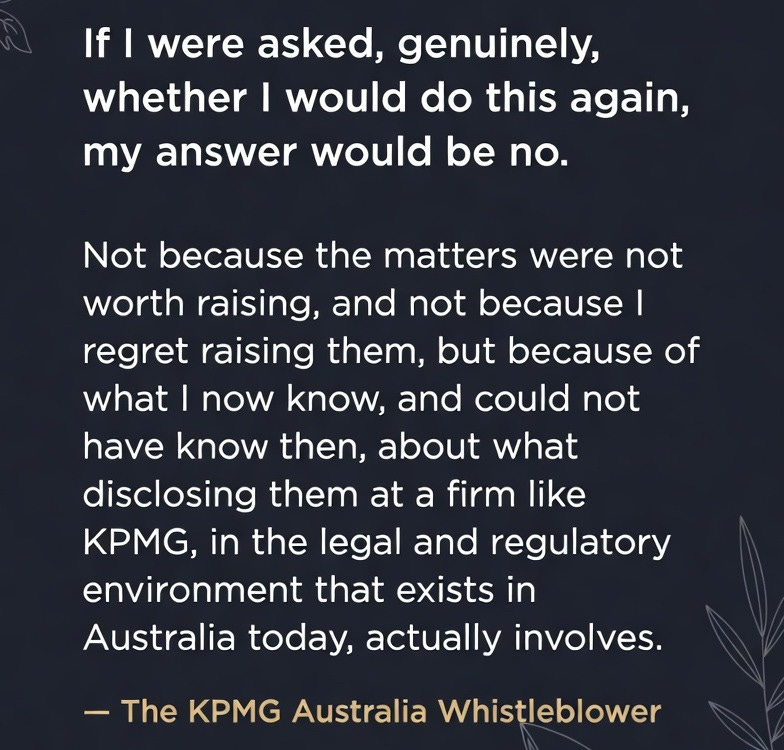
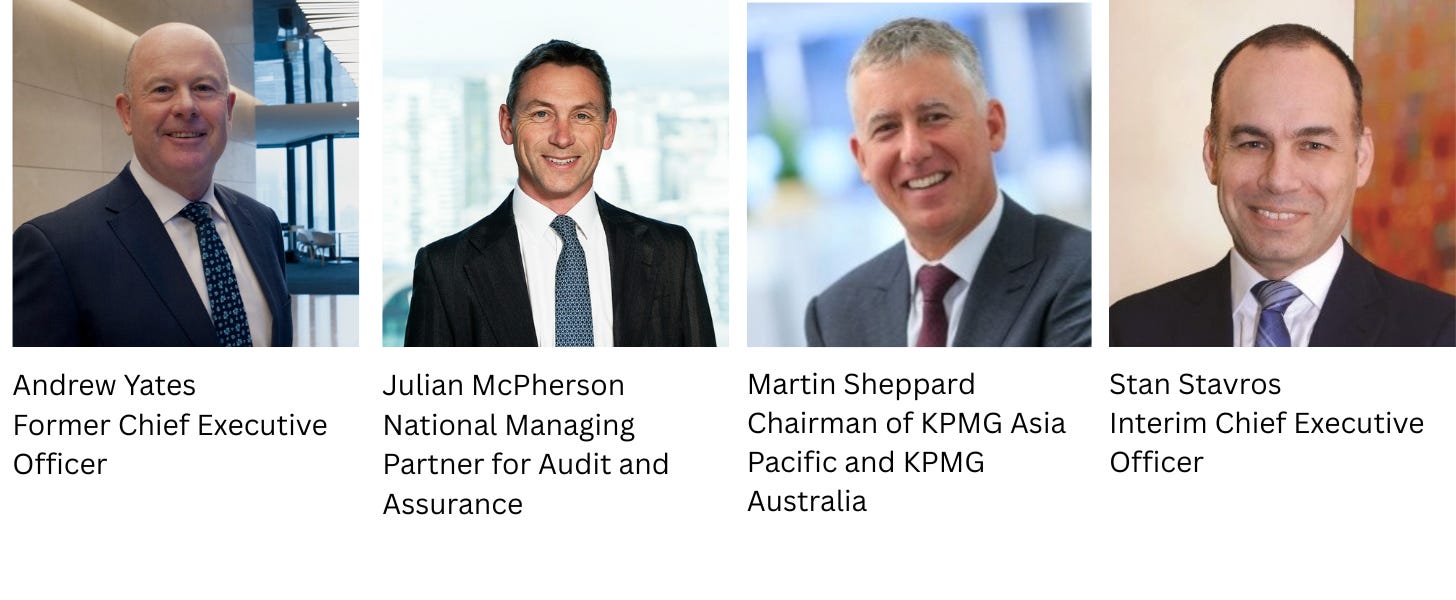
A later review by Allens, commissioned with an expanded scope, reached different conclusions. KPMG has since acknowledged shortcomings in its handling of the whistleblower, the rigour of the process, and leadership’s response. The CEO and head of audit resigned in May 2026.
Corporate Travel Management — The Post-Mortem Channel
PwC auditors accepted a series of internal letters as evidence that the UK government had agreed to waive repayment of £54.6 million in taxpayer money — without seeking independent verification from the relevant departments. The overcharging grew to £128 million before CTM’s own internal accountants discovered the discrepancy. The forensic investigation that followed was not conducted by PwC.
A whistleblower then sent allegations directly to the PwC board after trading had been suspended and analysts had marked the equity value down severely. The internal reporting channel in this case functioned as a post-mortem, not a safety mechanism. The concern arrived after the collapse, not before it.

WHSmith — The Statutory Audit That Missed Two Cycles
Revenue recognition errors in the North American business went undetected across multiple reporting periods from at least fiscal 2023 to 2025, with initial findings indicating a material overstatement of revenues and profits. The scope of issues, including supplier-income and inventory-related matters, was only fully established through subsequent independent review.
It was not PwC that uncovered them. A whistleblower from WHSmith’s own finance team, acting in August 2025, forced action that the statutory audit had not triggered across two full reporting cycles.
A subsequent independent review (by Deloitte) commissioned by the company identified a target-driven culture as a key factor behind the aggressive accounting treatments that had gone unchallenged. The resulting profit warning wiped nearly £600 million from WHSmith’s market value in a single day.
The UK Financial Reporting Council has since launched a formal investigation into PwC’s statutory audit of WHSmith’s consolidated financial statements, examining whether appropriate professional scepticism was applied and whether sufficient audit evidence was obtained in relation to revenue recognition judgements — particularly given the known incentive structure at the client.
In each of the cases described here, the public record shows the same sequence: formal institutional systems — whether internal whistleblower channels or statutory audits — failed to surface, escalate, or resolve serious concerns before external actors intervened. The pattern does not prove design. It demands explanation.

Act Three: The Structural Problem
To understand why this pattern recurs so consistently, you have to understand what a partnership actually is — not as it describes itself in its values documentation, but as a governance structure.
A Big Four partnership is an ownership model in which equity partners jointly own the firm, share its profits, and are collectively and individually invested in its reputational and financial performance.
When a whistleblower raises an allegation implicating a senior partner, every subsequent decision in the institutional response is made by people who are, in a precise economic sense, stakeholders in the outcome of that decision.
The person who decides whether to escalate the allegation is a fellow equity owner whose distributable profit is partially determined by the firm’s overall performance and reputation. The person who commissions the investigation controls the terms of reference, selects the investigating law firm, and briefs it on the relevant background. The person who reviews the findings has their own annual distribution on the line. The law firm engaged to conduct the “independent” review depends on the partnership for ongoing legal work and is selected, briefed, and paid by the same leadership the allegation concerns.
Too often, there is no point in this chain at which a genuinely independent actor makes a genuinely independent decision. The investigation is not corrupted at one node — it is structurally vulnerable to capture at multiple nodes, by the same ownership interest, operating through different institutional roles.
This is not primarily a failure of individual integrity. It is a structural problem. You cannot engineer genuine independence into an investigation process that is wholly owned and controlled by the subjects of the allegation.
The KPMG Australia case illustrates this precisely: the first round of external legal engagement was never tasked with examining the substantive allegations at all. The architecture did not merely fail by accident — it operated in the way the ownership structure made more likely.
And the people inside the firm know this. Which is why the shadow architecture — the shunning, the marginalisation, the quiet expulsion — does not need to operate most of the time. The mechanim of control hinges on the memory of what happened to the last person who defied the unwritten rules.
This pattern is not random. It flows directly from the ownership structure of these firms — a structure in which those who must decide whether to investigate serious allegations are the same people who stand to lose if those allegations are substantiated.
Act Four: America Learned This the Hard Way — Enron and the Architecture That Followed
The United States did not arrive at its current whistleblower protection framework through policy foresight. It arrived there through catastrophe — and the catastrophe had a name: Enron.
When Enron collapsed in December 2001, destroying approximately $74 billion in shareholder value and the retirement savings of thousands of employees, investigators found that multiple people inside the company had identified, documented, and attempted to raise concerns about the accounting fraud years before the collapse.
Sherron Watkins, Enron’s Vice President of Corporate Development, wrote a memorandum to CEO Kenneth Lay in August 2001 describing, with forensic precision, exactly how the off-balance-sheet structures were concealing debt and would eventually unravel. She was not protected. Her concerns were not independently examined. The memo was handed to Enron’s lawyers — Vinson & Elkins — who conducted a review and concluded there were no significant issues. The firm that produced that conclusion was paid by the institution whose conduct it was reviewing.
Sound familiar?
Arthur Andersen, Enron’s auditor, destroyed documents. Its own employees who had raised concerns about the Enron engagement were transferred or sidelined. The audit opinion remained unqualified until the institution collapsed.
WorldCom followed. Cynthia Cooper, the company’s internal audit chief, discovered that executives had fraudulently inflated assets by approximately $11 billion. She conducted her investigation covertly, at night, because she correctly understood that if it became visible inside the institution it would be stopped before it produced a finding.
Congress’s response was the Sarbanes-Oxley Act of 2002 — built on a specific diagnosis: that internal reporting mechanisms inside corporations and their auditors could not be trusted to surface material misconduct because the people controlling those mechanisms had a financial interest in the outcome. SOX therefore moved the accountability architecture outside the institution.
Section 806 of SOX established civil whistleblower protections for employees of publicly traded companies, with reinstatement, back pay, and compensation available as remedies; in certain circumstances, separate criminal anti-retaliation provisions under Section 1107 may also apply.
Section 301 required audit committees — not management — to establish procedures for the receipt and treatment of complaints regarding accounting and auditing matters, specifically removing the allegation from the control of the people it most directly implicated.
Then in 2010, Dodd-Frank went further still, creating the SEC Whistleblower Program — a mechanism so structurally different from anything currently available to Big Four whistleblowers in Australia or the UK that it deserves detailed examination.
That examination, along with the 2025 US Senate Minority Staff Report that reveals how far the reform still has to travel, forms the subject of Part Two.
But before closing Part One, consider the question that Enron raised and SOX only partially answered: what happens when the auditor itself — not just the company — needs to be reported? What happens when the firm whose architecture is supposed to surface misconduct is the same firm whose architecture controls the investigation?
America has revisited that question recently. The answer, documented in the September 2025 Senate Minority Staff Report, is as troubling as anything in the cases described above.
Part Two examines that report — and what it tells us about the reform architecture Australia, the UK, and the US still need to build.
Who is Abdelhamid Taha?
Abdelhamid Taha is a financial regulation specialist and victim advocate with deep operational experience in anti-money laundering (AML), compliance, and systemic risk within global banking. He brings a rare insider’s perspective on how large financial institutions identify, document, and sometimes suppress compliance failures — insights directly relevant to understanding whistleblower challenges at firms like the Big Four.
Taha spent over 11 years at HSBC Egypt (2005–2016), where he served as AML and Deferred Prosecution Agreement (DPA) Compliance Champion for three years during the bank’s high-profile US regulatory scrutiny period. In this role, he designed and delivered compliance training, identified suspicious transaction patterns, prepared Suspicious Activity Reports to elevated post-DPA standards, and contributed to rebuilding financial crime controls under intense regulatory pressure. He also held additional responsibilities as Business Information Risk Officer (BIRO) managing information security and incident reporting, and performed KYC/CDD in banking operations.
He currently serves as a Member of the Secretariat Committee for the UK’s All-Party Parliamentary Group on Investment Fraud and Fairer Financial Services (May 2026–present). In this role, he contributes to legislative engagement on the Financial Services and Markets Bill, including proposed FSMA amendments and evidence-based briefings for the House of Lords.
Sources & Key References
Australian Senate Economics References Committee (2023). PwC: The Cover-up Worsens the Crime (Second Report). Chapter 1 – PwC: The Cover-up Worsens the Crime.
UK Financial Reporting Council (June 2026). Investigation into PwC’s audit of WH Smith plc. FRC Announcement
Sarbanes-Oxley Act of 2002 – Section 806: Whistleblower Protection
Financial Times (2020). Article on Big Four whistleblower treatment patterns.
The Guardian (June 2026). Reporting on KPMG Australia whistleblower investigation and Ashurst’s role.
Additional reading: Part Two of this series examines the 2025 US Senate Minority Staff Report on KPMG’s audits of Silicon Valley Bank, Signature Bank, and First Republic Bank.
This article is part of Big4News’ Expert Voices Series
Expert Voices

This section features candid interviews with whistleblowers, legal experts, and financial professionals who have direct experience with the inner workings of Deloitte, PwC, EY, and KPMG.
