

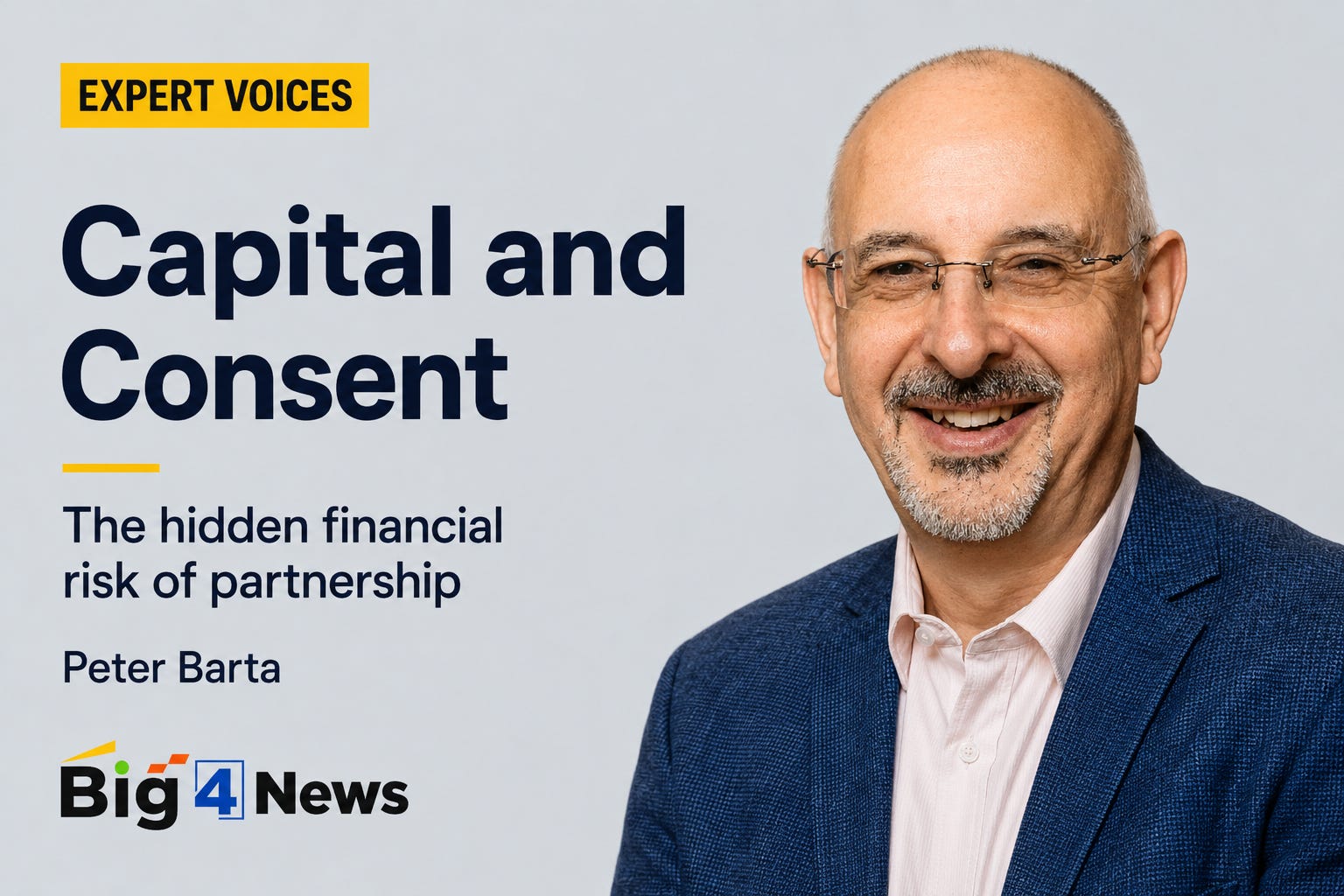
A guest post by Peter Barta CA, a former Deloitte Principal and senior finance and commercial strategy executive with more than 25 years of global experience
Key takeaways
Equity partners join a dual-layer, highly leveraged structure backed by personal guarantees
Firms distribute profits fully and fund growth or retirements with bank debt
Incoming partners inherit the cost of past acquisitions and unfunded exit obligations
Complex documents and limited access create a real transparency gap at admission
Peter Barta is a Chartered Accountant and commercial strategy specialist whose career has spanned auditing, corporate finance and management consulting. He spent 13 years as a Principal at Deloitte Australia, where he led commercial strategy for major technology and business-process services engagements, advising on costing, pricing, commercial terms, deal funding and revenue recognition.
Earlier in his career, Barta served as Chief Financial Officer of EDS’s $1.5 billion Australia and New Zealand outsourcing and services business and held senior finance, pricing and commercial leadership roles across Africa and the Asia-Pacific region. He has helped shape and implement technology contracts worth more than US$10 billion. Full bio at the end of the article.
The argument and what this piece sets out to do
Partnership in a large professional services firm is presented as a community of equals sharing commercial risk and reward. In practice, the modern equity partner buys into a highly leveraged, dual-layer capital structure documented in agreements so long and technical that grasping their implications, in the time and terms offered at admission, is difficult.
I write as an Australian Chartered Accountant, but the pattern is broader: professionals in the United Kingdom, Europe and elsewhere describe much the same. The gap between the idea of partnership and its financial reality is structural, and one the profession should examine openly.
My aim is threefold:
to explain the capital and debt architecture of a mega-partnership, rarely described outside the firms;
to show what it means for incoming partners who commit years and significant personal capital on documents offered largely on standard terms, and
to set out, as considerations rather than accusations, what a more sustainable and transparent model would require.
None of this depends on wrongdoing. The tensions are systemic, arising from the structure itself, and they deserve public discussion by those who understand them.
Findings: how the money actually moves
A hybrid legal structure with a hard edge
A large Australian firm typically operates as a traditional partnership under state legislation: the partnership is not a separate legal person and partners carry joint and several liability.
Equity partners rarely join in their own name; each is commonly admitted through a personal entity, usually a company as trustee of a family trust, and that entity, not the individual, is the legal partner. Alongside the partnership sits a centralised service trust, usually a unit trust, which owns leases, technology and staff and charges the partnership a fee; partners’ entities also hold its units.
The design buffers the individual from ordinary operational liabilities, but it is transparent to the firm’s bankers: because the trustee companies are usually asset-poor, lending syndicates require personal cross-guarantees from the practitioners behind them. The individual’s real exposure therefore flows from those guarantees rather than automatically from partnership law.
Other jurisdictions use different vehicles, such as limited liability partnerships, but the effect is similar: partners pledge personal wealth to support the firm’s infrastructure.
Where client recourse actually sits
Because partner entities are typically asset-poor, and the individuals behind them are shielded from direct claims except where held out as partners, client recourse rests mainly on three layers: professional indemnity insurance, firm assets, and statutory liability limits.
Indemnity cover is mandatory and scaled to fees, though the minimums, in the tens of millions for large audits, can be small relative to the entities audited.
Proportionate liability confines each firm to its share of a loss, and Professional Standards Schemes cap occupational liability, subject to a statutory maximum.
These settings keep the audit market viable, and clients must be told a scheme applies.
The protection is asymmetric, though: it operates against client and creditor claims but not against the firm’s bankers, to whom partners’ personal wealth remains exposed through cross-guarantees.
The zero-permanent-reserve norm
A company retains profit to fund investment and absorb downturns. A partnership of this kind generally does not. By tax necessity, the partnership and its trusts are flow-through vehicles, so taxable profit must be allocated each year to avoid punitive taxation at the trust level.
Distributing that cash in full, rather than retaining a post-tax buffer, is a commercial preference driven by partner compensation expectations, not a legal necessity.
The firm therefore carries minimal permanent reserves. When it needs capital, it calls on partners for cash or draws on syndicated bank facilities held in the service trust.
Two structural debt multipliers
The first is acquisitions
During the consulting boom, firms chased boutique targets against private equity and technology integrators, often favouring large upfront cash at premium multiples over earn-outs. With no retained earnings, those tranches were funded by service-trust bank debt; when synergies disappoint, the debt remains.
The second is retirement
Older agreements promised departing partners payouts set by peak profit shares or unit values. Because profits were distributed annually, these liabilities were rarely pre-funded; when a cohort retires, the trust draws on bank facilities to redeem their units, leaving a debt-funded liability for those who remain.
The intergenerational burden
This is where the structure bears most heavily on individuals.
An incoming partner steps into a leveraged capital pool, buying units whose returns are diluted by debt raised for past acquisitions and retirements.
The buy-in is commonly funded by a firm-arranged bank loan, sometimes personally guaranteed, so the capital at risk is borrowed before the first distribution arrives.
Public reporting for at least one large firm disclose borrowings of several hundred million dollars, or well into high six figures per partner, and a revenue fall of only ten to fifteen per cent can pressure covenants tied to partner performance.
The transparency gap
All of this is documented, yet not always accessible to those it binds.
Partnership agreements and trust deeds are long and technical, and pricing the interaction between guarantees, unit valuations and firm debt requires time, specialist advice and firm-level information not always available at admission.
Firms often administer the mechanics, arranging the capital-contribution loan, deducting repayments from drawings and, in some jurisdictions, handling tax reporting; the extent varies, and some partners report little of it. But administration is not disclosure, and disclosure is not informed consent.
Consent is meaningful only when the person understands the obligation, has time to test it, and can genuinely question it.
Reported features across jurisdictions show how constrained that opportunity can be:
agreements accessed through secure applications that restrict printing or retention;
unilateral amendment clauses, under which a partner is treated as consenting in advance to future changes;
instances where partners report that requests for documents such as indemnity terms or the funding of retirement obligations are not always met; and
limited visibility of consolidated accounts where interests sit within personal companies and central structures.
None of this requires bad faith; much follows from scale and legal form. But the cumulative effect is an information asymmetry at the moment a significant personal commitment is made. That reflects not a lack of sophistication, but structural complexity and compressed timing—conditions that sit uneasily with the democratic language of partnership and shared liability.
Considerations for the profession and its members
In fairness, these structures arose for reasons: the hybrid partnership-trust model reconciled partnership law with legitimate aims, shielding practitioners from operational liabilities, accommodating flow-through tax, and funding modern assurance and advisory work.
The question now is whether frameworks built over decades still serve practitioners, clients and the public interest as well as they could. For Australian Chartered Accountants, who carry a public interest mandate, that is a question of sustainability rather than blame.
Modern capital retention
The zero-reserve norm ties operational viability to bank debt and partners’ personal balance sheets. Reforms allowing large partnerships and service structures to retain a tier of earnings internally, without punitive tax treatment, would let firms fund technology and long-term investment from equity rather than leverage. This is a matter for professional bodies and policymakers, not any firm alone.
Insulating audit from consulting volatility
Where core assurance work shares the balance sheet that carries high-multiple, debt-funded consulting acquisitions, audit can be exposed to pressures unrelated to audit itself.
A more disciplined, capital-insulated footing for assurance practices would help protect the part of the profession with the clearest public interest role. This is distinct from operational separation: in the United Kingdom, regulators required the largest firms to give audit practices separate governance, an independent audit board, a distinct profit and loss account, and remuneration no longer tied to non-audit sales, concluding in 2024.
In Australia, the November 2024 final report of the Parliamentary Joint Committee on Corporations and Financial Services recommended legislating operational separation for large multidisciplinary firms, alongside a Treasury options paper canvassing structural separation and a cut in the partnership cap from 1,000 to 400.

Protecting intergenerational equity
Legacy retirement formulas that were never pre-funded transfer historical liabilities to the next generation. Moving towards self-funding transition arrangements, and pre-funding future obligations rather than distributing everything each year, would help ensure incoming partners are not asked to carry the cost of decisions made before their time.
Transparency, inward and outward
Firms already invest considerable effort in admitting and advising new partners. A natural next step would be to provide a plain-language summary of the capital commitment, personal guarantees, relevant borrowings and exit terms, with sufficient time and access to independent advice before signing.
The same logic applies outward: if client recourse rests on insurance and caps rather than partners’ wealth, those limits should be visible, so clients understand the protection they have. Commitments understood at the outset are more durable, and less contested later, than those recalled only in outline.
Partnership at its best implies a shared enterprise among people who understand what they have joined. The structures here do not make that impossible. They simply make transparency, and the honest conversation that supports it, worth investing in.
Who is Peter Barta?
Peter Barta CA is a Chartered Accountant, commercial strategy specialist, and founder and CEO of Barta Global Services. He has more than 25 years of international experience across accounting, corporate finance, technology services and management consulting, with particular expertise in the pricing and negotiation of complex, long-term commercial agreements.
From 2011 to 2024, Barta was a Principal at Deloitte Australia. As the firm’s Commercial Strategy leader, he built and led a specialist team advising Deloitte partners and executives on the costing, pricing and commercial structuring of major technology and business-process services engagements. His work included reviewing deal economics, developing pricing strategies, negotiating commercial terms, advising on contract funding and value capture, and developing methods for the financial management and revenue recognition of long-term contracts.
Earlier, Barta was Chief Executive Officer and Asia-Pacific Managing Partner of Everest Group Australasia, where he advised senior executives across the Asia-Pacific region and the United States on technology sourcing and offshoring transactions.
He previously held several senior roles at EDS, including Chief Financial Officer of its $1.5 billion Australia and New Zealand outsourcing and services business; Director of New Business Pricing for the Asia-Pacific region; Director of Commercial and Government Sales; and General Manager of Finance for EDS Africa. Before moving to Australia, he worked in the auditing and resources sectors.
Across his career, Barta has helped shape and implement technology contracts valued at more than US$10 billion. Through Barta Global Services, he now advises and coaches executives on commercial strategy, complex deal structures, pricing and negotiation. He holds an Honours Bachelor of Accounting Sciences from the University of South Africa and completed the Senior Executive Programme at London Business School.
This article is part of Big4News’ Expert Voices Series
Expert Voices

This section features candid interviews with whistleblowers, legal experts, and financial professionals who have direct experience with the inner workings of Deloitte, PwC, EY, and KPMG.