



Key takeaways
AI growth: EY reported a 49% increase in AI services sales.
New rivals: OpenAI, Anthropic and Microsoft are moving into AI implementation.
Partnership paradox: The Big Four increasingly compete with their own technology partners.
Pricing pressure: AI developers may undercut consulting firms by bundling licences and implementation.
Middle-market competition: The Big Four are targeting smaller clients, challenging BDO, RSM and Grant Thornton.
For years, the Big Four have positioned artificial intelligence as an opportunity to transform their businesses. Deloitte, PwC, EY and KPMG have invested heavily in AI, formed alliances with leading developers and trained thousands of professionals to incorporate the technology into client services.
The commercial opportunity is becoming increasingly apparent. In October, EY reported that global sales of AI services had increased 49%, compared with growth of just 4.4% in its overall consulting revenue.
But a new competitive challenge is emerging: the companies supplying the technology are increasingly seeking to capture the implementation work themselves.
In May 2026, OpenAI launched its own deployment company, designed to help corporate clients identify opportunities for AI, redesign workflows and implement production systems. Two months later, Anthropic and a consortium of investors launched Ode with Anthropic, a specialist business offering AI implementation services.
Microsoft, one of the Big Four’s most important technology partners, has also expanded its direct enterprise AI implementation capabilities.
At the same time, AI is changing the economics of consulting. As the technology makes smaller engagements more commercially viable, the Big Four are increasingly targeting the middle market, bringing them into more direct competition with established mid-tier firms. The Financial Times reported on 6 November that Accenture and the Big Four are expanding their efforts to capture smaller clients.
Together, these developments point towards a changing competitive landscape for the firms. The Big Four face growing competition from technology suppliers for enterprise AI implementation work, while their expansion into the middle market brings them into more direct competition with established mid-tier firms.
The partnership paradox
The situation with the likes of Anthropic and Microsoft is particularly striking because of the partnerships these companies have forged with the Big Four.
In October 2025, Deloitte announced an expanded alliance with Anthropic, making Claude available across its global network of approximately 470,000 people and establishing a programme to certify 15,000 professionals.
In May 2026, PwC expanded its relationship with Anthropic, announcing a joint centre of excellence and plans to train and certify 30,000 US professionals.
Days later, KPMG announced its own global alliance with Anthropic, incorporating Claude into its Digital Gateway platform and agreeing to develop new AI-powered products.
These agreements formed part of a wider race among the Big Four to establish AI partnerships, with the firms investing in technology, training and new client offerings.
Anthropic has also committed $100 million to its Claude Partner Network, supporting professional-services firms and other partners helping businesses adopt its technology.
OpenAI has similarly cultivated major consulting alliances. In February, it announced its Frontier Alliances with McKinsey, Boston Consulting Group, Accenture and Capgemini, combining its technology with their expertise in systems integration, business transformation and enterprise delivery.
These relationships benefit both sides. AI developers gain access to established client relationships and industry expertise, while consulting firms acquire the technology and engineering capabilities needed to develop new services.
The financial commitments are substantial. PwC, for example, reported $3 billion in network-wide capability investments in FY2026, including AI and other technology initiatives. The firm did not disclose how much of that expenditure related specifically to artificial intelligence.
EY: a case study
EY provides a particularly revealing example of the commercial opportunities and competitive tensions created by AI.
In its October 2026 global results, the firm reported a 49% increase in sales of AI services during the financial year ended June 2026. Its overall consulting business grew 4.4% to $17.4 billion, while total global revenues reached $57 billion.
The contrast was even more pronounced in the UK. Sales of AI and data projects increased 46%, despite a 3% decline in overall consulting revenue.
These figures measure sales growth rather than recognised AI implementation revenue, and EY has not disclosed the absolute value of its AI-related sales or their contribution to consulting revenue. Nevertheless, the reported growth points to rapidly increasing demand for AI-related services at a time when EY's overall consulting business is growing much more slowly.
EY has been investing heavily to capture that opportunity. The firm has committed more than $1 billion to developing its EY.ai capabilities, including technology, research, talent and workforce training. In April 2026, it announced the recruitment of forward-deployed engineers — specialists who work directly with clients to design, build and implement AI solutions.
A month later, EY and Microsoft announced a joint investment of more than $1 billion over five years, combining Microsoft’s engineering capabilities with EY’s industry knowledge and consulting expertise.
The initiative brings Microsoft’s forward-deployed engineers together with EY professionals to develop and implement AI solutions across clients’ core business functions.
But Microsoft is pursuing its own ambitions in the same market.
In July 2026, less than two months after announcing the expanded EY alliance, Microsoft launched its $2.5 billion Frontier Company initiative.
The initiative brings together approximately 6,000 engineering, AI and industry professionals to help corporate customers build, deploy and operate AI systems. It draws primarily on Microsoft’s existing workforce, expanding and reorganising capabilities the company had already developed through its consulting and engineering operations.
So while EY is investing in AI implementation as an important growth opportunity, Microsoft, its longstanding technology partner, is simultaneously expanding its own capacity to deliver AI implementations directly to customers.
An old competitive tension, but much higher stakes
Technology suppliers competing with consulting firms for implementation work is nothing new.
In enterprise resource planning (ERP), companies such as SAP and Microsoft have long maintained their own consulting and implementation capabilities. The Big Four have operated alongside them for decades, sometimes collaborating on projects and sometimes competing for the same engagements.
The consulting firms have traditionally differentiated themselves through services extending beyond the technology itself: business process redesign, organisational change, governance, risk management, internal controls and the integration of multiple systems across complex organisations.
That broader expertise remains valuable in AI implementation. Many enterprise AI projects require precisely the organisational and operational capabilities that the Big Four have spent decades developing.
What makes the current developments different is the scale of the Big Four’s commitment to AI — and how much they are counting on it to drive future growth.
The firms have collectively committed billions to technology, specialist capabilities, strategic partnerships and workforce training. AI is no longer simply another offering within their consulting portfolios. It has become central to their plans for expanding services, winning clients and generating new revenues.
The competition may be familiar, but the commercial stakes are considerably higher.
Do the AI companies have a pricing advantage?
In enterprise technology markets, implementation partners sometimes act as software resellers, earning margins or commissions on the licences they sell. Where such arrangements exist, a technology developer selling directly to the client may have greater flexibility to discount the combined technology and implementation package, potentially passing on some of the margin that would otherwise go to an intermediary.
Where such arrangements exist, technology developers could have a pricing advantage over independent implementation partners. By controlling both software pricing and implementation fees, they may be able to offer more competitive packages.
The Big Four look towards the middle market
At the same time, AI is changing the economics of consulting delivery.
According to the Financial Times, Accenture has launched a new business targeting companies with annual revenues between $300 million and $3 billion, while KPMG is identifying growth opportunities among businesses generating less than $250 million annually.
The attraction is straightforward. AI can reduce the time and resources required to deliver certain services, potentially making engagements economically viable for clients that previously could not afford the largest consulting firms.
This brings the Big Four into more direct competition with firms such as RSM, Grant Thornton and BDO, which have established positions among smaller and privately owned businesses.
Those firms are investing in AI and technology capabilities of their own, while private equity investment and acquisitions are helping some mid-tier competitors expand their service offerings.
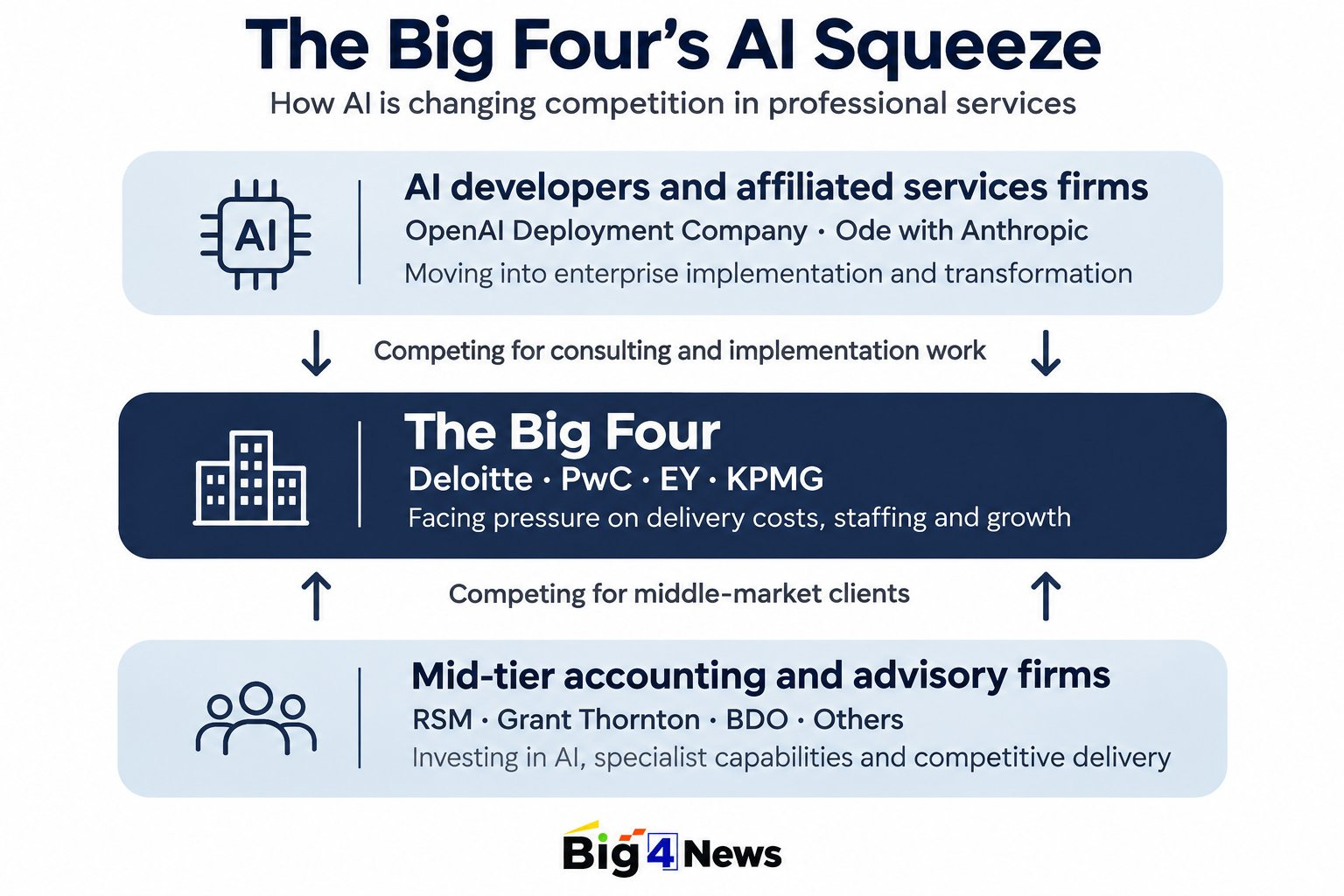
The Big Four therefore face competition on two fronts: technology suppliers expanding into implementation services, and established professional-services competitors seeking to defend and expand their middle-market businesses.
Who will capture the growth?
The Big Four have committed billions to developing AI capabilities, forging technology partnerships and training their workforces. They are counting on AI to become a major engine of future consulting growth.
But the competitive landscape is changing. At the top end of the market, the technology companies supplying the AI are increasingly competing to deliver the implementation services themselves. Further down the market, AI is making it easier for the Big Four to pursue smaller clients, bringing them into more direct competition with established mid-tier firms.
AI may expand the overall market for consulting services, but it is also changing who competes for that business. The question is no longer simply how much growth AI will generate, but who will capture the value it creates.
This article is part of the Big4News Investigations & Analysis series, which examines the structural forces shaping Deloitte, PwC, EY and KPMG.
For more cases involving the Big Four audit firms, explore our Global Big Four Scandal Timeline, which documents major controversies, regulatory investigations, enforcement actions and corporate scandals involving the firms around the world.
About Claudine Cassar

I’m a corporate anthropologist and former Deloitte equity partner. I sold my technology business to Deloitte in 2016 and led the Malta Consulting team for five years. I am the founder and editor of Big4News, which provides independent, clear analysis of PwC, Deloitte, EY, and KPMG — free from corporate spin.
Find me on LinkedIn, X, Instagram, or my author website.
Feel free to reply to this newsletter — I read every reply.