

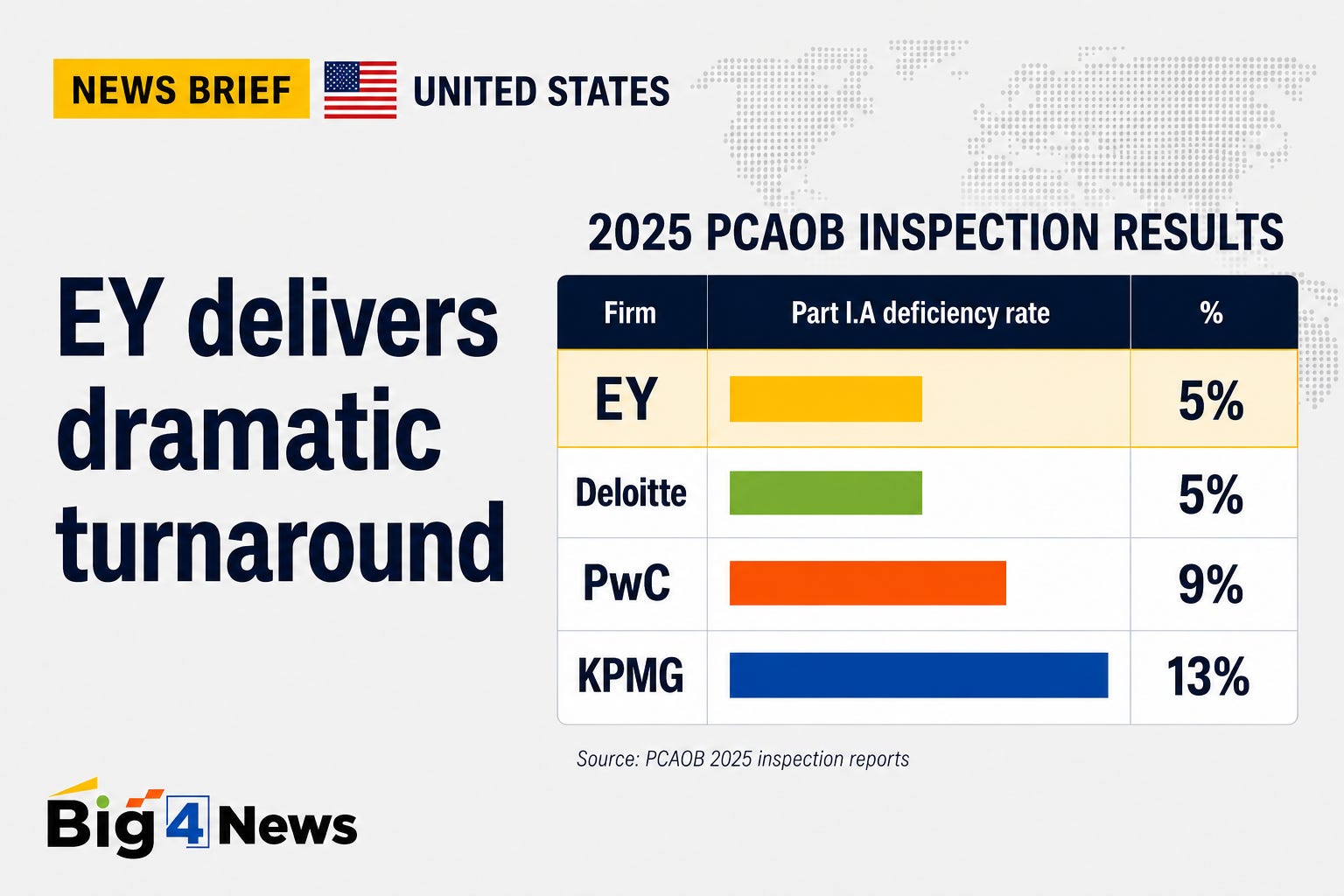
EY has recorded its best-ever result in inspections by the US Public Company Accounting Oversight Board (PCAOB), cutting its Part I.A audit deficiency rate from 28% to 5% in a single year.
The PCAOB’s 2025 inspection report for Ernst & Young LLP found Part I.A deficiencies in just three of the 64 issuer audits reviewed. That put EY level with Deloitte, where inspectors also identified deficiencies in three of 64 audits.
PwC recorded deficiencies in six of the 64 audits inspected, producing a 9% rate, while KPMG had eight deficient audits out of 64, or 13%.
All four firms improved on their previous inspection results. In 2024, EY’s deficiency rate was 28%, KPMG’s was 20%, PwC’s was 16% and Deloitte’s was 14%. Taken together, the latest reports suggest that the Big Four’s aggregate Part I.A deficiency rate fell from approximately 20% in 2024 to about 8% in 2025.
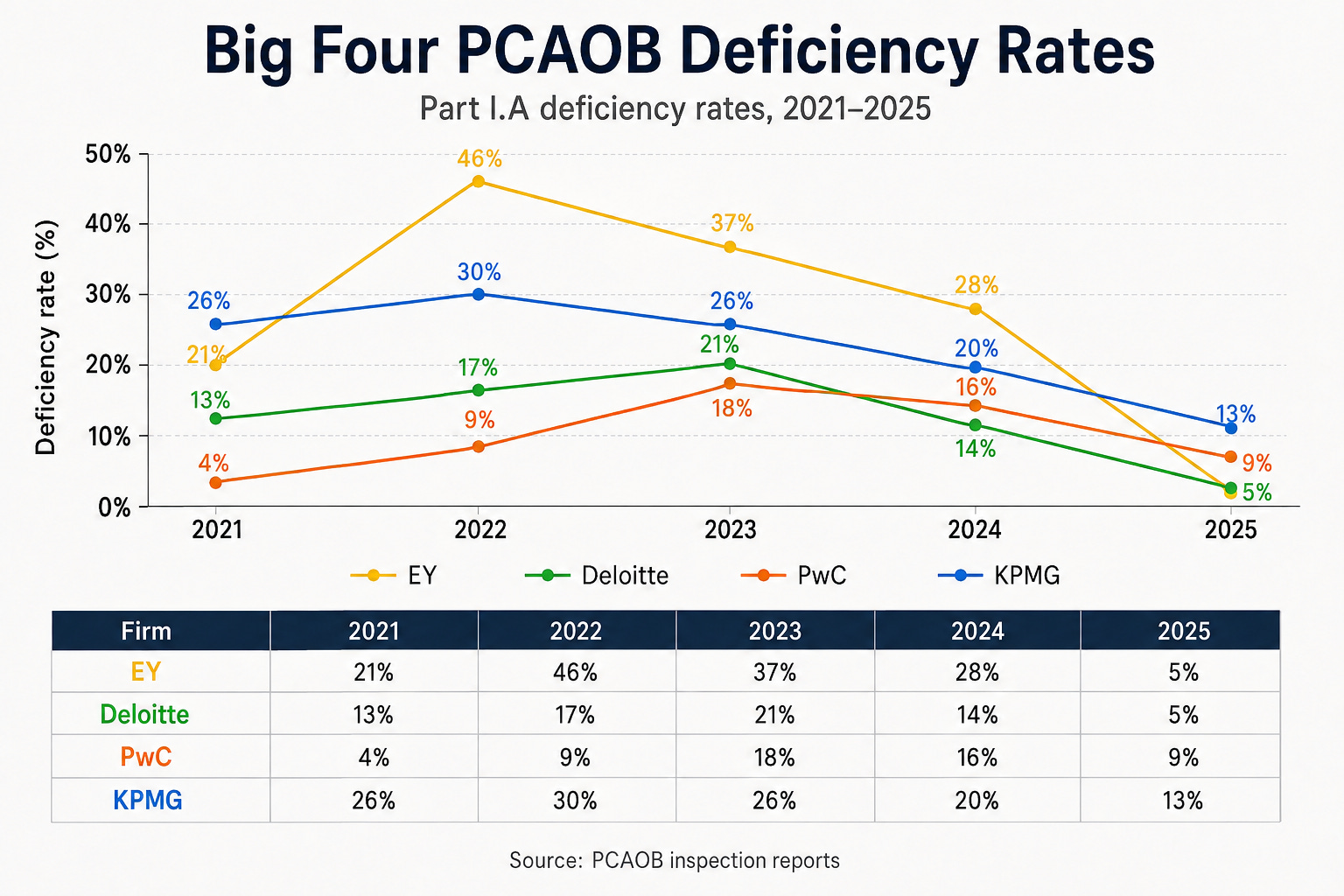
EY’s improvement is particularly striking because it follows several years in which the firm lagged its Big Four rivals. Its inspection findings rate rose from 21% in 2021 to 46% in 2022, before falling to 37% in 2023 and 28% in 2024. EY said the new 5% result was the best it had ever achieved.
The three EY audits cited in Part I.A involved deficiencies relating to revenue and related accounts, income taxes, and insurance-related assets and liabilities, including insurance reserves. None was classified by the PCAOB as an audit involving an incorrect opinion on the financial statements or internal control over financial reporting.
EY has attributed the turnaround to a wider transformation of its US audit practice. The firm says it is making a multi-year $1 billion investment in technology and talent, including AI and advanced data analytics, alongside changes to audit methodology and the timing of audit work.
Joe Link, EY Americas assurance vice-chair, told the Financial Times that the result validated investments in technology, data analytics, streamlined methodologies and people. Previous reporting has also documented EY’s decision to shed a significant number of public-company audit clients as it sought to improve the risk profile and quality of its audit portfolio.
The improvement extends beyond EY. Deloitte’s three deficient audits primarily involved revenue testing. PwC’s six deficiencies primarily related to revenue and related accounts and long-lived assets, while KPMG’s eight primarily involved inventory and other assets.
The PCAOB cautions, however, against treating the inspection percentages as a simple ranking of audit quality. Its inspections concentrate heavily on audits and areas considered to present heightened risks, and the regulator says the audits selected do not constitute a representative sample of a firm’s overall audit portfolio. It also says inspection results are not necessarily comparable between firms or between years and are not intended to function as overall ratings.
The latest results arrive as the PCAOB itself prepares to rethink the way it conducts inspections. Chairman Demetrios “Jim” Logothetis has said the regulator wants an inspection programme more focused on firms’ systems of quality control, and the PCAOB has established an Inspections Modernization Council to help shape the future regime.
Want to stay up to date on all things Big Four around the world?
Check out the News section and subscribe to Big4News for weekly deep dives and briefings.