



Key Takeaways:
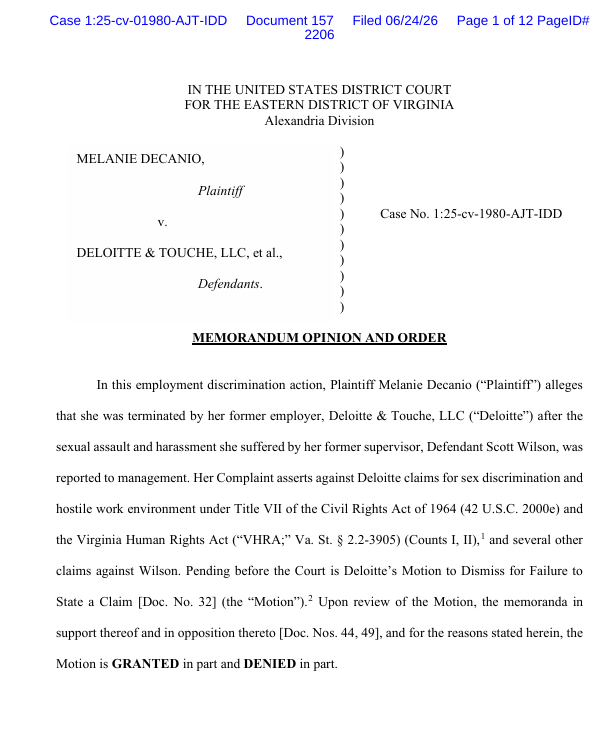
A federal judge allowed former Deloitte auditor Melanie DeCanio’s hostile-work-environment and retaliation claims to proceed
She alleges that after a report was filed about her supervisor, Deloitte investigated and fired her — citing a $115 audit discrepancy in a $4.3 trillion engagement that fell well below the firm’s own “clearly trivial” threshold
Melanie DeCanio v. Deloitte & Touche
Melanie DeCanio alleges that after a colleague reported her supervisor’s abusive behavior, Deloitte investigated her, placed her on administrative leave, and terminated her “for cause” on the basis of a roughly $115 audit discrepancy in a $4.3 trillion Fannie Mae engagement.
DeCanio claims the justification for the firing was pretextual and that Deloitte fired both her and the manager she alleges sexually harassed her for the same technical reason in an attempt to sidestep responsibility for what had occurred.
On June 24, 2026, Senior U.S. District Judge Anthony Trenga denied Deloitte’s motion to dismiss DeCanio’s hostile-work-environment claim and allowed the retaliation claim to continue. The court found that the allegations, taken as true at this stage, were sufficient to proceed.
This does not mean the allegations have been proven. At the motion-to-dismiss stage, the court is required to accept the plaintiff’s well-pleaded allegations as true and determine only whether they state a plausible claim for relief. Judge Trenga found that DeCanio’s hostile-work-environment and retaliation claims meet this standard and may proceed.
The Allegations - Sexual Harassment, Bullying and Retaliation
DeCanio joined Deloitte in 2021 as an audit assistant after graduating from the College of William & Mary. Her career at the firm initially progressed well – she passed her CPA examinations, worked on major audit projects, and received strong reviews, raises, and promotions.
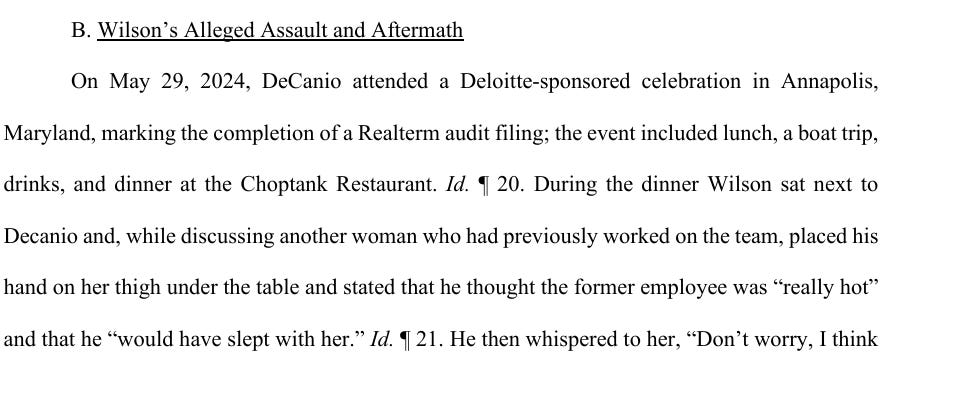
The allegations are centred on an incident that allegedly occurred on May 29, 2024, during a Deloitte event in Annapolis, Maryland. DeCanio and her team were celebrating the completion of the Realterm audit. Festivities started with a lunch, moving on to a boat trip, drinks, and dinner at the Choptank Restaurant.
DeCanio alleges that during dinner, her manager, Scott Wilson, sat next to her. At one point he placed his hand on her thigh under the table, and made sexual comments about another woman who had previously worked on the team. She says Wilson then intimated that he wanted to have sex with her.
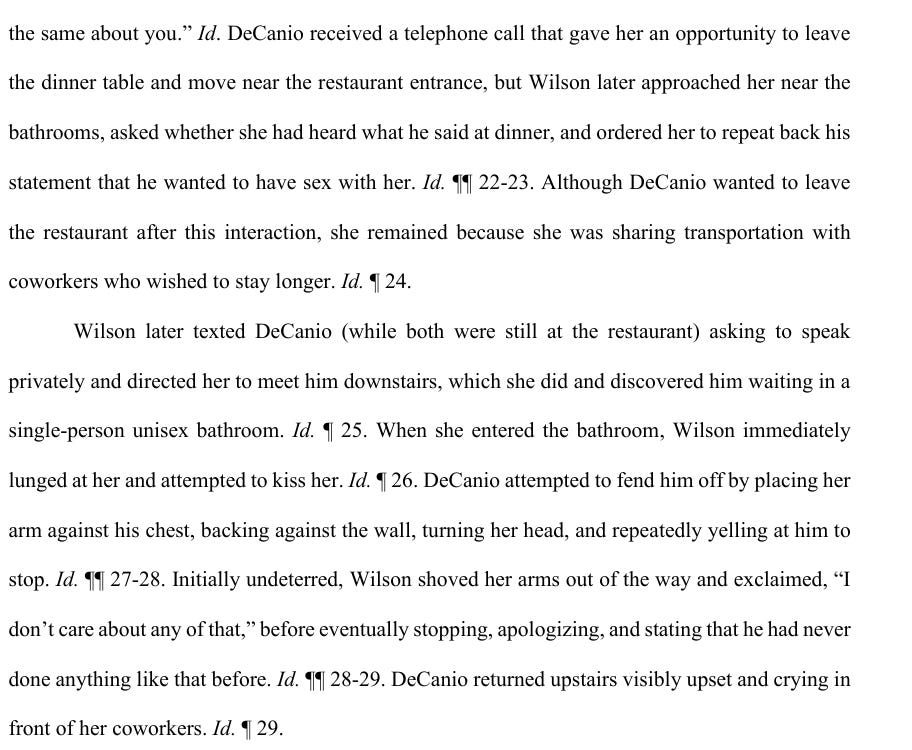
Later that evening, according to the allegations summarized by the court, Wilson texted DeCanio asking to speak privately and directed her to meet him downstairs. She says she found him waiting in a single-person bathroom. When she entered, she alleges, Wilson lunged at her and attempted to kiss her, while she resisted and repeatedly told him to stop.
DeCanio alleges that after the incident she struggled with whether to report Wilson to Deloitte management or human resources because she feared damaging her career, particularly because Wilson had previously given her positive evaluations. She says she was largely able to avoid Wilson for several months because of his parental leave and her temporary reassignment to a different sub-team.
But when she returned to Wilson’s team, she alleges that he became abusive, taking every opportunity to demean her and imposing too much work and crushing deadlines.
In February 2025, DeCanio alleges that Wilson made another inappropriate comment after seeing her speak with a male coworker at a team social event. A coworker later noticed DeCanio’s distress and reported Wilson’s conduct to HR because, according to the complaint, the work environment for DeCanio was “not healthy.”
DeCanio alleges that Deloitte’s response focused on her conduct rather than Wilson’s. According to the court’s summary, Deloitte began an investigation within a week of the coworker’s report. DeCanio says she was interviewed by Deloitte human resources personnel and members of Deloitte’s legal department for approximately two hours, placed on involuntary administrative leave, and then terminated “for cause.”
Deloitte allegedly told her she was being terminated because of purported breaches of approved audit-testing methodologies. DeCanio claims that explanation was pretextual.
According to the allegations summarized by the court, the audit issue relied upon by Deloitte involved a discrepancy of approximately $115 in a $4.3 trillion Fannie Mae audit. DeCanio alleges that Deloitte’s own auditing standards treated discrepancies of less than $100 million on that audit as “clearly trivial.” She also alleges that she had no prior disciplinary history, had never previously been accused of violating Deloitte policy, and was terminated without prior warning or counseling.
DeCanio further alleges that Deloitte also fired Wilson, but not for sexual harassment or assault. Instead, according to the complaint, Deloitte terminated both Wilson and DeCanio for the same purported audit-protocol reason. She claims this was an attempt to avoid responsibility for what had happened.
Deloitte Moves to Dismiss
Deloitte moved to dismiss several of the claims. Among other arguments, the firm contended that DeCanio’s hostile-work-environment claim was untimely to the extent it relied on the May 2024 incident, because she did not file her charge with the Equal Employment Opportunity Commission (EEOC) — the federal agency that handles employment discrimination complaints — until August 2025. Deloitte also argued that the complaint failed to allege facts sufficient to support a hostile work environment or disparate-treatment sex discrimination claim.
The court rejected Deloitte’s argument that the hostile-work-environment claim should be dismissed as untimely. The judge held that, based on the allegations, the continuing-violation doctrine could apply because the later alleged conduct was plausibly related to the May 2024 incident.
The court also held that DeCanio had sufficiently pleaded a hostile-work-environment claim at this stage. The judge pointed to the totality of the allegations, including the coworker’s decision to report Wilson to human resources and the allegation that Deloitte terminated two otherwise high-performing employees based on a pretext.
However, the court dismissed DeCanio’s separate disparate-treatment sex-discrimination claim. The judge found that the complaint did not plausibly allege that DeCanio’s termination was because of her sex, as opposed to because Wilson’s alleged harassment had been reported. In the court’s view, that theory substantially overlapped with DeCanio’s retaliation claim, which remains in the case.
Big4News Analysis
This case matters less for the underlying harassment allegations than for what it reveals about Deloitte’s response once the misconduct was reported.
DeCanio claims that after a colleague reported her supervisor’s abusive behavior, the firm investigated her, placed her on leave, and terminated her for a $115 audit discrepancy in a $4.3 trillion engagement — an issue she says fell well below the firm’s own “clearly trivial” threshold. She further alleges that Deloitte fired both her and the supervisor for the same technical reason in an apparent effort to avoid confronting the real issue.
These allegations echo concerns raised in the 2019 Financial Times investigation “Betrayed by the Big Four,” which reported that employees who raised complaints of sexual harassment, bullying, and discrimination at the Big Four firms were often sidelined, discredited, or pushed out, while alleged perpetrators were protected or faced little consequence. Unlike those largely anonymous accounts, DeCanio’s claims are on the public record and any future testimony will be given under oath. While the Virginia court has not yet made any findings of liability, the case revives a central question for the Big Four: when misconduct is alleged inside these powerful firms, does the internal process protect the complainant, protect the firm, or protect the hierarchy?
For now, the answer remains to be tested. What the court has determined at this early stage is narrower but still significant: DeCanio’s hostile-work-environment claims are plausible enough to proceed, and her retaliation claim remains alive.
This article is part of Big4News’ Case Watch Series
About Claudine Cassar

I’m a corporate anthropologist and former Deloitte equity partner. I sold my technology business to Deloitte in 2016 and led the Malta Consulting team for five years. I now write Big4News, providing independent, clear analysis of PwC, Deloitte, EY, and KPMG — free from corporate spin.
Find me on LinkedIn, X, Instagram, or my author website. You can also email me.
Feel free to reply to this newsletter — I read every reply.