


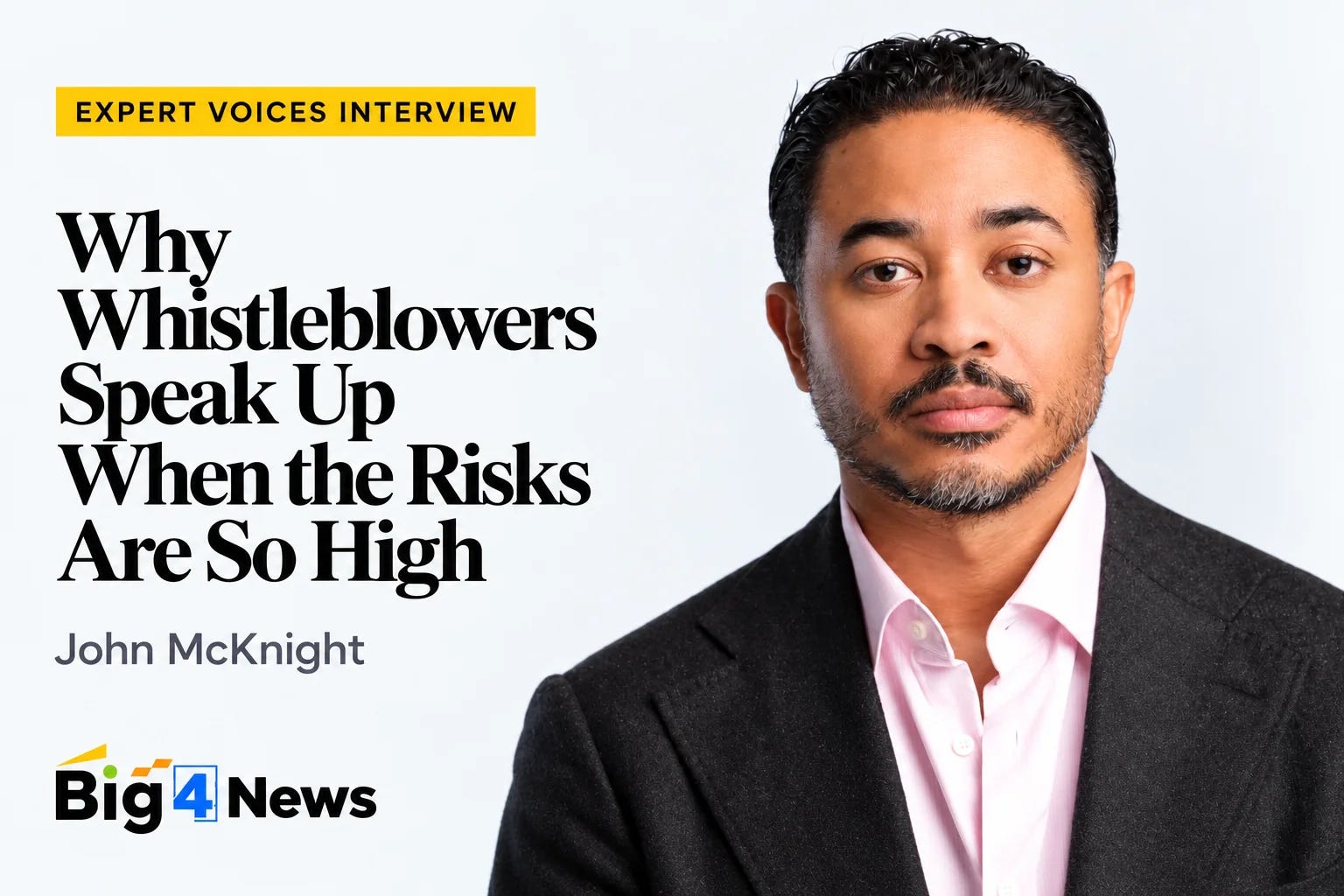
John McKnight is a Washington, DC-based partner and Co-Chair of the Whistleblower and Qui Tam Practice Group at Sanford Heisler Sharp McKnight, LLP. He represents corporate whistleblowers exposing securities fraud, banking misconduct, government procurement fraud and other forms of corporate wrongdoing. Full bio at the end of the interview.
Key Takeaways
Fraud can hide in plain sight. Evidence scattered across departments may reveal misconduct that individual employees and auditors cannot see.
Auditors face unavoidable blind spots. Professional skepticism matters, but sophisticated fraud can remain concealed even from experienced auditors.
Retaliation can start with one person. A supervisor’s instinct for self-preservation can trigger a wider organisational response.
Regulators and whistleblowers have different priorities. Government enforcement may address only part of the wrongdoing a whistleblower wants remedied.
Speaking up is rarely impulsive. Many whistleblowers spend months or years considering the risks before contacting a lawyer.
Discovering wrongdoing inside a company is one thing. Deciding what to do about it is another. For employees who uncover evidence of financial fraud, speaking up can mean risking their careers, their professional reputations and, in some cases, years of their lives pursuing a resolution that may never come.
As the experiences of Wirecard whistleblower Pav Gill and former PwC auditor Mauro Botta demonstrate, the consequences of challenging wrongdoing can extend well beyond the initial disclosure.
John McKnight represents corporate whistleblowers who expose securities fraud, financial misconduct and other wrongdoing. His work offers an unusual perspective on what happens after employees decide to challenge their employers. His experience has given him a close view of what happens after concerns are raised, from the challenge of assembling credible evidence to the institutional responses that can follow.
In this Expert Voices interview, McKnight discusses why fraud can remain hidden from external auditors, how organisations sometimes turn against the employees who raise concerns, and why government enforcement does not always deliver what whistleblowers hope to achieve. He also explains why, despite the possibility of retaliation, financial uncertainty and lasting career damage, some people remain determined to speak up.
The Interview
When the Documents Tell a Different Story
You have said that one of the first things you look for in a potential whistleblower case is whether the documents actually support the story you have been told. What distinguishes a genuinely strong documentary case from one that initially sounds compelling but does not stand up to scrutiny?
In a nutshell, we want to see documents sufficiently corroborate the story we hear from the potential client. Our clients generally have extensive experience in a particular industry, at a particular company, working with a particular group of people. Often this means that they unconsciously build in assumptions during their recollection of events, because everyone they have interacted with on a daily basis for years simply “knows” these things.
For example, employees of a department might all know that their director usually removes a key financial metric in their reports to the C-Suite, and they may also know that the C-Suite typically does not change the director’s reports before approving them for inclusion in the company’s financial reports.
However, the director’s email communications might not reference the metric’s removal, or the C-Suite’s reactions, at all. Therefore, while the story may sound plausible on its face, the documents might only illustrate a director thanking their team for their hard work.
Conversely, in an ideal case evaluation, the director’s email communications may more explicitly say that they won’t report that metric to the C-Suite, because the C-Suite doesn’t want it in the revenue statements.
In the latter situation, we have an actual discussion of intentionally hiding a key financial metric at the behest of the C-Suite. Accordingly, this document tells us that the financial reports are probably a falsehood and that the order might have come from someone with authority to bind the company. This is obviously much more useful.
Piecing Together the Evidence
In financial-reporting or securities-fraud cases, what kinds of documents or internal communications tend to be most revealing? Is there often a particular email, memo or contemporaneous record that changes your understanding of what happened?
Each case is so different from the next that I can’t point to one particular type of document that will push a scenario over the line from innocuous to fraudulent.
Ultimately, in these types of cases we usually have to see a fraud related to a core line of business and some kind of indication that the fraud is being hidden from investors and the SEC. Accordingly, when it comes to documents, we want to see evidence that tells that same story.
The documents themselves come in all forms. In fact, if there is any common theme when it comes to documentary evidence, it’s that we tend to see a variety of different types of documents in each case. Often it is some combination of spreadsheets, email communications, conversations over internal messaging apps, and/or some kind of long-form technical analysis. Sometimes it’s something completely different like an HR complaint or even a performance review.
Each type of document usually plays a specific role within the broader story, and each document provides context for what’s going on in the other ones. Once you put them all together, that’s when you can see a fraud taking place. The goal is for the documents to be able to tell as much of the story on their own as possible.
What Auditors Cannot See
External auditors are supposed to approach an audit with professional skepticism, but whistleblower cases sometimes involve misconduct that has persisted for years. From the cases you have seen, what should we realistically expect an external auditor to uncover — and where are the limits of what an audit can detect?
One of the biggest issues auditors are likely to face is the problem of “unknown unknowns.” Fraud evolves constantly, and with the rapid integration of new technological advances, it gets harder and harder to know what you should be looking out for and where to look out for it. You can have all the experience and professional skepticism in the world, but there will always be a scheme that you didn’t realize was possible hiding in a place that you didn’t know existed.
Auditors aren’t the only ones who fail to uncover a fraud. Often most of a company’s own employees are unaware as well. Frauds are able to persist for years, because knowledge about the fraud is limited to a small group of employees with specialized knowledge. In a situation like this, an auditor faces a significant uphill battle. There may be significant pressure within the knowledge group to keep the issue under wraps, while employees outside of the group may have no knowledge of the problem at all.
In other situations, the opposite may be true. There could be questionable transactions flowing in and out of one department, but they may never rise to the level of “suspicious” without further context that you need to retrieve from an entirely different, unknown department. As a result, the group of employees responsible for the operation of a fraud might actually be completely unaware that a fraud is taking place, because they don’t know how their work fits into the bigger picture at the company.
At the end of the day, we can’t expect auditors to be clairvoyant, because there will always be unknown unknowns. However, companies do tend to copy each other’s tactics, so auditors should make a habit of bringing themselves up to date on trends within a company’s industry, law enforcement trends, and even things like short seller reports. Having this type of knowledge on hand will help supplement professional experience and skepticism and prevent problems from falling through the cracks.
When Internal Reporting Breaks Down
When an employee raises concerns internally about accounting, valuation or other conduct that could affect investors, what tends to determine whether the organisation takes those concerns seriously? Are there particular points in the escalation process — management, compliance, the audit committee or external auditors — where things commonly break down?
A lot depends on what the problem is, and whether it can be solved without creating exposure to greater liability or admitting to wrongdoing. I think many companies will take a lot of these types of allegations seriously, but then the question is how this turns into action. If the issue is relatively minor and can be fixed with a restatement that won’t shake investor confidence or expose the company to liability, then there is a much greater chance that the company will take the simple and honest approach.
Unfortunately, problems concerning investor harm are rarely simple and often do expose the company to greater, more widespread liability. While the company might take the allegations seriously, they may also choose to respond with a pattern of isolating the employee who raised the concerns, denying the existence of the concerns, and burying any related evidence. This often happens very shortly after escalation, sometimes before anyone has even had time to assess the scope of the problem or the probability of liability arising in the first place.
The speed of the reaction also means that this breakdown is usually happening before auditors have had a chance to get involved. Sometimes the employee report actually ends up reducing the likelihood that an audit takes place or gets completed due to a fear of uncovering a larger problem than the company is prepared to deal with at that point in time.
Why Organisations Retaliate
Most of the whistleblowers you speak to have experienced some form of retaliation. From what you have seen, why do organisations sometimes focus on the person raising the concern rather than the underlying allegation? What does that response tell you about how an organisation handles challenge and bad news?
I think self-preservation plays a big role in the retaliatory response. When an employee uncovers a potential fraud and seeks guidance from a supervisor, it can trigger a knee-jerk reaction by that supervisor to avoid taking the blame for a problem within the scope of his responsibility.
The supervisor’s most immediate concern is usually protecting his own position, and if someone has to take the blame, the supervisor’s first order of business is often to make sure that person isn’t him.
The easiest way to achieve that goal is to put the blame on someone else, and the most natural target is usually going to be the person who raised the concern. The assumption is that removing the “squeaky wheel” will allow life to return to normal and provide the supervisors with more time to figure out how to deal with the underlying allegation, if at all.
Unfortunately for them, the whistleblowers also know that they are the most natural targets for blame, so when the retaliation materializes, it drives a number of them directly to my office and then to law enforcement.
Since I have seen retaliation of this sort happen in such a wide variety of companies, I tend not to draw any significant conclusions about the companies themselves. To some extent, what I described above is more of a matter of individual human psychology and less of a matter of company culture.
Even if the immediate supervisor handles the report by the book, and escalates it accordingly, if just one person in the reporting chain feels threatened, then the situation can quickly snowball into retaliation. When that happens the fear spreads like wildfire, and the entire reporting chain goes into self-preservation mode.
Companies can legitimately foster a culture of honesty and encourage employees to report problems, but it really just takes one weak link, on one bad day, for that to fall apart.
When Justice Means Different Things
People often assume that once a government agency becomes involved in a whistleblower case, the whistleblower has effectively succeeded. You have suggested the reality can be more complicated. How can the government’s objectives differ from those of the whistleblower, and what happens when an agency wants to resolve a case more narrowly than the whistleblower believes the evidence warrants?
One of the key points of divergence is the different perspectives that each party brings to the enforcement action. Each government agency works with a set of statutory frameworks that play a large role in determining the scope of an enforcement action. They approach these cases by analyzing how the initial facts and evidence fit into a particular legal framework, whether other useful facts can be obtained, whether this package will be able to withstand defense scrutiny, and ultimately whether they can succeed at trial. The government’s goals are more discrete, and they often stay within the confines of a particular legal framework.
Conversely, whistleblowers usually aren’t lawyers and therefore they often view the wrongdoing as an ethical violation first, a business practices issue second, and a legal violation third. Their priorities are usually to make sure that the problem is fixed on a technical level, that future harm is prevented, and that all harmed parties are compensated for their troubles. They often assume that the law provides all of the necessary remedies to meet these goals, and sometimes they are right, but they don’t focus on the legal frameworks and requirements as intently as the government does.
This can lead to disappointment if the government decides to focus on one set of allegations while setting aside others. The government may reason that they are focusing on fixing the harm that the law empowers them to fix under the circumstances, while the whistleblower may argue that the government is failing to fix the full scope of the problem.
Ultimately, enforcement decisions are within the government’s discretion, so whistleblowers have limited recourse to challenge the government’s judgment. However, the whistleblowers are often far more gracious and understanding than most people might think. These investigations take years to complete, and in that time, whistleblowers end up learning a lot about the challenges of bringing an enforcement action against a corporation. They get to know the government attorneys and investigators and see them as people trying their best to do a good job.
The Risks and Rewards of Going Public
You have said that your view of whistleblowers speaking publicly has changed and that, in some circumstances, media attention or congressional interest can help move a case forward. What has changed over the past few years, and how do you decide when publicity might help rather than harm a whistleblower?
As a disclaimer, publicity of any kind is only possible in the absence of a court-ordered seal. If a seal is in place, then the case simply cannot be discussed without causing a breach.
I started to change my opinion about different types of publicity over the pandemic, in part because I started noticing whistleblowers taking that route more frequently. It’s still quite rare, but once Frances Haugen, the Facebook whistleblower, went public with her claims, I thought I had a responsibility to take a step back and reassess my playbook.
I found that I still didn’t think this would be the right decision in most of my ongoing matters, or many of the future matters I would be likely to take on, but I did start to identify situations where it could be a useful path forward. For example, if a case has not received much attention from the agencies, but the issues raised by my client’s allegations have been publicly discussed by members of Congress, then it could be beneficial to have a conversation with those Congressmen. Similarly, if media outlets have been covering an issue that a client reported to government agencies, then it may be worthwhile to discuss the matter with one or more of those outlets.
I still tend to think it’s not the best route for many of my clients. Most of them value privacy far more than any benefit that publicity could possibly offer. They may still work in the industry they reported on, or they might be actively pursuing new job opportunities and therefore cannot afford to be publicly labeled as a whistleblower. Sometimes clients simply aren’t interested in that kind of attention.
At the end of the day, their well-being is my main responsibility, so I need to consider a client’s life circumstances just as much as I consider what can possibly push a case to a successful conclusion. I can’t recommend publicity unless I think it will bring a tangible, net benefit to the specific client at issue given their individual life circumstances.
Why They Speak Up Anyway
You have said that you warn prospective whistleblowers that coming forward may be a bad life choice — that cases can take years, there may be no award, and they may damage their future career prospects. Yet you have also said that this warning rarely deters people. Why do you think that is? By the time someone calls a whistleblower lawyer, has the decision effectively already been made?
Calling a whistleblower lawyer does not appear to be a spur of the moment decision. It takes quite a bit of time to go from observing a fraud to actually calling a whistleblower attorney. If I had to guess, I would say that the vast majority of people who observe a fraud stop short of making that call after doing a few hours of research. After all, you don’t have to spend much time online before you come across a host of stories about whistleblowers facing years of retaliation, having negative experiences with law enforcement, or not receiving an award.
The people who sift through those stories and continue on to look for a whistleblower attorney are definitely a different breed. You have to have a different level of commitment to read through all of that negativity and decide that you can still see this process becoming a part of your life for the next few years.
By the time most potential clients call me, they have often done months if not years of research on whistleblower cases and attorneys. Most have read my profile on numerous different websites, listened to interviews I have sat for, read my publications, and compared all of these resources to a handful of other whistleblower lawyers.
When I warn them about the downsides to filing a whistleblower claim, they literally may have already heard me give this same warning in an interview or a LinkedIn post. Nowadays, with easy access to AI, they can also read about all of the cases of similar whistleblowers, their various outcomes, and summaries of what differentiates their cases from previous ones. There are so many online resources now that people can run queries on any thought or question they might have about the whistleblower process before they reach out to an attorney.
I think the months of research allow people to live with the weight of this potential life change for a while, talk it through with their families, and get used to how this new set of circumstances might look in their own lives.
It doesn’t necessarily make the process more comfortable, but there are probably fewer surprises once they finally get on the phone with a whistleblower attorney. By the time they finally make the phone call, I think it often ends up confirming something they already knew: that they are ready to be a part of this process and for their lives to change.
About John McKnight

John McKnight is a partner at Sanford Heisler Sharp McKnight, LLP, in Washington, DC, where he serves as Co-Chair of the firm’s Whistleblower and Qui Tam Practice Group. He specializes in representing corporate insiders who expose securities fraud, banking misconduct, government procurement fraud and other forms of corporate wrongdoing.
His practice involves litigation and whistleblower proceedings under the False Claims Act and the whistleblower provisions of the Dodd-Frank Act. He works with clients, federal regulators and government investigators to develop and pursue complex fraud allegations, often involving extensive documentary evidence and financial analysis.
Among his notable representations, McKnight acted for the former Executive Vice President and Chief Security Officer of Wells Fargo, who assisted US authorities in investigations arising from the bank’s fake-accounts scandal. Those investigations resulted in $3.5 billion in fines and penalties imposed by the Office of the Comptroller of the Currency, Securities and Exchange Commission and Department of Justice.
McKnight joined Sanford Heisler Sharp in 2014, became senior litigation counsel in 2017 and was appointed partner in 2021. He previously practiced at McKnight & Kennedy, LLC, where he worked on fraud investigations and False Claims Act matters.
He holds a Juris Doctor from the University of Maryland School of Law, a Master of Fine Arts from The New School and a bachelor’s degree from the University of Michigan. He is admitted to practise law in Maryland and the District of Columbia.
McKnight has been recognized in Lawdragon’s 500 Leading Civil Rights and Plaintiff Employment Lawyers and has written and spoken about whistleblower protections, financial fraud, cybersecurity and corporate accountability.
This article is part of the Big4News Expert Voices Series
Expert Voices

Expert Voices features interviews and guest contributions from former insiders, whistleblowers, academics, regulators and experienced practitioners. The series examines the structures, incentives and professional cultures behind events at Deloitte, PwC, EY and KPMG.
About the interviewer: Claudine Cassar is the founder and editor of Big4News, covering audit, consulting, regulation and governance across Deloitte, PwC, EY and KPMG.