



A guest post by Abdelhamid Taha, a financial regulation specialist with over a decade of operational experience in AML and compliance at HSBC, including during the bank’s US Deferred Prosecution Agreement period. He is a Member of the Secretariat Committee of the All-Party Parliamentary Group on Investment Fraud & Fairer Financial Services. He writes in a personal capacity.
Key Takeaways
Editor’s note: The Financial Reporting Council’s investigations into the auditors connected to Market Financial Solutions remain open. The FRC has stated that opening an investigation does not indicate that it has made, or will make, any finding of breach or misconduct. This article draws on Companies House filings, administrators’ proposals, FCA register entries, FRC press notices, and media reporting.
This essay is part of a series of 3 essays:
Part 1 — £1.8 billion and borrowed trust: the MFS structure no one was mandated to see whole
Part 2 (published next week) — £1.8 billion and borrowed trust: the limits of institutional oversight
Part 1: The system around MFS
On Friday, 7 August 2026, the Financial Conduct Authority published a short statement titled “FCA applying increased scrutiny to Annex 1 firms”. It warned that some firms “have relied too heavily on the financial crime controls of their parent company.” It noted the risks from complex structures including special-purpose vehicles. It did not mention Market Financial Solutions by name.
The Financial Times did. The newspaper reported the statement as a response to the collapse of MFS, which had increased scrutiny of Annex 1 firms. Administrators had earlier estimated the group deficiency at £1.807 billion. The regulator had described the problem. It did not mention the case that the FT linked directly to the increased scrutiny. It published the warning at the end of the week.
On 20 March 2026 — the same day the regulator announced its enforcement investigation into MFS — it also published a due-diligence notice to regulated firms, reminding them to verify the registration status of their Annex 1 counterparties. The notice was framed as general guidance and did not identify MFS as its subject. Its publication alongside the MFS investigation nevertheless placed renewed attention on the boundaries of the Annex 1 regime.
The narrower question is what concerns relevant to the FCA’s anti-money-laundering supervisory remit were identified before MFS collapsed, and what powers the regulator had to act on them.
This is the story the regulator has not spelled out.
It begins with a structure in which responsibility was divided among institutions with markedly different mandates.
The structure Raja built
Paresh Raja was not a financial genius. He was not a master hacker. But he built a structure that operated across gaps between regulatory, professional and institutional mandates.
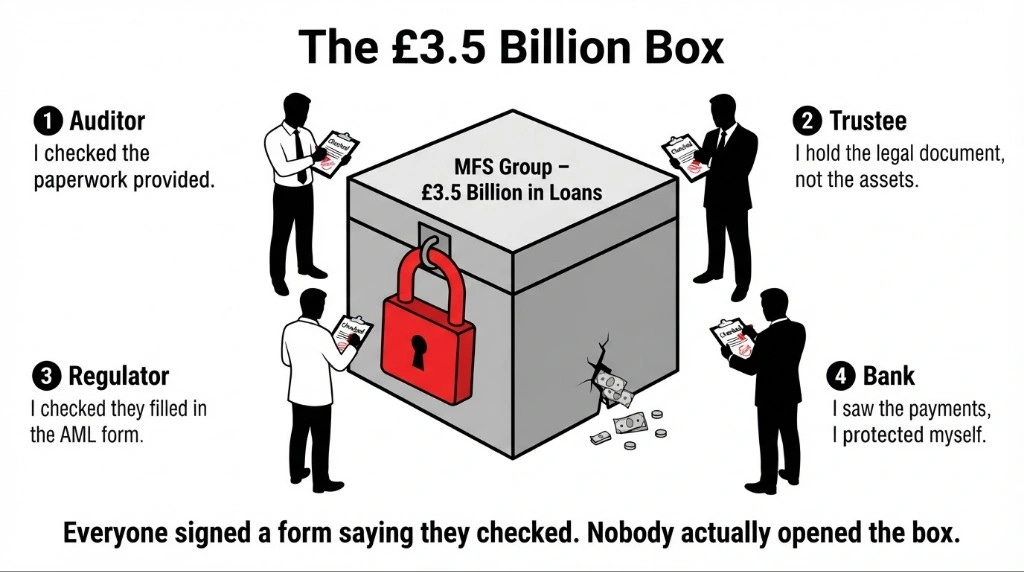
Every gatekeeper in the institutional chain around MFS had a narrow mandate. The auditors checked the entities they were asked to audit. The Security Agent held security on trust for the lenders. The bank managed its credit risk. The FCA supervised MFS solely for compliance with the Money Laundering Regulations. Each institution operated within a defined professional, commercial or regulatory role.
The structure Raja controlled was divided across those mandates, and the public record does not identify a single institution with a formal end-to-end oversight role spanning the entire structure: the Security Agent was not subject to a standalone statutory audit; the bank’s transactional visibility was not necessarily shared across the syndicate; and the regulator’s remit was confined to anti-money-laundering supervision rather than wider conduct or prudential regulation.
Each gatekeeper was responsible only for a part of the structure, and the public record does not identify a single formal mandate requiring one institution to reconstruct how every part of the system came together. That fragmentation matters because risks arising between entities could fall outside the immediate scope of any one engagement or supervisory relationship.
The Architecture
Market Financial Solutions was founded in 2006. It was a bridging lender — the kind of firm that lends money quickly against property, to borrowers who need speed more than the cheapest rate. By 2024, its filed accounts showed a group managing a loan book of approximately £2.4 billion. It employed 149 people. It reported turnover of £71.6 million and profit after tax of £7.6 million.
But MFS was not the entity that held all the loans. A substantial part of the lending was held through special-purpose vehicles, including Zircon Bridging Limited, incorporated in January 2018, and Amber Bridging Limited, incorporated in October 2021. Both were wholly owned by Zircon Group Limited, which was itself controlled by Paresh Raja.
The SPVs raised money from institutional lenders. Zircon borrowed from a senior lender ultimately controlled by Apollo’s Atlas SP Partners and a mezzanine lender ultimately controlled by TPG Angelo Gordon. Amber borrowed from a senior lender ultimately controlled by Atlas SP and mezzanine lenders ultimately controlled by Avenue Capital. The combined debt across the two vehicles was over £1.1 billion.
The loans were secured. A Deed of Charge and Assignment, prepared by Cadwalader, Wickersham & Taft, appointed Intertrust Trustees Limited as Security Agent. Companies House records show Intertrust as Security Agent over Zircon and over Amber. The Security Agent held fixed and floating charges over the SPVs’ assets on trust for the lenders. The lenders were entitled to assume that if the borrower defaulted, they could enforce against the collateral.
MFS was the servicer. It introduced the borrowers, managed the loans, collected the payments, and directed the cash flows. According to the administrators’ proposals for Zircon and Amber, it was contractually obliged to pay income from the mortgage loans into designated funder accounts, where it would be applied in accordance with the agreed waterfall. Raja controlled every entity in the chain except the Security Agent and the lenders themselves. He sat at the point where the entities and cash flows converged.
As the group moved towards collapse, the governance thinned further. Companies House records show that directors Sharon Hewes and Stuart Hicks resigned in the weeks before MFS entered administration in February 2026. Pratibha Raja, a co-director and family member of the founder, resigned on 16 February 2026 — her termination form was filed at Companies House on 20 February. When MFS itself described its collapse, it attributed it to “a temporary restriction on access to the Company’s banking facilities, arising from a procedural matter with its primary banking provider”. The administrators would later allege in a High Court claim that Raja had engaged in the “systematic plundering” of the business.
The Auditors: Two Firms, One Cash Cycle
MFS was audited by Berkeley Finch Limited, an eleven-person firm in Finchley, north London. The audit fee for the 2024 accounts was £72,375. Berkeley Finch issued an unqualified opinion in March 2025, with no going-concern emphasis of matter. The Financial Times subsequently reported on the size of the firm, the audit fee and the FRC investigation into its work.
Zircon Bridging and Amber Bridging were audited by Silver Levene (UK) Limited. Silver Levene also audited Zircon Group’s consolidated accounts. The SPVs’ 2024 accounts — showing a Zircon loan book of £458.4 million — and Amber’s accounts, showing a £579.5 million loan book, were signed with unqualified opinions on 28 and 29 April 2025 respectively.
So Berkeley Finch certified the servicer, and Silver Levene certified the borrowing vehicles. The FT has described the lending empire as split across separate audit silos. The public record does not show whether either auditor reconstructed the complete cash cycle as it moved between the separate entities. The administrators would later find that income from mortgage loans had been diverted from the designated funder accounts to other accounts — a cross-entity problem that sat between separate audit engagements covering different parts of the structure.
The audit reports on file made the gap explicit. Both Zircon’s and Amber’s 2024 reports identified a fraud risk relating to “posting inappropriate journal entries.” There is no evidence on the public record that either engagement scoped a specific risk around servicer-level cash diversion, despite MFS being a related party, controlled by the same individual who controlled the SPVs.
Under the version of ISA (UK) 240 applicable to these audits, auditors considering fraud risk were also required to apply the relevant requirements of ISA (UK) 550 concerning related parties. Whether the audits considered that specific risk is a question the FRC’s investigation may help answer.
There is a further, sharper question sitting in FT reporting that the public record has not independently verified: that Berkeley Finch’s principal, Ajay Yadav, held mortgages through a company he owned from a Raja-linked entity, with MFS listed as the “manager” of those mortgages. If accurate, that is a relationship capable of raising independence questions under the FRC Ethical Standard 2019 provisions concerning financial relationships and loans. Whether it was disclosed, assessed, or missed is a question that may fall within the FRC’s investigation.
Silver Levene received recurring audit fees of £62,000 to £76,000 from the Zircon and Amber engagements. Under the FRC Ethical Standard, economic dependence is assessed by reference to those fees as a proportion of the audit firm’s annual fee income, or the relevant profit-sharing unit. The public evidence reviewed for this article does not establish whether the engagements approached the relevant thresholds.
The security agent: who guarded £1.1 billion?
The institutional lenders who funded Zircon and Amber needed someone to hold the security. They needed an independent, professional entity that would sit between the borrower and the lenders, holding the charges on trust and enforcing them if things went wrong. They chose Intertrust Trustees Limited.
The public record of Intertrust Trustees Limited was available at Companies House throughout the life of the MFS mandates. It contained details relevant to assessing the legal entity behind the Intertrust name.
The company had been acquired by the Intertrust group in 2016 for a purchase price of £1. Its net assets at the time were also £1. The £1 acquisition consideration is a corporate-history fact; it does not establish the entity’s economic value or operational capacity. It was not subject to a standalone statutory audit. Its filings show that it relied on a parent-company guarantee and the subsidiary audit exemption under Section 479A of the Companies Act 2006. This was lawful. The public record does not establish what audit work, if any, was performed on its internal controls, its processes for monitoring the security it held, or the completeness of its records as part of the wider group audit.
The company’s Articles of Association contained a provision — Article 23 — that allowed holders of a majority of the ordinary shares to appoint and remove directors by written notice, without a general meeting, without stating a cause. Its Companies House filing history records multiple director appointments and resignations occurring on the same dates during the life of the Amber and Zircon facilities, including in February 2022, June 2023 and August 2025. The public record does not show whether the lenders were notified.
The company’s financial profile was shifting in ways that raised further questions. Its filings show turnover falling from £660,262 in 2021 to £176,757 in 2024, while net assets rose from £1 to £45,762 and trade receivables increased from £15,096 to £180,996. These figures were not subject to a standalone statutory audit.
The parent group carried its own public compliance record. In 2021, the Cayman Islands Monetary Authority imposed fines totalling CI$4.23 million on Intertrust Corporate Services (Cayman) Limited for breaches of anti-money-laundering requirements. In November 2022, the Luxembourg CSSF imposed a €198,750 administrative fine on Intertrust (Luxembourg) S.à r.l. for failures concerning IT risk management, internal governance, professional secrecy and regulatory communications. In January 2024, De Nederlandsche Bank imposed a €2.5 million fine on Intertrust (Netherlands) B.V. for inadequate customer due diligence. Intertrust also reported €13.8 million of one-off costs in 2021 associated with remediation activities, the CIMA fine and other legal and compliance costs.
None of these facts, individually, proves that Intertrust Trustees Limited failed in its duties as Security Agent. I identified no MFS-related enforcement action against Intertrust Trustees Limited in the public record reviewed for this article. None of the group-level regulatory findings establishes that Intertrust Trustees Limited itself lacked adequate governance or compliance controls. They do show that lenders were relying on a legal entity exempt from standalone statutory audit within a wider group that was simultaneously dealing with significant compliance and remediation issues in other jurisdictions.
What due diligence was conducted on the legal entity’s governance, resources and ability to discharge a security mandate covering more than £1.1 billion? The public record does not answer that question. The administrators for Zircon and Amber later raised questions about the status and enforceability of the security. The contrast raises the question of how closely lenders scrutinised the legal entity behind the Intertrust brand.
Barclays: the bank with direct transactional visibility
Barclays had two roles. It was MFS’s transactional bank, processing day-to-day payment instructions. And it was a direct lender to the wider group, initially reported at roughly £600 million. The Financial Times has reported on Barclays’ dual role and exposure.
This dual role gave Barclays direct transactional visibility into cash moving through the accounts it operated. That visibility would have allowed it to observe payment activity and anomalies in those accounts, although the public record does not establish that Barclays could infer a portfolio-wide redemption freeze from transactional data alone. The administrators later documented that Amber showed zero redemptions in the three months before going into administration; Zircon showed only 13, worth £2.4 million against a £552.6 million book. For a business whose model depends on short-term loans with rapid turnover, a near-total cessation of redemption activity was an anomaly.
But the redemption freeze was not the only warning. In June 2025 — eight months before the administration — the National Crime Agency froze 342 properties linked to Saifuzzaman Chowdhury, worth about £185 million, as part of an ongoing civil investigation. A substantial part of Chowdhury’s UK property portfolio had been financed through MFS-linked entities. Castlelake had also intensified its due diligence following the collapses of US companies First Brands and Tricolor, with its exposure to First Brands prompting additional checks on MFS.
On or around 17 November 2025, Barclays began declining payment instructions from the SPVs. By January 2026, it had frozen MFS-linked accounts. The FT reported that Barclays had begun blocking transactions months before MFS collapsed, while the administrators’ proposals record the November date.
What happened between November and February is not fully documented. But the Telegraph has reported that Barclays was alerted by a whistleblower, attempted a last-ditch restructuring, and then “chose to protect its position first.” Bloomberg reported that, in late November 2025 — after Barclays had already begun restricting MFS-linked transactions — a company tied to MFS borrowed approximately £143 million from Wells Fargo, with Barclays repaid a similar amount. The Telegraph put the refinanced amount at £134 million.
There is no public evidence that the information which prompted Barclays to restrict payments was shared across the wider lending and assurance chain before the collapse. In National Westminster Bank plc v Rabobank Nederland [2007] EWHC 1056 (Comm), the court held that the Good Faith Agreement governing that particular workout did not impose the disclosure duty alleged. That does not establish a universal rule governing every syndicate arrangement or every possible duty Barclays may have owed. The absence of a general disclosure duty does not resolve the broader questions surrounding Barclays’ conduct. The institution with some of the earliest documented visibility into the payment problems had a strong incentive to protect its own position.
The administrators are now suing Barclays for access to frozen MFS accounts. Barclays held about £160 million across accounts tied to various MFS entities at the time of the collapse, although the amount held in MFS Ltd’s own account is unclear. The bank has asserted that it is entitled to use funds to offset other losses, and is defending the claim.
The bank with direct transactional visibility also had a financial incentive to protect its own position — and the public record cited here does not establish a general disclosure obligation requiring Barclays to warn the other lenders.
The FCA: supervision within a narrow perimeter
MFS’s FCA status was explicit. The regulator’s 20 March investigation statement described it as an Annex 1 business “solely registered with and supervised” for compliance with the Money Laundering Regulations, and emphasised that Annex 1 firms are not authorised or subject to wider FCA regulation.
This was lawful. It was not a loophole. It was the regulatory position applying to this category of unregulated lending. Many loans secured against investment or commercial property fall outside the regulated-mortgage regime, including investment property loans covered by Article 61A of the Regulated Activities Order. The FCA’s own mortgage guidance explains the circumstances in which mortgage lending falls inside or outside the regulated regime. MFS’s regulatory classification did not change as it grew into a £2.4 billion, 149-employee lending operation.
Annex 1 registration meant that the FCA’s role was limited to anti-money-laundering supervision rather than broader conduct and prudential regulation. In its March 2026 warning to regulated firms, the FCA itself stressed that Annex 1 firms were not subject to its wider rulebook and that their customers could not access the Financial Ombudsman Service.
The NCA’s June 2025 freeze of Chowdhury’s properties underlined what that limited remit meant in practice. Here was an ongoing NCA civil investigation touching a borrower with substantial links to MFS. The FCA’s only supervisory jurisdiction over MFS was AML. Whether the FCA was aware of the NCA’s action, and whether it connected that action to the firm it was supervising, is not a matter of public record.
In 2024, a skilled-person review commissioned by the FCA and conducted by DWF found MFS operating in line with UK money-laundering requirements, while recommending some potential improvements. The review therefore provides an important counterpoint to what followed, but its scope also matters: an AML-compliance review was not an end-to-end verification of MFS’s loan book, collateral, servicing arrangements or cash flows. Its conclusions should not be read as assurance over the wider problems later alleged.
The scale mismatch lay in the regulatory perimeter. As MFS grew, Annex 1 registration did not automatically bring it within broader FCA conduct or prudential supervision. Its AML obligations, however, remained risk-based and were expected to reflect the firm’s own risks, governance and operations. MFS in 2016 — eleven employees and net assets of £136,014, according to its historical Companies House filings — and MFS in 2024 — 149 employees and a group loan book of approximately £2.4 billion — remained within the same regulatory category.
The regulator’s formal remit did not extend to many of the broader conduct, prudential and business-model risks that later emerged.
The Collapse
The administrators’ proposals record that, following continuing Events of Default, the senior lenders accelerated their facilities, making the outstanding amounts immediately due. Companies House records show that Zircon, Amber and MFS subsequently entered administration.
The administrators’ proposals, available through the Companies House filing histories for MFS, Zircon and Amber, described two fundamental problems. First, income from mortgage loans had been diverted: money borrowers paid had not all reached the designated funder accounts. Second, the same collateral had allegedly been pledged to multiple lenders.
The numbers were extraordinary. Zircon’s records showed 525 live loans worth £552.6 million. The administrators could only find documentation for 98 of them, worth £98.4 million — a gap of £454.2 million, or 82 percent of the reported book. Amber’s records showed 191 live loans worth £691 million. The administrators documented 28 of them, worth £213.4 million — a gap of £477.6 million, or 69 percent. The total group deficiency recorded in the administrators’ proposals was estimated at £1,807,612,828.
In March alone, more than 100 connected real-estate companies entered administration, according to Insolvency Service data that the Financial Times linked to MFS.
These figures were not simply a valuation dispute. Double-pledging involves the same purported asset or collateral being pledged or represented to more than one creditor; it does not by itself establish the asset’s existence, ownership, value or enforceability. By value, about three-quarters of the reported live loan books across Zircon and Amber could not be matched to documentation the administrators were able to locate. Whatever the explanation, administrators were able to locate supporting documentation for only a fraction of the reported loan books.
Paresh Raja is subject to a £1.3 billion civil claim and worldwide freezing orders. Raja’s spokesperson has denied allegations of fraud and dishonesty, saying that funds administrators allege were received into personal accounts were held through nominee structures for the benefit of MFS and its creditors. The administrators’ proposals also record that Raja had not provided Statements of Affairs for the companies despite requests.
The Official Anchors
The FCA and FRC have opened investigations into different aspects of the MFS collapse. On 20 March 2026, the FCA announced an enforcement investigation into MFS. Its jurisdiction in relation to MFS is limited to compliance with the Money Laundering Regulations. On the same day, it warned regulated firms about dealing with Annex 1 businesses.
On 11 June 2026, the FRC announced four investigations: one into Magus Chartered Accountants and two individual accountants; one into another individual accountant; one into Berkeley Finch Limited’s audit of MFS for the year ended 31 December 2024; and one into Silver Levene (UK) Limited’s audit of Zircon Group Limited’s consolidated financial statements for the same year.
The FRC has stated that opening an investigation does not indicate that it has made, or will make, any finding of breach or misconduct.
Separately, the Financial Times reported on 28 August that the Solicitors Regulation Authority had opened an investigation into Gunnercooke over its work for companies linked to MFS. The investigation reportedly began in June. Gunnercooke denies wrongdoing.
The FCA and FRC are investigating different aspects of MFS, while the SRA is separately examining legal work for MFS-linked companies. These investigations do not resolve the broader systemic question examined here. The auditors had separate mandates. The security agent held security on trust for the lenders. The bank took steps to protect its own position. The regulator supervised MFS within the confines of the Money Laundering Regulations — against a backdrop of an ongoing NCA civil investigation whose connection to the FCA’s supervision of MFS is not clear from the public record. Each gatekeeper had a narrow role. Together, those arrangements did not prevent a £1.8 billion deficiency from emerging.
Part 2 of this series will examine what the MFS collapse reveals about the limits of the audit model, what the Bank of England’s collateral framework can — and cannot — tell us about third-party service providers, and what the FCA’s 7 August warning tells us about whether anything has really changed.
Scope and Limitations
This article is based on publicly available information: Companies House filings, the FCA register, FRC press notices, administrators’ proposals, and Financial Times, Telegraph, Bloomberg and other media reporting. It does not draw on internal bank or audit working papers, privileged communications, or confidential regulatory submissions. No finding of breach or misconduct has been made in the FRC investigations arising from MFS, which remain open, and nothing in this article should be read as a conclusion about the legal liability of any party in relation to the MFS collapse. Paresh Raja’s spokesperson has denied the fraud and dishonesty allegations and has said that funds administrators allege were received into personal accounts were held through nominee structures for the benefit of MFS and its creditors. The purpose is to describe, from the public record, the architecture of the MFS collapse and the borrowed-trust dynamic that may help explain why responsibility for detecting problems was fragmented across different institutions and mandates.
This essay is part of a series of 3 essays:
Part 1 — £1.8 billion and borrowed trust: the MFS structure no one was mandated to see whole
Part 2 — £1.8 billion and borrowed trust: the limits of institutional oversight
This article is part of the Big4News Investigations & Analysis series, which examines the structural forces shaping Deloitte, PwC, EY and KPMG.
