



Key Takeaways:
PwC was fined £3.25m (and partner John Waters £59k) for serious failures in the 2019 and 2020 Babcock audits — the second set of sanctions after the 2017–18 case
In key instances, there were clear warnings: component auditors raised formal scope limitations, PwC specialists flagged problems, and management itself supplied clear signals
PwC has been sanctioned for a second time over its audits of Babcock International.
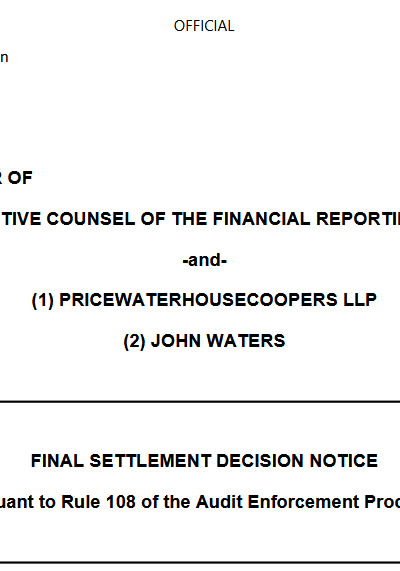
On 16 July 2026, the UK Financial Reporting Council announced that PwC and former audit engagement partner John Waters had admitted serious and numerous breaches in the audits of Babcock’s financial statements for the years ended 31 March 2019 and 31 March 2020.
Both PwC and Waters received severe reprimands. The regulator imposed financial sanctions of £3,248,437 on the firm and £59,062 on the audit partner. PwC has also been ordered to pay the FRC’s investigation costs of £1,085,360 and examine and report on how it manages changes of engagement partner during an ongoing audit and responds when indicators suggest that audit risk is increasing.
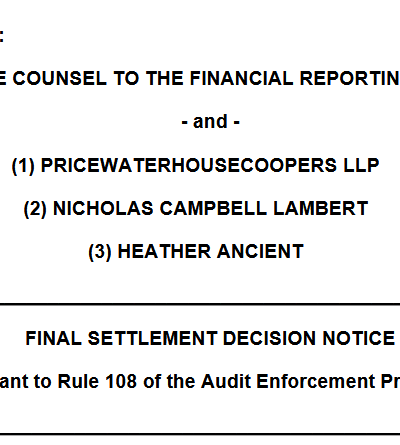
The decision follows the 2023 sanctions concerning PwC’s 2017 and 2018 Babcock audits and the 2018 audit of its Devonport Royal Dockyard subsidiary. After settlement discounts, PwC was fined £5.625 million, Nicholas Campbell Lambert £150,000 and Heather Ancient £48,750.
Across the two enforcement proceedings, the regulator has now identified serious failures in four consecutive years of PwC audits.
The latest Final Settlement Decision Notice is unusually stark. It says the 2019 and 2020 audits did not achieve the fundamental assurance they were intended to provide.
“failed in their principal objective”
Financial Reporting Council, Final Settlement Decision Notice concerning PwC and John Waters, paragraph 11, page 3.
The FRC’s findings are troubling: in several areas, warnings and contradictory evidence reached PwC but did not produce an adequate audit response.
There were warnings from component auditors.
There were also interventions from PwC’s own accounting specialists.
There were even indications from Babcock management.
And most troublingly, there was evidence in the figures and documents already sitting in the audit file.
The warnings were there.
The problem was that they did not produce an adequate change in the audit response.
The FRC found several breaches, but it expressly found that these were not dishonest, deliberate or reckless. The more difficult question is how repeated warnings and contradictory evidence could pass through the audit process without producing an adequate change in approach.
The proceedings concerned PwC and Waters. The FRC expressly states that its notice should not be treated as findings against Babcock, its directors, management or any other person or entity.
PwC’s Four Consecutive Babcock Audit Failures
The latest findings become more serious when placed alongside the FRC’s earlier Babcock decision.
That investigation covered PwC’s 2017 and 2018 audits of Babcock and the 2018 audit of its Devonport Royal Dockyard subsidiary.
The regulator identified breaches in every area it investigated and said that the failings were neither isolated incidents nor one-off oversights.
The failures occurred across different contracts, transactions, component teams and PwC offices. The FRC said that, across the parts of the audits it examined, the failures reflected a:
“general reluctance to challenge management”
Financial Reporting Council, Final Settlement Decision Notice concerning PwC, Nicholas Campbell Lambert and Heather Ancient, paragraph 2.15, page 7.
The earlier decision found no evidence that PwC had obtained and read a 30-year public-private partnership contract producing approximately £77 million in annual revenue and £3 billion over its lifetime.
Another contract, initially worth approximately €640 million, was written in French, but the audit team neither possessed the required language skills nor obtained a translation.
The investigation also found that PwC had provided inappropriate accounting advice to its audit client. In the Devonport audit, a workpaper concerning a sensitive government contract had been drawn up before the underlying evidence was received, creating a false record of the evidence obtained and audit work performed.
The FRC identified some overlap involving goodwill impairment and the Phoenix II and DSG contracts, but said the majority of the latest breaches were of a different nature from those examined in the earlier case.
The FRC also notes that the detailed findings from the earlier investigation were not available to the 2019 and 2020 audit team at the time.
It would therefore be unfair to suggest that Waters simply ignored an existing regulatory decision.
But the recurrence remains striking.
Different partners oversaw the audits. Different accounting areas were examined. Different component teams and business divisions were involved.
The underlying weakness remained substantially the same: management’s conclusions were not challenged with sufficient persistence, and contrary evidence did not produce an adequate audit response.

This Was Not a Foreign-Subsidiary Blind Spot
At first sight, the Babcock findings appear to fit a pattern examined previously by Big4News in PwC Audit Failures: CTM, WHSmith and the Foreign Subsidiary Blind Spot.
At Corporate Travel Management, questions arose over whether PwC had adequately challenged documentation and accounting connected with substantial overcharging by the Australian-listed company’s UK subsidiary. At WHSmith, material revenue-recognition problems in its North American business went undetected until a finance-team whistleblower raised concerns.
Those cases raise legitimate questions about whether the Big Four’s global networks deliver the consistent cross-border scrutiny that companies and audit committees believe they are purchasing.
Babcock is a complex multinational group. Its Aviation division alone contained more than 50 legal entities, with nine components included within the scope of the 2019 audit and 12 within the 2020 audit.
A number of Babcock’s components were audited by overseas component auditors, who reported their findings to PwC’s UK group audit team. The group team, led by Waters, remained responsible for evaluating their work, obtaining sufficient evidence and deciding whether PwC could sign an unmodified opinion on Babcock’s consolidated financial statements. PwC did so in both years. Its audit fees were £2.5 million in 2019 and £3.2 million in 2020.
This initially appears to be a familiar multinational-audit problem: geographically dispersed subsidiaries, inconsistent accounting practices and a group auditor too distant from the underlying operations to understand what was happening.
But the Babcock case is different. In some of the most important instances, component teams identified the risks and reported them to PwC’s group audit team.

The Warnings Reached the PwC Group Team
1. An auditor would not express an opinion on €137 million of aircraft
One component team raised a formal limitation on the scope of its audit work relating to aircraft depreciation and the capitalisation of maintenance costs.
The team would not express an opinion on the net book value of aircraft worth €137 million. It was concerned that local management applied a single depreciation rate to the whole value of each aircraft, despite major components such as engines, gearboxes and rotor blades having different useful lives.
It also raised concerns about Babcock’s practice of capitalising certain aircraft-maintenance expenses.
This was not a vague observation or a minor documentation point. A component auditor had concluded that it could not provide PwC with the assurance requested over a substantial asset balance.
The component team also reported a control deficiency with potentially significant consequences. Babcock’s Group Accounting Manual did not provide sufficient guidance on the relevant aviation-accounting issues, while local management was apparently unaware that the manual existed.
The component auditor identified a resulting risk of inconsistent accounting and non-compliance with IFRS across Babcock’s entities.
PwC’s group team recorded that it had discussed and challenged the matter but ultimately accepted the accounting treatment. Its stated reasoning was that the issue fell below the group reporting threshold and would not affect the group accounts. It therefore concluded that no further work was necessary.
The FRC’s response is blunt:
“no evidence to support these statements”
Financial Reporting Council, Final Settlement Decision Notice concerning PwC and John Waters, paragraph 68, page 17.
The regulator found no substantive response to the component auditor’s scope limitation and no adequate assessment of what it meant for PwC’s opinion on Babcock’s group accounts.
Audit documentation is the principal contemporaneous evidence that the required work, challenge and evaluation occurred. Where the file contains no support for a conclusion that allowed the group auditor to proceed despite a component team’s scope limitation, neither the regulator nor users of the audit can safely assume that a rigorous but undocumented assessment took place.
Nor did the warning disappear.
The component team reported similar scope limitations and the same control deficiency during the 2020 audit. PwC’s group team responded in essentially the same way it had the previous year.
In relation to this aircraft-cost accounting, the FRC found that PwC failed to recognise the possibility of material misstatement arising from information already placed before the auditors.
“facts which had been brought to their attention”
Financial Reporting Council, Final Settlement Decision Notice concerning PwC and John Waters, paragraph 74.1, page 19.
Babcock’s 2021 financial statements subsequently included substantial prior-period corrections in this area. The four categories listed by the FRC reduced net assets by approximately £112 million for 2019 and £126 million for 2020, although the regulator noted that the residual “Other” category included some errors not solely related to aircraft-maintenance costs.
2. A component auditor rejected the accounting. The group team took the issue out of its scope
Another episode concerned a ten-year contract with a foreign government agency for the provision of defence material and services.
Babcock had received advances from a bank against contract receivables. Management removed both the receivables and the associated bank liabilities from the balance sheet. The amounts involved were £137 million in 2019 and £101 million in 2020.
The component audit team believed that Babcock’s treatment did not comply with IFRS 9.
At the request of PwC’s group audit team, the issue was removed from the component team’s audit work and taken over by the group team. The FRC found that PwC’s workpapers did not explain why the matter had been removed from the component auditor’s opinion.
This matters because the decision was not made in an area where everyone agreed and only routine verification remained.
The component team and group team had reached opposing conclusions on a highly judgemental accounting treatment. The group team effectively removed the disputed issue from the work of the auditors who believed the accounting was wrong and assumed responsibility for reaching its own conclusion.
The sequence is troubling. But because the workpapers did not explain the decision, it is not possible to establish why the group team removed the matter from the component auditor’s work.
PwC’s internal Accounting Consulting Services specialists also explained what the group team needed to establish before Babcock could remove the receivables from its balance sheet. The burden was on Babcock to demonstrate that substantially all the relevant risks and rewards had transferred to the bank.
The FRC found that PwC’s analysis did not assess all the relevant recourse events and termination provisions and did not fully demonstrate that the required transfer had occurred. The group team had therefore not fully followed the approach set out by PwC’s own specialists.
An internal PwC hot review strongly recommended that the arrangement be disclosed as a critical accounting judgement because of its materiality and complexity.
Yet the FRC found no record showing that PwC adequately reported the level of judgement involved, the group team’s conclusion or the possible need for fuller disclosure to Babcock’s audit committee.
The following year, the component auditor again excluded the arrangement from its opinion. PwC’s group team relied on its deficient 2019 analysis and performed no additional substantive audit work.
Clearly, the component-audit process did what it was supposed to do at the identification stage.
A component audit team questioned the accounting.
PwC’s technical specialists explained the evidence required.
An internal reviewer highlighted the significance of the judgement.
But those warnings did not translate into an adequate audit response.
3. There were warning signs about management decisions
The pattern was not limited to matters identified by component auditors.
Babcock had recognised £440 million of finite-life intangible assets following the acquisition of an aviation business. During the 2019 audit, PwC was told that the customer relationships supporting part of those assets had not delivered the expected growth, were no longer valuable when bidding for work and had initially been considered for write-off.
Despite this, the FRC found no evidence that PwC established whether management had performed the annual review required under IAS 38. Nor did PwC adequately test whether the assets’ remaining useful lives were still appropriate.
The regulator concluded that an appropriate review would probably have revealed in 2019 that the customer relationships had been lost in earlier years, that the useful lives were no longer supportable and that there might have been a prior-period error.
PwC had not failed because the relevant information was buried deep within a distant operation. Management had effectively told the auditors that the economic basis for the asset had deteriorated.
The auditors did not follow through on the implication.
4. Evidence that contradicted management’s forecasts was overlooked
The same lack of challenge appeared in PwC’s work on Babcock’s DSG military-vehicle contract.
Babcock’s model assumed that £499 million of cost savings would be achieved over the contract’s ten-year life. Of that amount, £39.7 million was expected to be delivered during 2020 through two workforce-streamlining projects.
Actual savings were only £6 million.
The FRC found that the enormous shortfall did not appear to have been noticed by the component audit team during the 2020 audit and did not prompt an adequate reassessment of the remaining forecasts.
PwC also accepted £29.2 million of unidentified future savings without sufficient challenge. Its impairment work included projected profits from opportunities that remained at proposal stage, assumed margins of 60 per cent on some of those opportunities and relied on a five-year Ministry of Defence contract extension that had not been granted.
Babcock subsequently impaired the DSG contract intangible asset by £56.4 million.
Again, the difficulty was not an absence of information.
The previous forecast and actual result could be compared. One of the projected opportunities had already been rejected by the Ministry of Defence on value-for-money grounds. The contract extension remained unconfirmed.
The evidence showed that important management assumptions had failed or remained unverified. PwC nevertheless did not reassess them with sufficient rigour.
Stage Three: When Professional Scepticism Collapses
Professional scepticism is sometimes described as though it were an abstract quality: a mindset that auditors should bring to their work but that cannot readily be observed.
The Babcock findings show what its absence looks like in practice.
It looks like a component auditor refusing to provide an opinion over €137 million of aircraft assets, followed by a group-team conclusion that no more work is needed.
It looks like a warning about inconsistent accounting policies and possible IFRS non-compliance that produces no documented substantive response.
It looks like the same warning returning the following year and receiving essentially the same treatment.
It looks like an accounting judgement being removed from the scope of a component team that disagreed with management, without the audit files explaining why.
It looks like internal accounting specialists identifying the proof required, but the audit team accepting management’s treatment without fully obtaining it.
It looks like a forecast of £39.7 million in savings producing only £6 million, without the shortfall prompting sufficient challenge to the remaining assumptions.
What Babcock’s 2021 Review Found
Babcock’s new management commissioned a detailed Contract Profitability and Balance Sheet Review in 2021. The resulting exercise produced approximately 140 adjustments totalling around £2 billion.
Not all of those adjustments represented accounting errors. They comprised a mixture of changes in estimates, corrections of prior-period errors and a change in accounting policy.
It would therefore be misleading to say that PwC simply missed £2 billion of misstatements.
But the FRC found that Babcock’s 2021 financial statements contained material restatements correcting prior-period errors associated with five of the eight areas covered by its latest investigation.
The FRC also noted that PwC and Waters audited the FY2021 accounts and that the FY2021 audit team was responsible for identifying the material prior-year errors in all five of those areas. That later correction does not remove the failures in the preceding audits, but it is relevant context.
In addition, the restatements associated with those five breach areas did not affect Babcock’s core performance measures and had no quantifiable effect on shareholder value.
The regulator nevertheless concluded that the 2019 and 2020 audits failed in their principal objective of obtaining reasonable assurance that the accounts were free from material misstatement.
“not dishonest, deliberate or reckless”
The FRC explicitly records that the breaches were “not dishonest, deliberate or reckless” and did not occur with a view to financial benefit.
We also need to consider the contributing factors that materially affected the audits.
John Waters inherited the Babcock audit in exceptionally difficult circumstances. He was appointed after the 2019 audit had already commenced, following the sudden and unexpected departure of his predecessor. He received no handover and did not have an opportunity even to speak to the outgoing partner.
The following year, the Covid-19 pandemic made the audit significantly more difficult and restricted normal face-to-face contact with management and audit teams.
The FRC also acknowledged that Waters understandably concentrated on the areas identified as significant risks, which were not the areas affected by most of the breaches.
Full Disclosure and Cooperation
PwC and Waters provided exceptional cooperation during the investigation. PwC conducted internal reviews and a root-cause analysis and disclosed the findings to the regulator. Their cooperation was taken into account in reducing the sanctions imposed.
PwC also apologised. In a statement reported by the Financial Times, the firm said:
“We’re sorry that some aspects of these audits were not of the standard expected.”
The firm added that audit quality remained a constant focus and said recent inspection results reflected its commitment to improvement.
An Institutional Failure
The mitigating circumstances do not explain away the institutional failure.
Waters inherited a large and complex public-interest audit after the work had begun, without a handover from his predecessor. The following year, the pandemic made the engagement significantly more difficult. Those were severe challenges for an individual partner.
This is where PwC failed as an institution. This was an audit of the financial statements of a multinational group whose work included sensitive government and defence contracts. Babcock’s Aviation division alone contained more than 50 legal entities, with nine components included in the scope of the 2019 audit and 12 in 2020. PwC received audit fees of £2.5 million and £3.2 million for the two years.
When an engagement partner is appointed after an audit has started and receives no handover, the appropriate institutional response cannot simply be to expect that partner and the existing team to absorb the disruption.
The firm must assess whether additional partners, managers, technical specialists and review capacity are needed. It must reconsider the timetable. It must identify areas where institutional knowledge has disappeared and rebuild that knowledge before the audit opinion is signed.
The same principle applies when the risk profile of an audit changes.
When component auditors report scope limitations, internal specialists raise technical concerns, forecasts fail and contradictory evidence accumulates, the audit should become more demanding. It should require more time, more senior involvement, more specialist input and more intensive review.
Risk cannot be allowed to rise while the resources, timetable and staffing model remain fixed.
This is where the question of working hours arises. The FRC decision does not disclose how many hours the Babcock team worked or establish that it was understaffed. But across the audit profession, workload is recognised as sufficiently important to audit quality that the FRC now includes staff workload, partner involvement, attrition and staffing ratios among the metrics used to assess audit-firm performance. The regulator cautions that these measures are not mechanically linked to audit quality, but considers them relevant to understanding how firms manage the conditions in which quality is produced.
Long hours are often presented inside professional firms as evidence of dedication. In an audit, however, sustained overwork can impair judgement and increase the risk that contradictory evidence is not pursued with sufficient rigour.
An audit model that routinely relies on people working deep into the night to meet compressed reporting deadlines creates its own risks. Tired auditors are less able to interrogate contradictory evidence, revisit earlier conclusions, challenge senior client personnel or recognise that apparently separate problems may form part of a wider pattern.
A firm entrusted with a public-interest audit has a responsibility to organise the engagement so that professional scepticism does not depend on depleted individuals finding additional reserves of stamina.
If the planned team cannot complete the necessary work to the required standard within the available time, the answer must be to add resources, extend the timetable, escalate the problem or reconsider whether the audit opinion can safely be issued.
PwC was responsible for staffing the engagement, managing the partner transition, providing technical and supervisory support, responding to escalating risk and ensuring that commercial or reporting pressures did not override the work required by the auditing standards.
The firm delayed the signing of the 2020 audit opinion by two weeks to allow additional time to complete the work in the face of the pandemic. Those facts are relevant mitigation. They do not, however, answer whether the firm provided sufficient additional capacity, supervision and review.
The FRC’s remedial order reinforces this institutional dimension. PwC must examine its systems for managing changes of engagement leader and responding to increasing audit risk. The order therefore focuses not exclusively on Waters’s individual judgements, but also on the mechanisms through which the firm should have recognised that the engagement was becoming more difficult and changed how the audit was led, supported and reviewed.
The FRC made the division of responsibility explicit: despite the difficult circumstances, the firm and the engagement partner should together have ensured that the challenges were properly addressed and the audit work met the applicable standards.
Conclusion
A statutory audit is not expected to identify every error. It provides reasonable, rather than absolute, assurance.
But reasonable assurance cannot be meaningful if explicit warnings, contradictory evidence and unexplained limitations on audit scope repeatedly fail to change the auditor’s approach.
The purpose of professional scepticism is not merely to encourage auditors to ask a few difficult questions. It is to ensure that they remain willing to revise their conclusions when the evidence points in a different direction.
At Babcock, the warnings were not hidden.
They appeared in component-auditor reports, specialist advice, internal reviews, management communications, prior-year forecasts and the audit evidence itself.
The failure was not simply that PwC could not see deeply enough into Babcock’s operations. It was that information already inside the audit process repeatedly failed to change what the audit did.
This article is part of the Big4News Case Watch Series
About Claudine Cassar

I’m a corporate anthropologist and former Deloitte equity partner. I sold my technology business to Deloitte in 2016 and led the Malta Consulting team for five years. I now write Big4News, providing independent, clear analysis of PwC, Deloitte, EY, and KPMG — free from corporate spin.
Find me on LinkedIn, X, Instagram, or my author website.