


Key Takeaways
PwC signed off on Ueno Bank’s 2025 accounts less than nine months before its collapse.
US$353 million in trust-related assets represented 99.4% of the bank’s reported shareholders’ equity.
Regulators questioned a US$20 million addition to the merger-related trust and called for further verification of expenses.
Ueno’s collapse exposed severe capital deficiencies, triggering regulatory intervention, criminal investigations and political upheaval.
PwC’s audit responsibilities remain under scrutiny, but the published evidence does not establish an audit failure.
On 19 February 2026, PwC signed off on the annual accounts of Ueno Bank, one of Paraguay’s fastest-growing financial institutions.
Less than nine months later, the country’s central bank intervened after discovering that the bank’s financial position was substantially weaker than previously reported. Ueno’s collapse left approximately three million customers temporarily unable to access their accounts, triggered criminal investigations and contributed to the removal of Paraguay’s president.
But questions about the bank’s accounts had emerged well before its collapse.
In August, Paraguayan newspaper ABC Color questioned the treatment of approximately US$353 million in trust-related assets, a sum almost equivalent to Ueno’s reported shareholders’ equity.
Two months later, the newspaper published extracts from an internal central bank memorandum questioning whether an additional US$20 million in expenses had been included in the trust without the necessary authorisation.
The documents raise questions about the boundaries between regulatory approval, management’s responsibility for financial reporting and the external auditor’s obligation to verify the accounts.
A chronology of the Ueno Bank case
June 2024 — The merger is approved. Paraguay’s central bank approves Ueno Bank’s merger with Visión Banco, including special accounting concessions covering merger-related expenses and portions of the acquired loan portfolio.
13 March 2025 — Additional costs enter the trust. An amendment adds approximately US$20 million in deferred charges to the merger-related trust. Regulators subsequently question whether the addition falls within the original authorisation.
29 August 2025 — Supervisors identify loan-classification concerns. A supervisory report questions whether Ueno’s records adequately distinguish loans eligible for exceptional accounting treatment from other loans.
19 February 2026 — PwC issues its audit opinion. The firm concludes that Ueno's 2025 financial statements present its financial position fairly, in all material respects, under the applicable Paraguayan banking accounting requirements.
29 June 2026 — Supervisors question the merger arrangements. An internal central bank memorandum raises concerns about trust-related expenditure, supporting invoices and the application of exceptional treatment to certain loans.
20 August 2026 — Questions about US$353 million in assets become public. ABC Color publishes an investigation examining Ueno’s trust-related assets, equivalent to 99.4% of its reported shareholders’ equity.
16 October 2026 — The June memorandum becomes public. ABC Color publishes extracts questioning the US$20 million addition and calling for more extensive verification of the trust’s underlying expenditure.
2–3 November 2026 — The central bank intervenes. After regulatory adjustments reveal a severe capital shortfall, the BCP votes to begin proceedings to manage Ueno’s failure and announces its decision the following morning.
An unusual asset worth $353 million
In January 2024, Ueno Bank and Visión Banco began the process of merging, with Ueno absorbing the older institution.
The merger required approval from the Banco Central del Paraguay (BCP), which examined a financial feasibility plan submitted by the banks. On 27 May 2024, the BCP authorised the merger process to proceed, accepting the plan as economically and financially viable. Final approval followed on 21 June.
The central bank also granted special accounting concessions to make the merger financially feasible.
In an October 2026 explanation of its merger policy, the BCP said it sometimes authorised such concessions to facilitate financially viable mergers, which could prove less costly to the financial system than intervention or liquidation. The regulator said these arrangements were subject to conditions and ongoing supervision.
The concessions allowed Ueno to defer certain loan-loss provisions, postpone the recognition of some accumulated losses and establish a trust for costs associated with reorganising the merged business.
How the trust worked
The trust, administered by Zeta Banco, covered qualifying merger-related expenditure, including legal and consultancy fees, systems integration and organisational restructuring.
Under the BCP-approved arrangements, Ueno could record its interest in the trust as an asset on its balance sheet rather than immediately recognising all the qualifying expenditure as expenses.
The resulting asset was classified as Derechos Fiduciarios, or trust-related rights. The approved accounting treatment permitted the costs to be amortised, meaning gradually charged against profits over subsequent accounting periods rather than recognised entirely as expenses when incurred.
The financial implications were significant. Recognising costs as assets and spreading their recognition as expenses over future periods can leave reported profits and shareholders’ equity higher initially than if the expenditure had been charged immediately.
The arrangement does not eliminate the costs or create additional cash. It simply changes when the expenses appear in the financial statements.
A balance almost equal to shareholders’ equity
By 31 December 2025, Ueno’s audited financial statements reported a remaining balance of approximately 2.1 trillion Paraguayan guaraníes (US$353 million) under Derechos Fiduciarios.
That balance was equivalent to 99.4% of Ueno’s reported shareholders’ equity.
PwC’s Paraguayan member firm, PricewaterhouseCoopers S.R.L., issued its audit report on those financial statements on 19 February 2026.
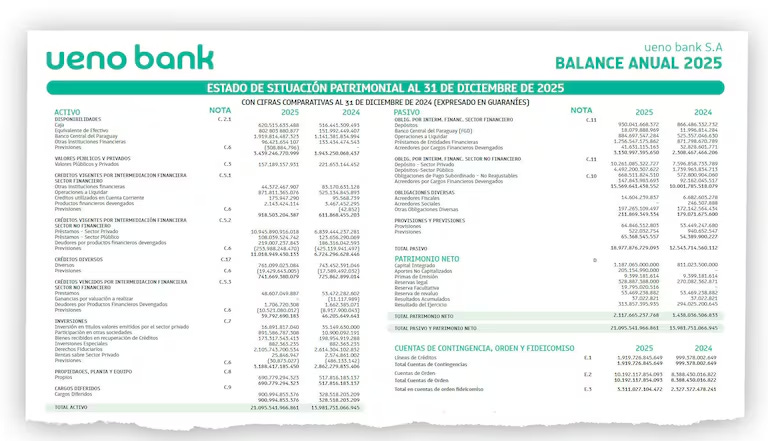
In an investigation published on 20 August 2026, Paraguayan newspaper ABC Color questioned the unusually large balance.
The newspaper noted that other Paraguayan banks generally used trusts to administer loan portfolios or investments, whereas Ueno’s trust held costs associated with reorganising its business.
It also questioned the limited disclosure of the expenditure making up the US$353 million balance.
The accounting arrangements had been authorised by the central bank. Their existence did not, by itself, establish any irregularity.
The more significant question was whether all the expenditure included in the trust qualified under the conditions the regulator had approved.
What was PwC responsible for?
PwC’s audit opinion explicitly referred to Paraguay’s central bank accounting requirements, including the special instructions issued in connection with Ueno’s merger with Visión Banco.
It was not PwC’s responsibility to decide whether the central bank should have granted those concessions. The auditor’s responsibility was to assess whether Ueno had prepared its financial statements in accordance with the applicable accounting framework, including the special arrangements, and to obtain sufficient appropriate audit evidence to support its opinion.
That included assessing whether Ueno had applied the concessions correctly, complied with conditions affecting its financial reporting, and adequately recognised, measured and disclosed the resulting transactions and balances.
A regulator’s approval of an accounting arrangement does not establish that every transaction subsequently recorded under that arrangement complied with its terms.
A $20 million addition raises new questions
On 16 October 2026, ABC Color published details of an internal central bank memorandum dated 29 June.
The memorandum examined aspects of Ueno’s merger arrangements and raised concerns about approximately 155.7 billion guaraníes (US$20 million) in additional expenses included in the restructuring trust.
According to the newspaper, the addition had been made in March 2025, during the financial year covered by PwC’s audit.
The memorandum questioned whether these expenses fell within the categories authorised under the original merger plan.
It indicated that expenses outside the approved categories would require a formal amendment to the plan.
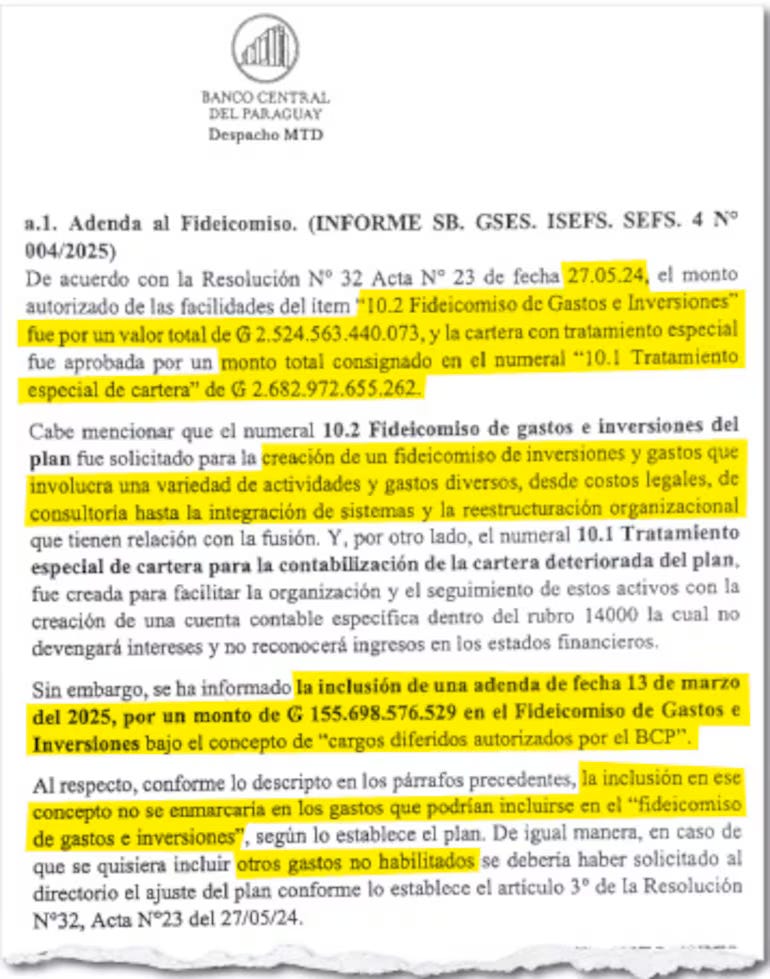
English translation of selected passages
“On 13 March 2025, an amendment amounting to G.155,698,576,529 was included in the Expenses and Investments Trust under the category of ‘deferred charges authorised by the BCP’.”
“The inclusion of this category would appear not to fall within the expenses eligible for inclusion in the Expenses and Investments Trust under the approved plan.”
“To include expenses outside the authorised categories, the bank would have needed to request an amendment to the approved plan from the BCP’s board.”
Translated from Spanish by Big4News. Source: Central bank memorandum reproduced by ABC Color, 16 October 2026.
In other words, the concern was no longer simply whether the central bank had permitted Ueno to recognise restructuring costs as assets.
It was whether Ueno had included costs that fell outside the regulator’s original authorisation.
Regulators wanted the invoices examined
The June memorandum went further.
It called for a more extensive examination of invoices supporting the restructuring trust, including invoices involving companies connected to the Vázquez Group, which controlled Ueno.
According to ABC Color, the review examined a sample representing approximately 66% of the trust’s authorised amount. Ueno provided supporting documentation for 92% of that sample.
The memorandum called for a comprehensive review of the expenditure, including verification of the invoices and whether the costs were directly connected to the merger.
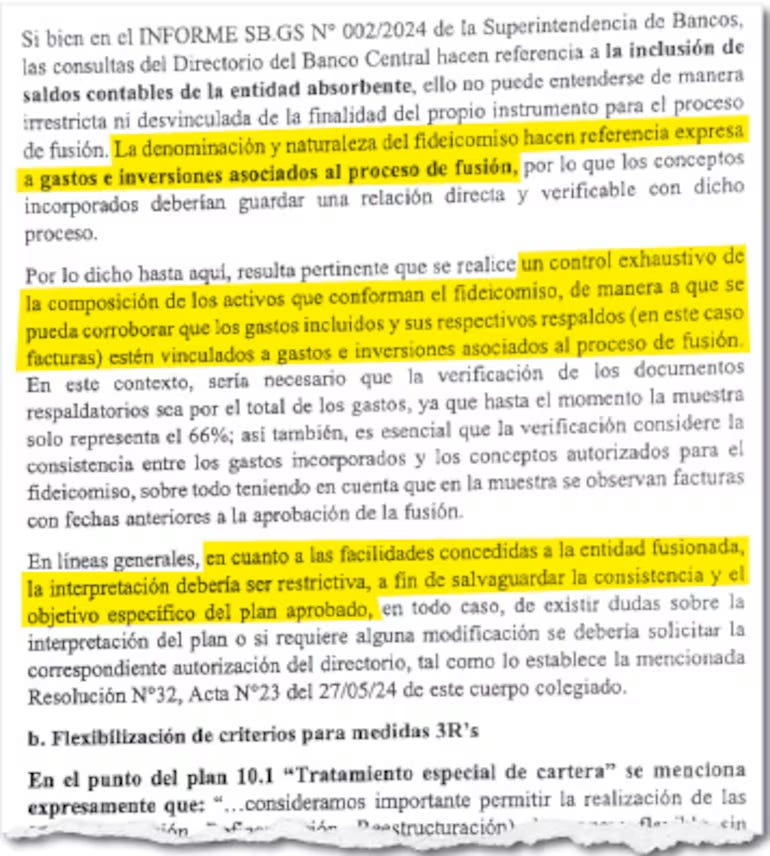
English translation of selected passages
“The name and nature of the trust expressly refer to expenses and investments associated with the merger process.”
“A comprehensive examination of the assets comprising the trust should be undertaken to verify that the expenses included, and their supporting documentation (in this case invoices), relate to expenses and investments associated with the merger process.”
“The concessions granted to the merged entity should be interpreted restrictively, in order to safeguard the consistency and specific purpose of the approved plan.”
Translated from Spanish by Big4News. Source: Central bank memorandum reproduced by ABC Color, 16 October 2026.
The memorandum’s concerns extended beyond the trust. It also raised concerns about the classification of overdue loans inherited from Visión Banco, an issue with potential implications for provisioning and regulatory capital.
The memorandum cited a supervisory report dated 29 August 2025, before PwC issued its audit opinion. That report questioned whether Ueno’s accounting records adequately distinguished loans eligible for special treatment from other loans. The concern was that inadequate classification could affect whether the appropriate loan-loss provisions were recognised.
This establishes that supervisory concerns about loan classification existed before PwC issued its opinion. It does not establish whether PwC knew of that report or whether the accounts contained a material misstatement.
Ueno had separately challenged earlier reporting about its regulatory compliance.
In a statement issued on 7 October, responding to reports about a memorandum concerning lending to related companies, the bank said it had not received the document and could not verify its authenticity or completeness.
Ueno maintained that it had addressed the central bank’s requirements concerning related-party lending within the applicable deadlines.
The statement preceded ABC Color’s publication of the June trust-related memorandum on 16 October and was not a direct response to the concerns about the US$20 million addition.
What did PwC sign off on?
PwC’s February audit opinion is central to the case. The opinion addressed Ueno’s financial statements for the year ended 31 December 2025. It was issued under Paraguayan auditing requirements and the central bank’s rules governing independent bank audits.
The report explicitly identified management as responsible for preparing the accounts, applying appropriate accounting policies and maintaining relevant internal controls.
PwC’s responsibility was to obtain reasonable assurance that the financial statements were free from material misstatement, whether caused by fraud or error.
In performing the audit, PwC was required to evaluate the accounting policies, relevant management estimates and disclosures, and obtain evidence supporting material balances and transactions.
The disputed US$20 million addition reportedly occurred during 2025, before PwC issued its opinion.
However, the publicly available material does not establish what audit procedures PwC performed on the trust, which invoices it examined, or whether the disputed expenditure was material to the financial statements.
Nor does it establish that PwC knew about the concerns subsequently recorded in the June memorandum.
The fact that regulators questioned an accounting treatment after the audit does not, by itself, demonstrate an audit failure.
The central question is whether Ueno correctly recognised and disclosed the relevant transactions under the applicable accounting rules, and whether PwC obtained sufficient appropriate evidence to support its opinion. Those questions cannot be answered from the published financial statements and supervisory extracts alone.
The collapse of Ueno Bank
Ueno Bank’s financial problems came to a head in early November 2026, following several months of regulatory scrutiny.
Paraguay’s central bank had been examining the bank’s financial position and transactions involving companies connected to its controlling shareholders. Its review identified previously undisclosed related-party lending, weaknesses in asset quality and deficiencies in the documentation supporting certain transactions.
The regulatory review led to adjustments to Ueno’s financial statements, including the recognition of additional credit risks. Following those adjustments, the bank’s solvency ratio fell below half the minimum required by law.
On 2 November, the board of the Banco Central del Paraguay unanimously approved an intervention, announcing the decision the following morning.
The BCP began a formal process to manage the failing bank, protect depositors and preserve financial stability. The intervention restricted Ueno’s banking operations and access to deposits while the authorities determined how to deal with its assets and liabilities.
On 3 November, credit rating agency FIX SCR downgraded Ueno from AA-py to Dpy. In a statement published two days later, the agency said the intervention had uncovered information that the bank had not previously supplied, including transactions with connected companies and deficiencies in supporting documentation.
In a subsequent statement on 10 November, FIX SCR said information from the central bank indicated that certain transactions had been concealed or incorrectly accounted for. Had they been properly reported, the bank’s inadequate solvency position would have become apparent much earlier.
FIX SCR also explained that its earlier ratings had relied on audited financial statements, regulatory submissions and management information supplied by Ueno. Those materials had not revealed the problems subsequently identified by the regulator.
The immediate cause of Ueno’s collapse is established: regulatory adjustments exposed a capital shortfall that left the bank below the legal solvency requirement. What remains unclear is whether those adjustments involved the merger-related trust or the additional expenses questioned in the June memorandum.
Millions of Paraguayans affected
Ueno had expanded rapidly, bringing digital banking services to approximately three million customers, including many small businesses and people who had never previously held bank accounts.
The intervention temporarily froze their accounts and disrupted everyday transactions.
Reuters reported on 11 November that approximately 80% of vendors at Asunción’s Mercado 4 had used Ueno’s services. Traders were forced to return to cash or find alternative payment providers, while depositors faced uncertainty over access to their savings.
The bank also held more than US$850 million in public funds, including money belonging to Paraguay’s social security system.
The crisis also prompted protests and a strike by public schoolteachers concerned about approximately US$40 million in pension funds deposited at Ueno, together with nearly US$20 million in expected future interest.
The central bank activated Paraguay’s deposit guarantee arrangements. By 10 November, the BCP reported that approximately 1.78 million depositors had received advance payments totalling G.2.205 trillion. President Pedro Alliana subsequently said that 95% of depositors had been reimbursed.
The central bank’s figures concern depositors receiving payments under the guarantee arrangements, a different population from the approximately three million people who used Ueno’s services.
Political fallout
The bank’s collapse also triggered a political crisis that reached the highest levels of Paraguay’s government.
President Santiago Peña had previously held an investment in Ueno’s parent company and had appointed Carlos Carvallo, a former Ueno executive, as governor of the central bank.
As questions intensified about the bank’s lending practices, regulatory oversight and the placement of public funds, Peña attempted to resign. Congress instead impeached and removed him on 6 November, and Vice President Pedro Alliana assumed the presidency.
Carvallo also resigned.
Both men subsequently faced criminal charges involving alleged breaches of trust and misuse of public office. Both deny wrongdoing.
According to Reuters, prosecutors had charged 35 people in connection with the collapse by 11 November.
The political fallout has intensified scrutiny of Ueno’s connections to senior government officials and raised questions about the independence of the bank’s supervision.
The consequences have extended well beyond Ueno’s customers, affecting public funds, confidence in financial supervision and Paraguay’s political leadership.
Where does the auditor’s responsibility begin and end?
Ueno’s collapse exposes an unusual intersection of regulatory discretion, financial reporting and external audit.
The central bank authorised accounting concessions to facilitate Ueno’s merger with Visión Banco. Supervisory documents subsequently questioned whether some expenses fell within those concessions, while separate regulatory findings ultimately revealed a severe capital shortfall.
PwC’s role was different from that of the regulator. It was required to audit the financial statements under the applicable accounting requirements and obtain sufficient appropriate evidence to support its opinion.
The published evidence does not establish that PwC's audit failed to meet professional standards.
Equally, the regulator’s original approval of special accounting treatments does not settle whether the bank applied them correctly or whether the auditor obtained sufficient evidence concerning the resulting balances.
Those questions require further examination of the underlying transactions, the precise terms of the regulatory approvals and the work performed during the audit.
The Ueno case illustrates a fundamental tension in bank supervision. A regulator may authorise exceptional accounting arrangements to facilitate a merger, but management remains responsible for applying those arrangements correctly, and the external auditor must obtain sufficient evidence that the resulting financial statements comply with the applicable requirements.
The unresolved question is whether those safeguards operated as intended at Ueno Bank.
This article is part of the Big4News Investigations & Analysis series, which examines the structural forces shaping Deloitte, PwC, EY and KPMG.
For more cases involving the Big Four audit firms, explore our Global Big Four Scandal Timeline, which documents major controversies, regulatory investigations, enforcement actions and corporate scandals involving the firms around the world.
About Claudine Cassar

I’m a corporate anthropologist and former Deloitte equity partner. I sold my technology business to Deloitte in 2016 and led the Malta Consulting team for five years. I am the founder and editor of Big4News, which provides independent, clear analysis of PwC, Deloitte, EY, and KPMG — free from corporate spin.
Find me on LinkedIn, X, Instagram, or my author website.
Feel free to reply to this newsletter — I read every reply.
The question I'd carry into any bank merger from this is: what is equity once the concession is taken out? According to the post, the central bank let Ueno defer some loan-loss provisions, postpone some losses and carry merger costs in a trust as an asset, and by end-2025 that trust balance was about 99.4% of reported equity. A regulator allowing that to get a merger done isn't wrong in itself, and the post is careful to say the published evidence doesn't show an audit failure. But costs already spent don't absorb losses the way cash or loans do. When they make up nearly all of the equity, a buyer or lender needs two things early: equity recalculated without the concessions, and a list of who was paid out of the trust, especially any supplier linked to the controlling shareholder. The June memo asking for exactly that invoice review is the part I'd read twice.
This is fascinating. I am a non-accountant but an ethicist. But I note the following (minimalist) statement of the ethical boundaries of PwC, namely that its "role was different from that of the regulator. It was required to audit the financial statements under the applicable accounting requirements and obtain sufficient appropriate evidence to support its opinion."
If this is a legal definition or even one derived from professional ethical standards, it is open to question.
Is there not a duty of care as auditors to the wider banking system and to the community that obliges the auditor to provide advice over and above what has been given.
Surely auditors should ask questions: What foreseeable harm is occurring? What will a court, regulator, player or community reasonably expect us to have done once the risk was known? What decisions today will look indefensible in ten years?
The best auditor should be capable of moving upstream and noting in their report how the client can prevent the conduct, system or governance failure (or risk of) that could lead to the dire outcome that was predictable. It is sophisticated advice and fulfilling a duty of care.
Someone within PwC must have asked questions or had doubts about the integrity of the 'books' and the bank named. After all, the President of the country and the CEO had to resign. One appointed the other. What relationships existed between the bank and the reserve bank? What relationships did PwC have with them?
We have had a massive set of issues with auditors in Australia. The facts are that the audit clients are filled with ex-'Big 4' leaders who decide who the auditor is. One bank board member, head of the bank's board committee during a tender process, stayed at a KPMG execs house.
This creates a moral blindness to conflicts of interest. But it shows how low standards become normalised and integrity risks are neither seen (moral blindness) or simply ignored (i.e. assume that we manage these risks or that such behaviours do not compromise us).
Great piece Claudine yet again. By the way, how did you come to live on the brave island of Malta with its George Cross for its valour and courage and, I might add, moral clarity. Were you thrown out of another country because you were trouble? Did you raise difficult and insightful questions? Did your work about Sicily mean you could no longer live in Italy? You write with such (moral) clarity that you could only end up in trouble! Long may this be the case!!