


Key Takeaways
The Big Four are expanding aggressively in India, even as parts of their businesses in mature markets are cutting or resetting capacity
India’s growth is being driven by technology consulting, GCCs, tax, deals and advisory
Headline revenue figures need caution because they are not always directly comparable
The question is whether the firms can scale without weakening quality, culture and long-term resilience
Deloitte South Asia CEO Romal Shetty captured the moment when he told The Economic Times (ET) that his firm is hiring about 1,000 people a month in India.
That statement is striking because it contrasts sharply with what is happening in other developed markets. In the US, PwC cut around 1,500 positions in 2025, while KPMG trimmed roles in parts of its business. In the UK, KPMG warned nearly 600 employees that their roles were at risk, and Deloitte has sought voluntary redundancies affecting up to 175 audit roles.
On one level, this is exactly how global professional-services firms behave. They cut capacity in slower markets and add it where demand is strongest. There is nothing unusual about firms reallocating people and investment toward growth.
But the scale of the contrast is revealing. India is clearly becoming a central growth engine of the Big Four model.

The Technology Consulting Boom
The expansion in the country is powered first and foremost by technology consulting: cloud, data analytics, automation, digital services, business transformation and Global Capability Centres.
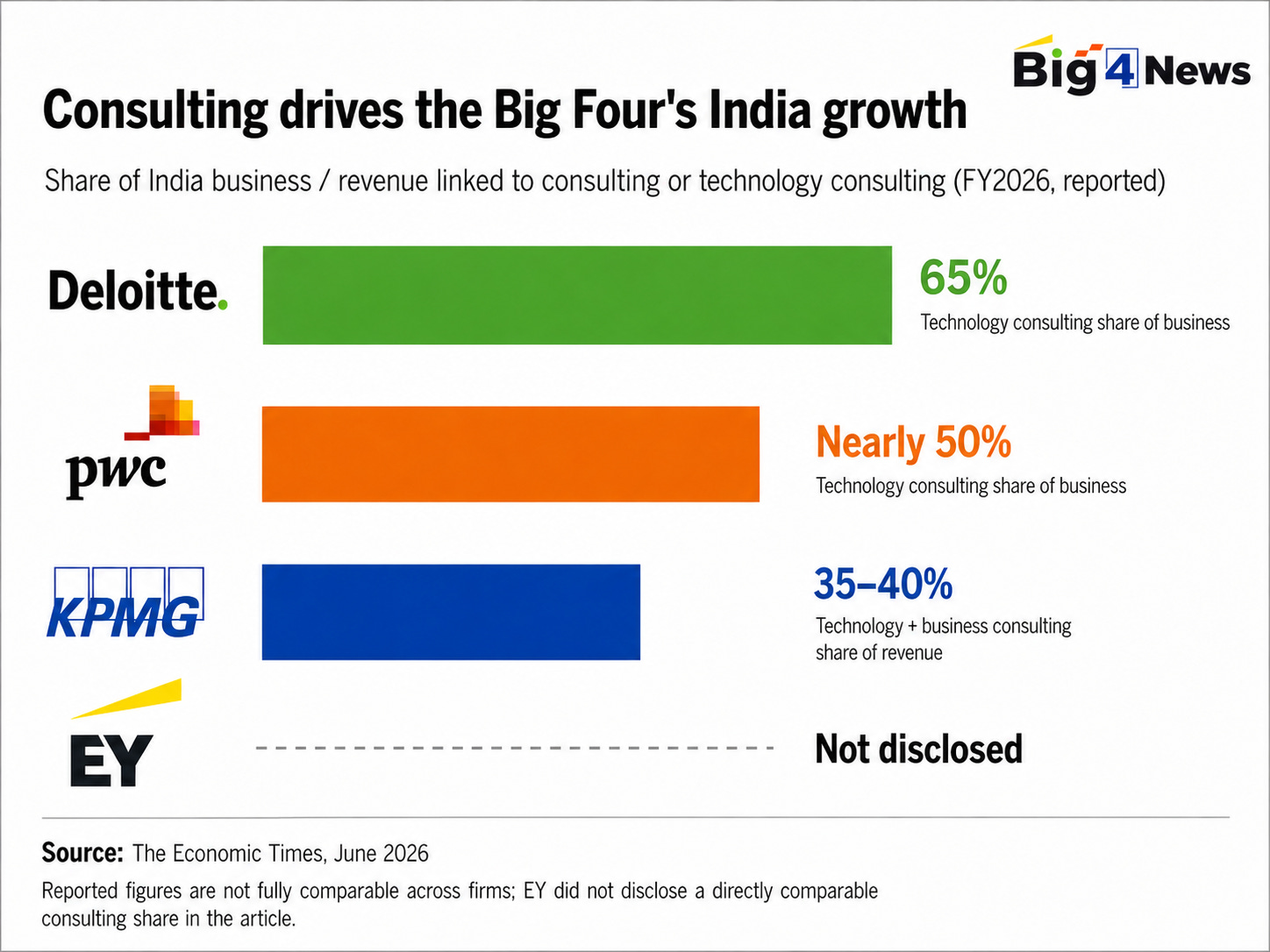
Technology consulting accounts for nearly half of PwC India’s business and around 65% of Deloitte’s. KPMG does not disclose separate technology numbers, but consulting, which includes technology, constitutes 35–40% of its overall revenue.
Deloitte is the clear leader in this area. It has expanded its technology consulting footprint, widened its client base, and invested in new technology platforms and innovation centres. The investment appears to have paid off: Deloitte South Asia generated nearly ₹19,000 crore (~US$2.0 billion) in sales in FY26 and had a pipeline of close to ₹34,000 crore (~US$3.6 billion).
The GCC Surge
Much of this growth is connected to GCC-related work. Global Capability Centres allow multinational companies to concentrate technology, finance, analytics, operations, compliance, product development and other corporate functions in India. The Big Four are competing to help clients design, build, expand and upgrade these operations.
The numbers show how important this has become. GCCs bring in 25% of PwC’s technology consulting revenues, 40% of Deloitte’s and 35% of EY’s.
The scale of this investment should not be underestimated. The Big Four are not merely adding headcount in India. They are building technology capacity, expanding delivery platforms, deepening sector expertise and positioning India as a central node in their global operating models.
That is why the boom matters. But it is also why the risks matter.
Why Big Four India Revenue Figures Need Caution
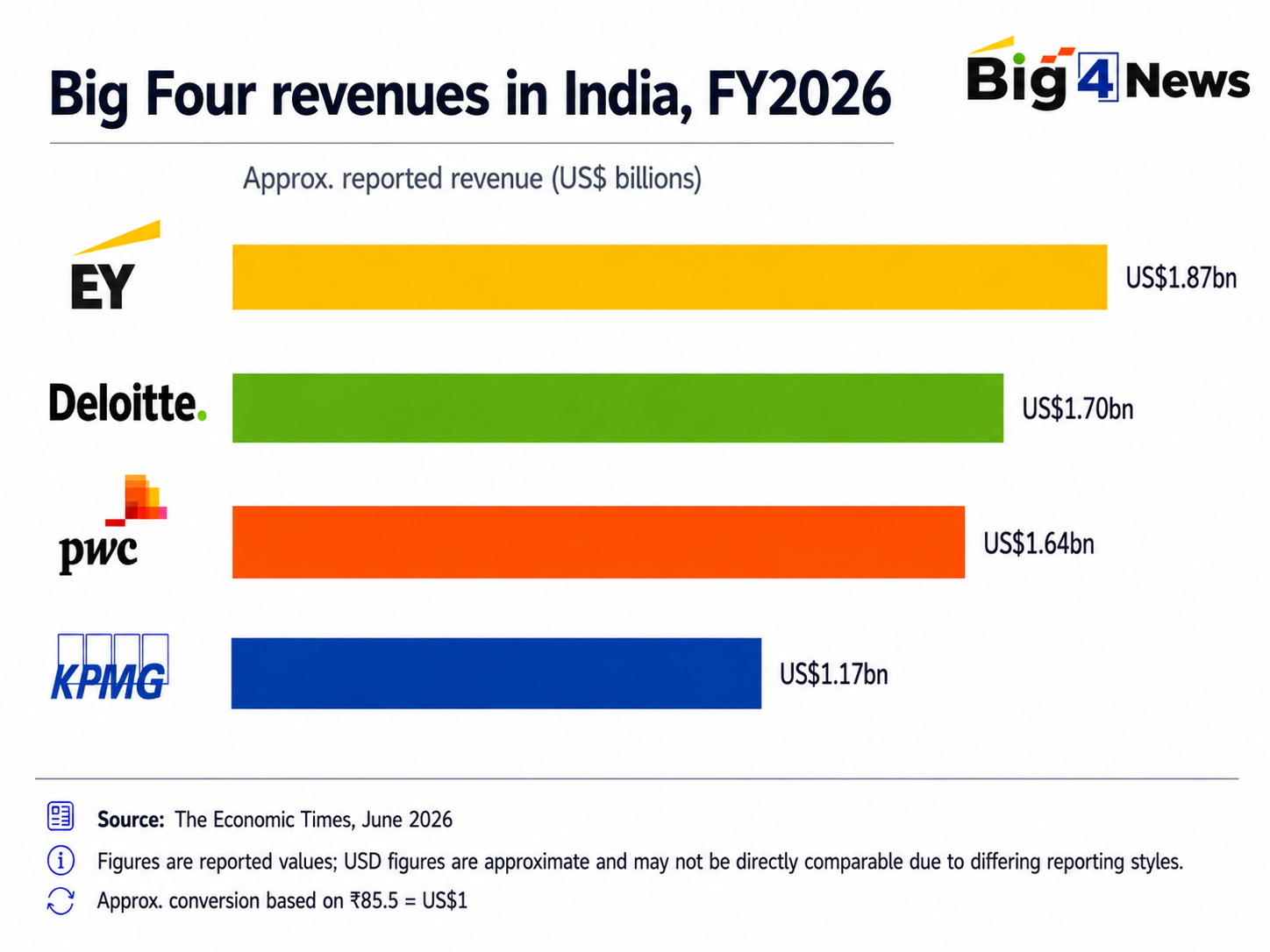
The Big Four in India are locked in an intense competition to outdo each other, but their headline revenue figures are not always directly comparable. The Economic Times reports that the firms sometimes use expansive approaches to headline revenue reporting, including items such as out-of-pocket expenses billed to clients, GST, royalties, subcontracted work, global delivery centre revenues and even one-off asset sales.
Some of these items are arguable. Reimbursed expenses and subcontracted work can depend on the structure of the arrangement and whether the firm is acting as principal or agent. But the Goods and Services Tax (GST) is different.
Professional services in India are generally subject to 18% GST. That tax is collected from the client and remitted to the government. Under ordinary revenue-recognition principles, amounts collected on behalf of third parties are not revenue. They are pass-through amounts.
That makes the reported inclusion of GST in headline revenue perplexing. These are accounting and audit firms whose own audit practices require clients to separate revenue from taxes collected for the state. Yet when discussing their own performance, at least some appear willing to report numbers that include an 18% consumption tax.
A one-off asset sale raises a different, but related, presentation problem. The proceeds or gain may belong to the firm, but they are not generated by audit, tax, consulting or advisory work. Under normal accounting treatment, a property disposal gain would be reported separately, not folded into operating revenue.
Nonetheless, according to The Economic Times, KPMG’s FY26 revenue included royalties, a one-off asset sale and revenue from KDN, its global delivery centre. Those inclusions may have helped KPMG cross the $1 billion mark, but they also underline the core problem: headline revenue is being used in a way that makes the firms look larger while making their numbers harder to compare.
The result is that headline performance reporting becomes competitive posturing.
This does not undermine the broader growth story. India’s Big Four boom is clearly being driven by real demand. But it does mean that the headline numbers need to be read with care.
According to ET, these inclusions can create a 10% to 25% variation between headline revenue and core revenue. Once they are excluded, the combined core India revenue of the Big Four lands at approximately US$6.2 billion.
Can the GCC Model Move Up the Value Chain Fast Enough?
The Big Four are clearly investing heavily in the market. However, there is a danger that the relentless competition to be the biggest and the fastest-growing could direct funds towards investments that will pay off in the short term, as opposed to ones where the return could take years to crystallise.
This is where the GCC boom becomes especially important. GCCs offer the Big Four a powerful combination: scale, skilled labour, lower delivery costs and strong client demand. That makes them attractive growth engines.
It also creates a strategic challenge. The current GCC model is highly valuable, but the market is changing quickly. AI will alter how much human labour is needed for some forms of process-heavy work. It will also increase demand for higher-value services: AI governance, model oversight, cybersecurity, data architecture, enterprise automation, product development, complex transformation work and human judgment around risk and controls.
The Big Four know this. They are not ignoring the shift. Significant investments in AI readiness and delivery capability are already underway in India. Deloitte, for example, has trained tens of thousands of its Indian professionals in AI tools and applications, while the other firms are also building AI-enabled platforms and upskilling delivery teams in their Indian operations.
The question, then, is not whether the firms are investing. They are. The question is whether the profitability and scale of the current GCC model will delay their move up the value chain.
That transition requires more than headcount. It requires senior expertise, deep training, judgment, supervision and the willingness to absorb short-term costs for longer-term capability. It is less immediately scalable than adding thousands of people to support the current delivery model.
This is the strategic risk inside the boom: not that the Big Four will fail to see the future, but that the present may remain profitable enough to slow the harder transition toward it.

The Quality Question
There is a second, related risk: quality.
Deloitte’s reported pace of hiring roughly 1,000 people per month is extraordinary. While this enables the firm to capture market share quickly, aggressive expansion creates pressure on training, supervision, quality control and culture.
In professional services, quality depends heavily on experience, judgment, mentorship and consistent standards — all of which take time to develop and transmit. When headcount grows at this velocity, training and onboarding become harder to deliver at the required depth. Mentorship and supervision get stretched. Cultural dilution becomes a genuine possibility, as new joiners have less opportunity to absorb the firm’s standards and ways of working.
Maintaining quality thus becomes one of the central management risks of growth at this speed.
This tension is fundamental. The very attributes that make India attractive as a growth engine — the ability to scale rapidly and cost-effectively — can, if not carefully managed, undermine the quality that underpins the Big Four’s reputation and ability to command premium fees.
The Real Test
India is now one of the Big Four’s most important growth markets. But the race to dominate India is not risk-free. The same competitive pressure visible in headline revenue reporting is also visible in how aggressively capacity is being built. Growth at this scale requires more than ambition. It requires transparency, discipline, quality control and patience.
That is the real test of the India boom. Not whether the Big Four can keep hiring, keep expanding and keep reporting larger numbers. They almost certainly can. The harder question is whether they can build something durable: a business that grows quickly without blurring its numbers, diluting its culture, weakening its quality controls or postponing the investments needed for the next stage of professional services.
India may be the Big Four’s great growth story. Whether it becomes a sustainable one will depend on how carefully the firms manage the risks created by their own success.
Trying to keep up with technology at Deloitte, PwC, EY and KPMG? Start here →
https://www.big4news.com/t/technology-and-ai
About Claudine Cassar

I’m a corporate anthropologist and former Deloitte equity partner. I sold my technology business to Deloitte in 2016 and led the Malta Consulting team for five years. I now write Big4News, providing independent, clear analysis of PwC, Deloitte, EY, and KPMG — free from corporate spin.
Find me on LinkedIn, X, Instagram, or my author website.
You can also email me.
Feel free to reply to this newsletter — I read every reply.