


This timeline is a live document and continues to be updated as new developments emerge. Last updated: 10 October 2026
The KPMG Australia scandal began with a whistleblower’s 2024 allegations that senior partners misused confidential Lendlease board documents to gain an unfair edge in winning major audit mandates, including Westpac.
The story exploded into the open in 2026 after parliamentary revelations, a firm admission that internal investigations “fell short,” multiple leadership exits, fresh admissions of further breaches (including Optus-related material), regulator action, and mounting client and government fallout.
It also fits a broader Australian pattern, in which the Big Four have been forced to confront the consequences of treating confidentiality, independence, and oversight as problems to manage after the fact rather than standards to protect from the start.
The scandal has put reform back on the table, reviving and extending proposals first canvassed after the PwC tax leaks scandal — including tougher independence rules, stronger whistleblower protections, tighter oversight and a harder line on separating audit from consulting.
Timeline of a Scandal
November 2022 — Eight months after joining the Macquarie board, and following a 37-year career at KPMG, Michelle Hinchliffe gives a fireside chat to KPMG audit partners at a two-day conference at Q Station in Manly. The discussion covered audit quality, how rival firms perceived KPMG, her transition into non-executive roles and other audit matters.
May 2023 — Eileen Hoggett authorises another KPMG executive to view printed Lendlease board material kept in her locker to assist KPMG in pursuing work from Australian Unity. The email would later become significant evidence in investigations into KPMG’s handling of confidential client information.
”I think we confidentially allow him to look at the printed version in my locker when he is back in Sydney. He needs to do it sensitively without letting too many people know 😊.”
Email sent by Eileen Hoggett in May 2023
June and August 2023 — KPMG personnel twice access a Lendlease folder containing confidential audit-pitch documents submitted by rival firms EY and PwC, according to findings from a later Allens investigation. The material later becomes part of KPMG’s preparations for its attempt to win the Westpac audit.
September–December 2023 — During the Senate consulting inquiry, then-CEO Andrew Yates denies that KPMG engages in “power mapping or any similar practice”, despite senators presenting a KPMG-branded relationship map identifying 72 decision-makers within Transport for NSW and categorising the strength of KPMG’s relationships with them. After further correspondence, Yates maintains that the document should not be characterised as a power map, although KPMG acknowledges producing relationship documents.
10 October 2023 — Seven people from KPMG’s audit business meet to help prepare partner Kim Lawry for the Westpac audit tender. During the meeting, confidential material taken from Lendlease board papers is displayed, including an assessment of rival bids submitted by EY and PwC.
“WBC- Eileen sharing EY/PWC feedback from Lendlease tender.”
Calendar invitation for the 10 October 2023 meeting
6 November 2023 — The “Lunchgate” incident occurs at KPMG’s Barangaroo office, during KPMG’s pursuit of the Dexus external audit. According to the whistleblower, partner Jeff O’Sullivan said he would go to lunch and leave his laptop open on confidential Dexus internal-audit material so members of the bid team could view it. KPMG later said the remark was intended as a joke and that it found no evidence the information was actually shared, but sanctioned O’Sullivan for making an inappropriate remark.
Late 2023–March 2024 — Westpac audit tender raises questions about relationships and perceived conflicts. During Westpac’s audit tender, Peter Nash, Westpac’s audit committee chair and a former KPMG Australia national chairman, attended audit pitch meetings. KPMG chair Martin Sheppard later told a parliamentary hearing that Nash had stayed at his house during the pitching process, describing him as a long-standing friend. Westpac said Nash declared his KPMG links and was not on the selection committee, but later acknowledged the perception of bias created by those relationships.
8 March 2024 — Westpac selects KPMG as its preferred external auditor for the 2025 financial year, replacing PwC, subject to KPMG becoming independent, regulatory consent and shareholder approval.
May 2024 — Macquarie issues a public statement saying it would tender its external audit at least every ten years, with the first tender to occur no later than 2026. Separately, Macquarie later disclosed that during 2024 Hinchliffe introduced KPMG director Charles Hatchman to members of the Macquarie team, and Hatchman provided informal guidance on how an audit tender could be conducted. KPMG said it had provided similar informal guidance to other companies.
30 May 2024 — A KPMG audit director makes a formal internal disclosure about the alleged misuse of confidential client board papers and other concerning conduct.
30 May 2024 — Julian McPherson, then head of audit, authorises a search of the whistleblower’s work laptop. McPherson later tells the parliamentary inquiry that KPMG was concerned the individual might share firm information externally while considering other employment.
July 2024 — According to the whistleblower, KPMG tells him that he must relocate or his position will be terminated, within weeks of his disclosure. He alleges that the firm treats the disclosure as an employment dispute and begins pushing him out.
21 and 26 November 2024 — KPMG conducts further searches of the whistleblower’s laptop without his knowledge. IT personnel locate two documents setting out additional allegations concerning the misuse of client information. The documents are copied and distributed to then-CEO Andrew Yates and senior figures in audit and human resources.
November 2024 — KPMG wins the Dexus audit engagement.
Late 2024 — The whistleblower attempts to escalate his concerns directly to KPMG’s independent board members. According to later reporting, then-chair Martin Sheppard instructs directors to direct communications concerning the matter to general counsel Louise Capon.
13 December 2024 — Westpac formally appoints KPMG as its external auditor with effect from the end of the bank’s annual general meeting, completing the auditor transition first announced in March.
January 2025 — KPMG engages Ashurst to advise on an employment matter connected with the whistleblower. KPMG later cites Ashurst’s work when describing its external review of the allegations, but Ashurst tells the June 2026 parliamentary hearing that it was never engaged to examine the substance of the whistleblower’s claims and did not conduct such an investigation.
February–August 2025 — Ashurst provides KPMG with a series of legal advice and reviews concerning the whistleblower matter, with subsequently published documents dated 24 February, 9 May and 19 August. The work includes reviewing KPMG’s response to the allegations and advising on whistleblower protections and the former employee’s settlement deed.
The 9 May advice (document attached below) records allegations that an advisory partner provided an audit partner with access to confidential papers, and that commercially sensitive information about a competitor was used to gain an advantage in a tender. It then states:
“We are instructed that KPMG investigated those matters and found them to be false and misleading.”
Ashurst, Advice in relation to claims made by former employee, 9 May 2025
That statement records what KPMG told Ashurst, rather than an independent finding by Ashurst that the allegations were false. The advice describes its account of the background as based on file notes of discussions and information supplied by KPMG.
Ashurst also distinguishes the statutory whistleblower regime from KPMG’s own commitment to investigate concerns:
“The whistleblower regime does not require that any particular action (such as an investigation as [the former employee] wrongly asserts in the course of his email correspondence) is undertaken following receipt of a qualifying whistleblower disclosure. However, KPMG’s Whistleblower Policy does say that KPMG will promptly investigate any reasonable report of a concern.”
Ashurst advice, 9 May 2025
The advice acknowledges that the ethical concerns appear, on their face, to concern disclosable matters, but says the former employee has provided insufficient detail to determine whether they qualify for statutory protection or to enable KPMG to investigate further.
It also considers the consequences of taking the allegations to Parliament or the media without satisfying the statutory requirements for a protected public-interest disclosure:
“Such a disclosure may also constitute a breach of his obligations under the Deed, which KPMG could seek to enforce.”
Ashurst advice, 9 May 2025
Under “Next steps”, Ashurst writes:
“There is not going to be any easy way to finalise this matter and put an end to [the whistleblower’s] incessant communications.”
Ashurst advice, 9 May 2025
The same paragraph recommends that KPMG tell him it is not trying to silence him, takes his concerns seriously and encourages him to supply further details so that it can examine the matters.

March 2025 — Macquarie’s formal audit tender process begins, running to November 2025. It later emerges that Hinchliffe recalled three interactions with KPMG pitch-team personnel during that period. The first was in March, when she and her husband had been due to dine with KPMG director Charles Hatchman and his wife; Hatchman briefly attended the restaurant after his wife became ill, to excuse them both.
Hinchliffe also attends early-stage audit-pitch meetings in Sydney and London and is later reported to have been the only Macquarie director attending the presentations; Macquarie says she does not score the bids and recuses herself from the final appointment decision.
May 2025 — The whistleblower raises the allegations with international chair Bill Thomas and global general counsel Anne Collins. Global leadership declines to open its own investigation at that time and refers the matter back to the Australian firm.
May 2025 — Michelle Hinchliffe meets then-KPMG Australia chairman Martin Sheppard in her capacity as a BHP director and, separately that month, she and her husband share a meal with KPMG audit partner Patricia Stebbens and Stebbens’s daughter. Both occurred while KPMG was bidding for the Macquarie audit.
Around July 2025 — KPMG’s employee-relations conduct panel concludes that there is sufficient information to sanction senior partners Eileen Hoggett, Kim Lawry and Paul Rogers over the handling and sharing of confidential Lendlease information. The panel recommends financial penalties, but Andrew Yates argues against the sanctions and action is delayed.
19 August 2025 — KPMG receives detailed correspondence from the whistleblower setting out further allegations, identifying individuals and describing specific incidents involving confidential client information. Matters raised in the letter subsequently form part of the allegations referred to Allens under Project Magenta.
9 September 2025 — KPMG commissions law firm Allens to conduct another review of the whistleblower’s allegations. The investigation is codenamed Project Magenta and is overseen by a subcommittee of KPMG’s board, which approves its scope and methodology.
7 November 2025 — Macquarie Group announces that KPMG will replace PwC as its auditor following an 18-month transition, subject to shareholder approval.
The decision followed the formal tender conducted from March to November 2025. Hinchliffe attended presentations but Macquarie says she did not score competing firms and recused herself from the final decision because of her former KPMG relationship.
The appointment later comes under scrutiny after the whistleblower raises concerns about independence and integrity during KPMG’s pursuit of the mandate.
12 December 2025 — Allens delivers its Project Magenta report. The review is based on 14 interview sessions with senior KPMG partners and directors, 13 of which last approximately 30 minutes.
Allens does not interview the whistleblower, junior staff, affected clients, rival audit firms or other key external witnesses. The report states that the whistleblower had not been willing to provide further information or evidence to KPMG or Allens.
“Based on our conversations with Ms Hoggett, Mr Rogers and Ms Lawry, their positions of authority and accountability as the lead partners for the Lendlease audit and Westpac audit tender respectively, and our findings as to their credibility, we concluded it was not necessary or proportionate to interview members of their teams or to ascertain the recollections of others who attended the meeting.”
Allens, Project Magenta Final Investigation Report, p. 10
The investigation also does not include a comprehensive review of emails and digital records. In examining the alleged circulation of Lendlease board papers, Allens explains:
“Given this, and given their credibility, we have assessed it to be disproportionate and unnecessary to attempt to undertake a review of mailboxes and other communications channels to seek to prove whether Lendlease board papers were communicated via email or some other channel that might leave a record of the circulation.”
Allens, Project Magenta Final Investigation Report, p. 10
Nevertheless, Allens finds that confidential Lendlease information was shared with KPMG’s Westpac audit tender team without Lendlease’s authorisation. Although Allens does not inspect the underlying evaluation document itself, it concludes from the interview accounts that the document constituted confidential information:
“Sharing it with the Westpac external audit team, however fleetingly on screen, was not authorised by Lendlease”.
Allens, Project Magenta Final Investigation Report, p. 17
Its overall conclusion is explicit:
“We conclude that the Lendlease Audit Assessment Criteria Document should not have been shared on screen (or at all) with the Westpac audit tender team.”
Allens, Project Magenta Final Investigation Report, p. 18
However, Allens also concludes that no competitive advantage resulted and that the information was not particularly sensitive. It does not substantiate the broader allegation that board papers were stolen and circulated extensively to secure audit contracts.
Despite its acknowledgement of unauthorised sharing, the report’s summary table labels the Lendlease allegation “Not substantiated”. KPMG subsequently relies on the report in its internal and external responses to the allegations.
24 March 2026 — Senator Deborah O’Neill uses parliamentary privilege to make the whistleblower’s allegations public, triggering national scrutiny.
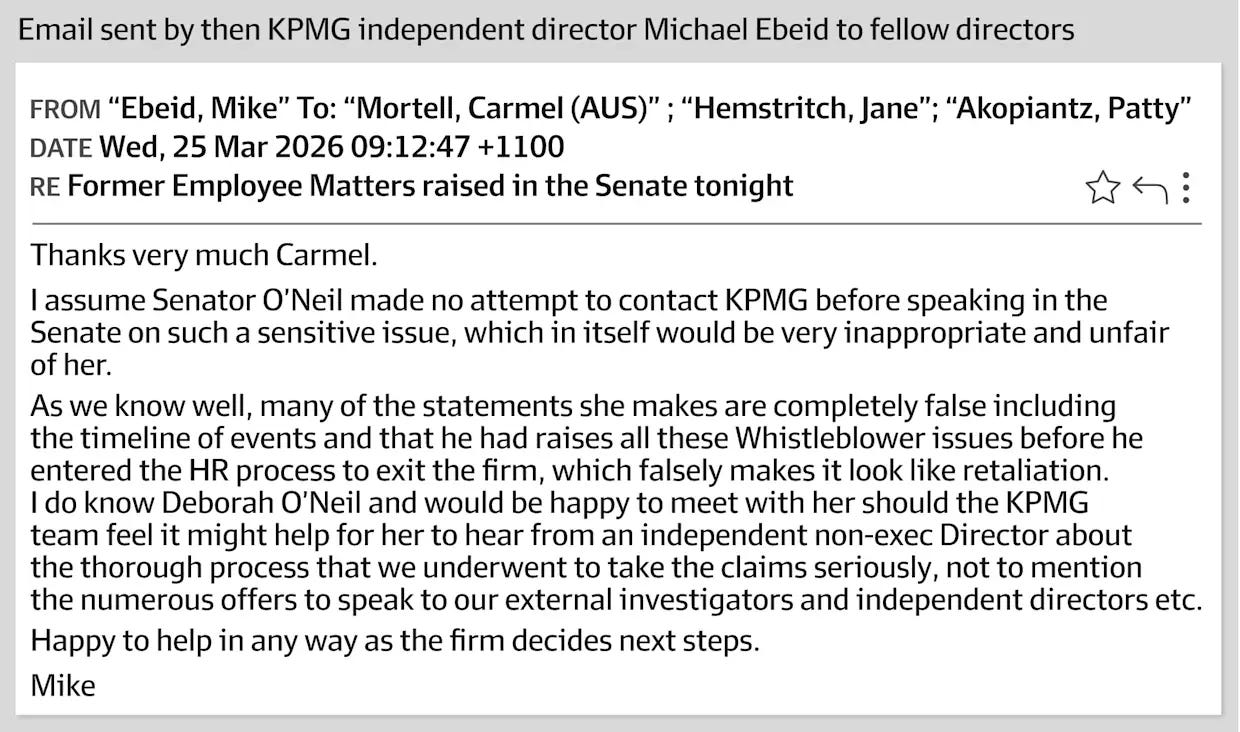
25 March 2026 — Michael Ebeid, then an independent director involved in KPMG’s response to the allegations, emails other directors after reading O’Neill’s speech. He describes many of her statements as “completely false” and says her conduct was “very inappropriate and unfair”. The email does not become public until July.
April 2026 — ASIC begins preliminary inquiries into the conduct of three registered company auditors connected with the allegations.
9 April 2026 — KPMG finally imposes financial sanctions on Hoggett, Lawry and Rogers over the Lendlease and Westpac conduct. The penalties come months after the internal conduct panel first recommended action and shortly after the allegations become public. The penalties imposed on Hoggett and Lawry are reportedly reduced from the amounts originally recommended.
30 April 2026 — KPMG provides the parliamentary committee and regulators with a “Summary of Events” and “Summary of Factual Findings” based largely on the Project Magenta process. The documents present the whistleblower’s allegations as unsubstantiated or unsupported by sufficient evidence and devote substantial attention to his employment, performance and proposed relocation. The submission is later criticised for failing to provide a complete account of misconduct already identified within the firm.
14 May 2026 — Published parliamentary correspondence reveals that KPMG had admitted an audit partner improperly accessed and displayed two documents from Lendlease’s board papers while the firm was pursuing Westpac’s audit. In a letter dated 30 April, Lendlease chief executive Tony Lombardo records KPMG’s admission and describes the conduct as unacceptable. KPMG had told Lendlease that the documents were of “low sensitivity” and provided “zero competitive advantage”.
27 May 2026 — Senior Department of Finance officials confront KPMG over its failure to proactively notify the Commonwealth about the allegations under new significant-event disclosure rules. A meeting originally planned as a routine “meet and greet” becomes a formal interrogation, and Finance warns that possible responses include intensified monitoring, a voluntary restriction on bidding or suspension from the government’s management-advisory panel.
By 29 May 2026 — KPMG confirms that it has internally sanctioned Jeff O’Sullivan, its head of internal audit services, over a remark made during the firm’s successful bid for Dexus’s external audit. According to the whistleblower, O’Sullivan said he would leave his laptop open with confidential Dexus internal-audit material visible while he went to lunch. KPMG concludes that the remark was intended as a joke and says it found no evidence that the information was accessed, shared or used, but penalises O’Sullivan for making an “inappropriate informal remark”. The adequacy of the investigation is later questioned after it emerges that investigators did not interview anyone from Dexus or several members of KPMG’s audit-bid team.
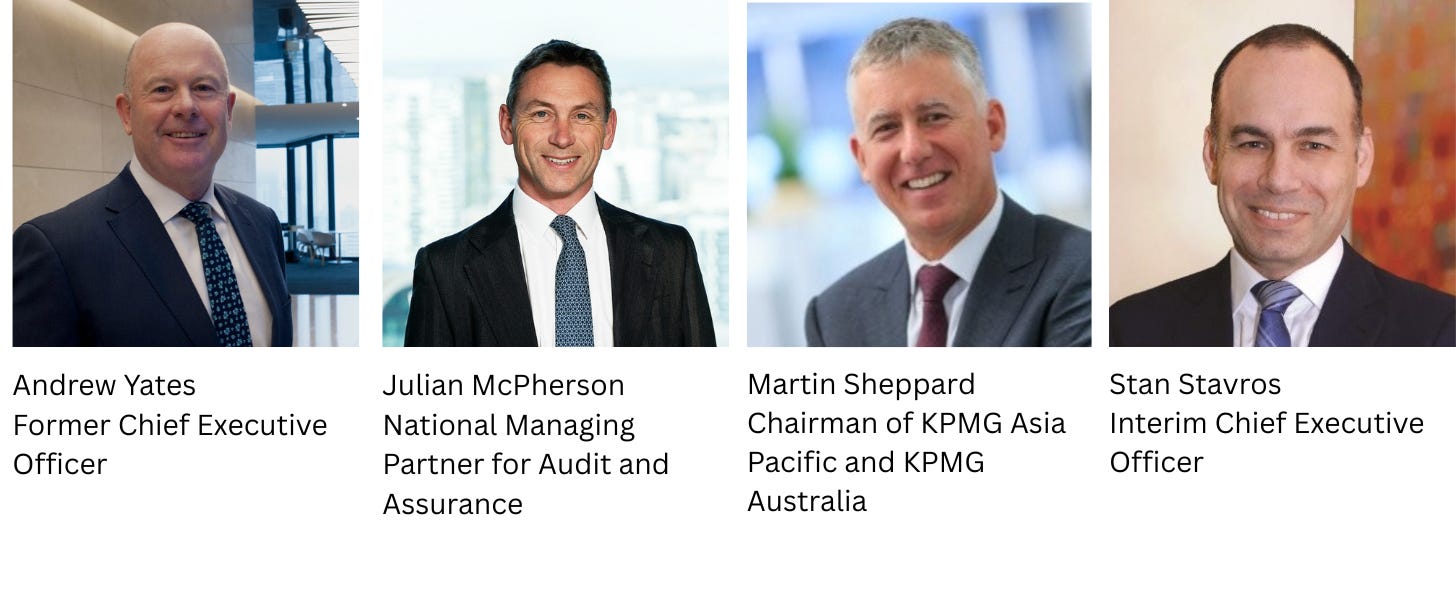
29 May 2026 — CEO Andrew Yates and national managing partner of audit Julian McPherson resign. Yates's resignation as CEO is effective immediately. McPherson stands down immediately as National Managing Partner, Audit & Assurance and is to resign from the firm after an orderly transition of client responsibilities. Stan Stavros is appointed interim CEO. KPMG says the appointment is temporary while the firm continues the process of selecting a permanent successor.
29 May 2026 — The Parliamentary Joint Committee on Corporations and Financial Services decides to hold a public hearing into KPMG’s handling of the whistleblower allegations. The hearing is scheduled for 19 June and will summon senior KPMG leaders, clients, independent directors, law firms and regulators.
31 May 2026 — KPMG asks for the parliamentary examination of the scandal to be conducted behind closed doors and invokes legal professional privilege over internal investigation material sought by Parliament and ASIC. The position prompts criticism from committee members about whether privilege is limiting scrutiny of KPMG’s handling of the allegations.
1 June 2026 — Reporting reveals that independent directors Mike Baird, Jane Hemstritch and Patty Akopiantz had demanded that KPMG commission another investigation after receiving additional information that demonstrated the inadequacy of its earlier reviews. The intervention ultimately led to Project Magenta, although Baird subsequently left the board.
2 June 2026 — The Victorian government begins reviewing approximately $24 million in current KPMG contracts amid concern about the firm’s handling of confidential information. Other state governments also seek assurances that their information and engagements have not been affected.
2–5 June 2026 — The Reserve Bank prepares to replace KPMG as provider of its FairCall whistleblower hotline. Newly released RBA documents show that KPMG told the Bank on 2 June that it would not be able to renew FairCall beyond 31 December 2026 because revised auditing standard ASA 240 would, in KPMG’s interpretation, create a self-review threat if it continued operating whistleblower services for external audit clients. On 5 June, RBA governor Michele Bullock publicly said the Bank expected to re-tender the service.
3 June 2026 — Eileen Hoggett, KPMG Australia’s former chief operating officer, steps down from her senior role after Andrew Yates and Julian McPherson resign.
4 June 2026 — Reports emerge that partners are seeking to leave KPMG as the scandal threatens client relationships, partner capital and career prospects. KPMG’s leadership tells the partnership that the crisis is being managed.
4 June 2026 — The Financial Times reveals that KPMG International repeatedly declined to conduct its own investigation after the whistleblower approached global chair Bill Thomas and global general counsel Anne Collins in May 2025. KPMG International argued that it lacked sufficient evidence and could not compel the legally separate Australian partnership to act. Freshfields subsequently advised that disciplinary responsibility rested with KPMG Australia and that the global organisation’s role was one of oversight rather than control.
5 June 2026 — ASIC confirms formal investigations into registered company auditors Eileen Hoggett and Paul Rogers and says it is conducting preliminary inquiries into other individuals connected with the allegations.

5 June 2026 — The federal Department of Finance classifies the scandal as a “significant event” and places more than $270 million in Commonwealth contracts with KPMG under heightened scrutiny. Government agencies can require KPMG to certify that individuals associated with the misconduct are not working on their engagements.
5 June 2026 — Client fallout begins to become concrete. Dexus says Hoggett will not sign its 2026 accounts, while Rest Super, one of Australia’s largest superannuation funds, seeks further information from KPMG.
8 June 2026 — KPMG International is reported to have blocked or delayed further partner exits amid concern about disruption to audit work, the repayment of partner capital and the risk of the local crisis accelerating.
9 June 2026 — The witness list for the 19 June parliamentary hearing becomes public. It includes 13 current and former KPMG partners, together with Lendlease executives, representatives of Ashurst and Allens, independent directors and ASIC officials. The final programme ultimately comprises more than 30 witnesses.
11 June 2026 — Chartered Accountants Australia and New Zealand orders a practice review of ethics and confidential-data handling at KPMG, Deloitte, EY, PwC and four other large professional firms. The intervention broadens the fallout from an investigation of individual KPMG partners to a review of controls across the major accounting firms.
12 June 2026 — Macquarie Group declines to provide evidence to the parliamentary inquiry about its audit tender, while Dexus summons KPMG chairman Martin Sheppard to explain the alleged misuse of its confidential information. The contrasting responses intensify scrutiny of how affected clients are dealing with the allegations.
15 June 2026 — KPMG agrees with the Department of Finance not to bid for new Commonwealth work from 16 June to 30 September while the government reviews the firm’s culture, ethics, integrity and governance. The restriction does not apply to existing contracts or permitted extensions.
15 June 2026 — Lendlease announces it will change auditor, representing the first major public client loss tied to the scandal.
16–17 June 2026 — State procurement restrictions widen. Western Australia says KPMG will not tender for new state contracts from 16 June until at least 30 September. In New South Wales, a Procurement Board direction effective 17 June suspends new procurements involving KPMG and imposes approval and reporting requirements on certain existing and in-flight engagements.
16 June 2026 — One day after the federal government announces the pause on new KPMG bids, the Department of Defence approves a $9 million extension to an existing KPMG contract. The government explains that the restriction applies only to new work, not extensions to existing contracts. The extension increases the value of the engagement to approximately $21.7 million.
16 June 2026 — Greens refer KPMG to the National Anti-Corruption Commission.
17 June 2026 — KPMG and its lawyers refuse to comply with a parliamentary committee request for internal investigation documents, asserting legal professional privilege and arguing that a court should determine whether the documents must be disclosed.
18 June 2026 — Details of KPMG’s internal sanctions become public. Eileen Hoggett is fined approximately $40,000, Kim Lawry $19,000 and Paul Rogers $22,000 over their handling or viewing of confidential Lendlease material. Evidence later given to parliament shows that the proposed penalties for Hoggett and Lawry had been reduced after intervention by Andrew Yates.
19 June 2026 — The parliamentary committee holds an 11-hour public hearing at which KPMG leaders, Lendlease executives, independent directors, lawyers, professional bodies and ASIC officials give evidence.
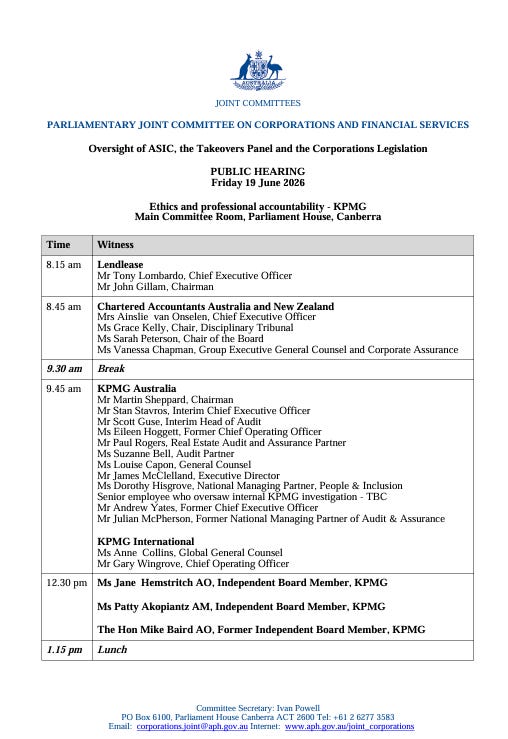
19 June 2026 — During the hearing, KPMG acknowledges further breaches, including the internal sharing of confidential Optus information in the context of a Telstra bid.
19 June 2026 — Ashurst tells the parliamentary inquiry that it was not engaged to investigate the substance of the whistleblower’s allegations and did not conduct such an investigation. The evidence contradicts repeated statements by KPMG that Ashurst had investigated the claims and found no wrongdoing.
19 June 2026 — During the parliamentary hearing, incoming KPMG International Global Chairman and CEO Gary Wingrove personally apologises for the whistleblower’s treatment. In a statement to the committee, the whistleblower argues that KPMG International’s refusal to investigate represents the scandal’s most serious failure and exposes a gap between the global organisation’s whistleblowing promises and its willingness to intervene in a member firm.
19 June 2026 — After hours of questioning and criticism from its own independent directors, KPMG reverses its refusal to disclose documents and agrees to provide the internal investigation material to the parliamentary committee.
19 June 2026 — ASIC chair Sarah Court describes KPMG’s conduct as an “egregious and serious breach of trust” and tells the parliamentary inquiry that ASIC needs powers to regulate and take action against large accounting firms themselves, rather than being limited largely to individual registered auditors.
22 June 2026 — KPMG Australia’s debt position comes under scrutiny, with reporting pointing to pressure from client losses, revenue covenants and the risk of partner exits.
23 June 2026 — Findings from KPMG’s latest Allens investigation become public, confirming that KPMG personnel accessed EY and PwC audit-pitch documents held by Lendlease on two occasions in June and August 2023. The findings substantiate one of the whistleblower’s most serious allegations.
23 June 2026 — KPMG Australia chairman Martin Sheppard announces he will leave the firm after a short transition period and retire from his regional board responsibilities, as part of a broader governance overhaul.
23 June 2026 — KPMG announces that Rogers and Hoggett will leave the firm; that it will appoint its first independent chair and add independent directors; and that it will commission a lessons-learned review, ask Principia Advisory to examine its whistleblowing system, and strengthen controls governing confidentiality and audit pursuits.
24 June 2026 — The Department of Finance appoints former senior public servant Dr Ian Watt AC to conduct an independent, arm’s-length review of KPMG Australia’s culture, ethics, integrity and governance. The review is designed to assess the firm’s “ethical soundness” and is due to report to Finance by 30 September 2026, the same date the federal government’s pause on new KPMG contracts is scheduled to end.
26 June 2026 — Proxy adviser Ownership Matters calls for listed companies to be required to tender their audits at least every ten years, arguing that KPMG’s 68-year relationship with Lendlease illustrates the dangers of excessive auditor tenure. The proposal would threaten several of KPMG’s longest-standing major audit mandates and foreshadows options later included in the Treasury reform paper.
29 June–7 July 2026 — Tax Practitioners Board chair Peter de Cure recuses himself from any involvement in the board’s investigations of KPMG on 29 June. A formal conflict-management plan adopted on 7 July prevents him from discussing the investigation with TPB personnel, participating in related meetings or decisions, or engaging with KPMG about the matter. In a 21 July letter to Senator Deborah O’Neill, de Cure acknowledges that his earlier contact with a KPMG audit partner had not been formally disclosed or recorded. The details become public through media reports at the end of July.
1 July 2026 — The federal government releases a Treasury options paper on reform of the accounting, auditing and consulting sector. Proposals include possible structural separation of audit and consulting, ASIC licensing and direct oversight of large accounting firms, stronger financial penalties, partnership-size restrictions, enhanced governance requirements and mandatory audit tendering and rotation. No timetable for implementing reforms is announced.
1 July 2026 — Westpac non-executive director Peter Nash, a former KPMG Australia national chairman, steps down from the bank’s board amid scrutiny of his KPMG relationships during the Westpac audit tender process. Westpac said Nash had disclosed his links and was not on the selection committee, but acknowledged the perception issue.
1 July 2026 — The AFR reports that KPMG “rainmaker” Evan Rawstron, who managed more than $100 million in contracts, has left the firm.
2 July 2026 — KPMG publicly announces Michael Ebeid as its incoming first independent chairman. He initially serves as a special adviser while the firm seeks partner approval to amend its partnership agreement and formalise his appointment.
2 July 2026 — The parliamentary committee releases Ebeid’s March emails, showing that he described some of O’Neill’s claims as “completely false” and her conduct as “very inappropriate and unfair”.
Ebeid publicly expresses regret after the March email is released, saying he did not know the full facts. He does not, however, apologise directly to Senator O’Neill at this stage.
2 July 2026 — During his first national meeting with partners, Michael Ebeid repeatedly urges them to stop leaking information to the media and to speak more positively about KPMG in front of staff. He acknowledges that he has not been formally installed as chair and has not read the partnership agreement governing his appointment. The AFR subsequently reports that partners were horrified by his performance.
7 July 2026 — Proxy adviser CGI Glass Lewis says Macquarie’s appointment of KPMG is likely to become a flashpoint at the bank’s 23 July annual meeting. Investors are expected to question how potential conflicts involving director and former KPMG partner Michelle Hinchliffe were managed during the audit tender.
9 July 2026 — ASIC launches a sector-wide review of how KPMG, Deloitte, EY and PwC handle internal complaints and whistleblower disclosures. Using compulsory information-gathering powers, the regulator demands documents from all four firms. The review is prompted by KPMG’s handling of the audit-leaks whistleblower and is separate from ASIC’s investigations into individual registered auditors.
10 July 2026 — Details of the previously confidential Project Magenta report become public. The report reveals that Allens relied mainly on short interviews with senior KPMG figures, accepted their credibility partly because of their positions of authority, interviewed no external witnesses and operated within a scope controlled by a KPMG board subcommittee. The disclosures intensify criticism of supposedly independent corporate investigations commissioned and controlled by the organisations they are examining.
13 July 2026 — During a national partner listening tour, Ebeid faces repeated questions about his authority, the board’s role in the failed investigations and the continuing presence of implicated partners in governance positions. Reports emerge that some partners are considering voting against the partnership-deed amendment, supporting a rival candidate or challenging whether the current board can appoint the next CEO.
14 July 2026 — KPMG is reported to be preparing to eliminate several hundred jobs as declining government and private-sector demand hits the firm’s finances. Sources say the eventual number could approach or exceed 1,000. The firm is also considering partner-pay reductions of up to 20 per cent, showing that the scandal has moved from reputational damage to direct financial and employment consequences.
15 July 2026 — A second public hearing into the KPMG scandal is scheduled for 14 August. Potential witnesses include Ebeid, KPMG’s current independent directors, its internal and external lawyers, affected clients, former KPMG partners linked to major audit tenders and the chairman of the Tax Practitioners Board.
16 July 2026 — KPMG’s search for a permanent chief executive narrows to chief financial officer John Sams, Asia-Pacific head of tax and legal Ben Travers and consulting leader Brad Miller. The internal-only shortlist prompts concern among some partners that the firm needs an external leader who is more clearly separated from the management responsible for the crisis. Questions also arise over whether the board can formally recommend a CEO while the national-chair position remains unresolved.
17 July 2026 — Westpac demands that senior partner Kim Lawry be removed from its $32 million-a-year audit because of her role in viewing confidential Lendlease material during KPMG’s pursuit of the engagement. Lawry resigns from KPMG’s national board and partnership, and Brendan Twining replaces her as lead partner on the Westpac audit. Westpac says it intends to retain KPMG as auditor.
17 July 2026 — KPMG imposes a new round of sanctions on seven partners and staff over the misuse of confidential Optus information during the firm’s unsuccessful bid for Telstra’s external audit. The penalties include formal warnings, restrictions on career progression, reduced performance ratings and financial sanctions of up to $180,000. Those sanctioned include former audit head Julian McPherson and another partner who has since retired.
21 July 2026 — The parliamentary committee publishes KPMG’s April summary of factual findings and related internal correspondence. The material shows how the firm relied on the initial Allens review to dismiss the whistleblower’s allegations before later evidence forced it to repudiate key conclusions of that process.
21 July 2026 — KPMG appoints long-serving partner John Sams as chief executive with immediate effect. Sams, who had served as chief financial officer and, since June, chief operating officer, succeeds interim chief executive Stan Stavros. Senators Deborah O’Neill and Paul Scarr publicly question whether appointing another member of existing leadership represents sufficient change.
22 July 2026 — ASIC writes to approximately 2,900 registered auditors warning that it will intensify surveillance and pursue disciplinary or civil action where auditors breach their legal and ethical obligations. The regulator says it will increase scrutiny of conflicts of interest, personal relationships and conduct that may compromise auditor independence, as the KPMG scandal prompts a wider tightening of oversight.
22 July 2026 — The AFR reveals that Ashurst’s confidential August 2025 review had warned KPMG there was “some risk” that the use of Lendlease information during the Westpac audit pursuit breached the firm’s obligations to its client. Despite that warning, KPMG relied on the Ashurst work—together with Project Magenta—to dismiss the whistleblower’s allegations internally and publicly.
23 July 2026 — At Macquarie Group’s annual meeting, chairman Glenn Stevens announces an integrity review of the decision to appoint KPMG as the group’s next auditor. Macquarie says it has made formal inquiries of KPMG following the misconduct findings and leadership departures, raising the possibility that the firm could lose the mandate before it begins the engagement.
24 July 2026 — KPMG expels former chief operating officer Eileen Hoggett from the partnership after Allens uncovers an email showing that she kept printed copies of confidential Lendlease board documents in her locker and authorised access to them by another KPMG executive. KPMG says the newly located evidence contradicted Hoggett’s previous denials, which had influenced information provided to Lendlease, regulators and Parliament.
New chief executive John Sams apologises to the whistleblower and says the evidence will be provided to ASIC, the parliamentary committee, the Department of Finance and Chartered Accountants ANZ. The revelation also intensifies pressure on Michael Ebeid to withdraw as KPMG’s proposed independent chair because of his role in overseeing the investigation that initially cleared Hoggett.
27 July 2026 — KPMG Australia agrees not to bid for new Victorian state work until 30 September 2026.
28 July 2026 — Independent directors had “unrestricted” investigative powers. The Australian Financial Review reports that KPMG Australia chair Michael Ebeid and the other independent directors overseeing the response to the whistleblower allegations had been given “full and unrestricted” powers to investigate the claims, but failed to use those powers adequately. The disclosure intensifies scrutiny of the directors’ oversight of Project Magenta and the investigation’s failure to establish the full facts.
Late July 2026 — disclosed 13 August — Allens discovers a photograph on Kim Lawry’s phone of confidential Lendlease board material. Lawry says she cannot remember taking the photograph or why she did so. The discovery occurs while she is negotiating her departure from KPMG and reopens discussions about her exit terms and possible further disciplinary action. The same investigation also uncovers the May 2023 Hoggett email described earlier in this timeline.
29–30 July 2026 — Reported restructuring expands to about 1,000 positions—roughly 10 per cent of KPMG Australia’s workforce—with changes expected to be implemented in September. KPMG says no final decisions have been made and that it is reviewing its operating model, cost base and workforce requirements.
30 July 2026 — KPMG International chair and chief executive Bill Thomas and global chief operating officer Gary Wingrove travel to Australia to meet partners and clients and support the local firm’s governance and cultural reset. The visit reflects the increasing involvement of KPMG International in the Australian firm’s response.
31 July 2026 — Further gaps reported in Telstra–Optus investigation. The second phase of Project Magenta addressed only allegation 11 of the whistleblower’s 17 allegations. It reportedly did not resolve separate claims that KPMG consultants offered to share a Telstra-issued laptop to extract information or that conversations with Telstra executives were covertly recorded and circulated within the firm. The allegations remain unresolved, and the wider Allens investigation is continuing ahead of the parliamentary committee’s 14 August hearing.
8 August 2026 — Michael Ebeid apologises directly to Senator Deborah O’Neill, more than four months after accusing her of making “completely false” statements about the whistleblower allegations. Ebeid describes his original email as “naive, embarrassing and wrong on every level”, says he is sorry it has taken him so long to apologise, and thanks O’Neill for helping uncover the wrongdoing. The apology comes days before KPMG partners vote on his appointment as independent chairman and less than a week before the second parliamentary hearing.
10 August 2026 — Publication of previously confidential Ashurst and Allens material exposes further shortcomings in KPMG’s response to the whistleblower. Ashurst had been told that the whistleblower supplied only “high-level information”, even though KPMG had secretly accessed his computer six months earlier and obtained documents setting out more than 15 complaints involving multiple named clients. Ashurst consequently assessed the whistleblower’s legal protections on materially incomplete information supplied by KPMG.
The documents also show that KPMG had enough information internally to investigate substantive allegations and later sanction partners, despite providing Ashurst with a much narrower picture of what the whistleblower had disclosed.
11 August 2026 — KPMG general counsel Louise Capon and human resources chief Dorothy Hisgrove finalise negotiated departures from the firm following sustained internal pressure over KPMG’s handling of the whistleblower. Capon steps down immediately from the national executive but remains during a transition, while Hisgrove remains until a replacement is appointed. Chief risk officer Paul Low also steps down from his role but remains with KPMG. New CEO John Sams simultaneously reshapes the national executive as part of what he describes as an effort to sharpen accountability.
12 August 2026 — KPMG’s partnership votes in favour of the required governance changes. The amended Partnership Agreement and the Board’s unanimous appointment of Michael Ebeid as National Chair take effect the same day. The changes proceed despite internal opposition over Ebeid’s role in the board subcommittee that oversaw one of KPMG’s failed investigations into the whistleblower allegations.
12 August 2026 — Treasury closes its consultation on options for regulating accounting, auditing and consulting firms. The process, launched in the aftermath of the PwC tax leaks scandal and given renewed urgency by KPMG’s crisis, canvasses structural separation of audit and consulting, direct ASIC regulation of large firms, governance reform, partnership limits and stronger audit-independence measures.
13 August 2026 — Reporting reveals that KPMG International chair Bill Thomas, KPMG International Global COO and incoming Global Chairman and CEO Gary Wingrove, and global general counsel Anne Collins have declined the parliamentary committee’s request to appear at the 14 August hearing. Their absence renews questions about the accountability of KPMG International for a scandal in which the whistleblower had previously sought help from global leadership. KPMG International says the original request was sent to an email address connected with the Australian firm rather than the global organisation.
13 August 2026 — The Chartered Accountants Australia and New Zealand Disciplinary Tribunal imposes significant interim restrictions on former KPMG partners Eileen Hoggett and Paul Rogers. Both undertake not to provide audit services or act as Registered Company Auditors. They are also required to cancel their Certificates of Public Practice and are prevented from practising as principals while the undertakings remain in force. The restrictions are imposed while regulatory and disciplinary processes arising from the KPMG whistleblower affair continue.
14 August 2026 — The parliamentary committee holds its second major public hearing into the KPMG scandal. The hearing brings together current and former KPMG leaders, representatives of Macquarie, Westpac, Optus and Dexus, and lawyers from Allens and Ashurst, allowing the committee to test KPMG’s previous explanations against evidence from the people who conducted the investigations and the clients affected by the misconduct.
14 August 2026 — KPMG deputy general counsel James McClelland tells the inquiry that his original investigation was undermined by misleading and potentially deceptive answers from unnamed KPMG partners. McClelland says “the truth was not told” during interviews and apologises to the whistleblower. Former CEO Andrew Yates disputes that he broadly shut down the investigation, saying the principal limitation he imposed was that junior staff should not be interviewed; he says that, with hindsight, he would also have asked the legal team to search for email evidence.
During the hearing, Senator Deborah O'Neill also asks KPMG to identify how many previous whistleblower matters were investigated by deputy general counsel James McClelland at Andrew Yates's request without scrutiny from the board or senior general counsel. KPMG undertakes to provide the information.
14 August 2026 — Evidence from Allens and Ashurst complicates the question of who was responsible for the narrow scope of KPMG’s earlier investigations. Allens tells the committee that some controversial omissions—including not conducting a broader trawl of emails or approaching Dexus directly—reflected its own methodological judgments rather than prohibitions imposed by KPMG. Deputy chair Carmel Mortell says KPMG accepted Allens’ advice that the approach was reasonable and proportionate. Ashurst, by contrast, emphasises that its advice was produced within the scope of its instructions and on the information KPMG made available to it.
14 August 2026 — Major KPMG audit clients openly question whether they can continue to trust the firm.
Westpac criticises KPMG’s “drip feed” of information and says the scandal has interrupted its assessment of whether the firm remains fit and proper to conduct its audit.
Optus describes KPMG’s conduct as an egregious and flagrant breach of professional responsibilities and says it has imposed much tighter controls while continuing to use the firm for now.
Dexus says its board will reconsider its relationship with KPMG once it has further information.
14 August 2026 — New CEO John Sams tells the inquiry that KPMG “absolutely failed” the whistleblower and rejects the idea that the scandal can be explained as the work of a few bad apples. Sams says the firm must examine its culture.
Senator Deborah O’Neill tells the hearing that “many, many more” whistleblowers have contacted the committee describing repeat behaviour, while former chairman Martin Sheppard confirms that a separate whistleblower dispute involving KPMG’s tax division was settled in late 2024.
Westpac director Michael Ullmer points to overseas audit-tendering and rotation rules and warns that, when serious problems arise inside partnerships, ownership ultimately gives partners the power to override nominally independent directors.
Optus chairman John Arthur says governance structures designed for corporations cannot simply be grafted onto partnerships and argues that professional responsibilities must take precedence over commercial considerations.
18 August 2026 — KPMG withdraws FairCall from its external audit clients. Newly released Reserve Bank of Australia records reveal that KPMG will stop providing its FairCall whistleblower hotline to organisations it audits as existing contracts expire. KPMG says revised fraud auditing standard ASA 240 creates a self-review threat because auditors will be required to assess clients’ whistleblower programmes. But the disclosure comes amid intense scrutiny of KPMG’s own treatment of a whistleblower, with several FairCall clients reviewing their relationships with the firm and the RBA already preparing to replace KPMG. The decision comes while KPMG’s own whistleblower processes are under intense scrutiny, increasing attention on its FairCall business.
19 August 2026 — ASIC’s scrutiny of KPMG reportedly expands beyond individual registered auditors. According to The Australian, ASIC is now probing various KPMG entities for alleged breaches of Part 9.4AAA of the Corporations Act, which governs statutory whistleblower protections. The development was disclosed in ASIC’s answers to questions on notice from Senator Barbara Pocock and is significant because ASIC had previously emphasised the limits of its jurisdiction over KPMG’s partnership.
19–24 August 2026 — Project Vector moves from reported plans to confirmed cuts. Initial reports indicate that KPMG is considering around 50 partner departures and approximately 450 employee reductions, with earlier reporting having suggested that the restructuring could ultimately affect substantially more positions. On 24 August, KPMG confirms cuts of 27 partners and around 360 employees — approximately 5% of the workforce — mainly from Consulting and Business Services. The firm reports FY26 revenue of A$2.257 billion, down 1%, Consulting revenue down 16.9% and average equity-partner remuneration down 13%. KPMG says its workforce review reflects difficult market conditions as well as “the impact of the firm’s conduct and whistleblower matters”. ABC reports that CEO John Sams said further cuts could follow.
24 August 2026 — KPMG Australia is reported to have sought financial support from KPMG International as pressure on the Australian partnership’s finances intensifies. ABC reports that the firm had sought support from KPMG International “to remain solvent”, while The Australian separately reports that the international organisation is considering potential support of around A$200 million. The development connects the reputational crisis directly to KPMG Australia’s financial resilience, following three consecutive years of declining revenue and substantial existing borrowings.
25–29 August 2026 — Newly released parliamentary material reveals separate historic whistleblower allegations involving former KPMG partners. ABC, reporting on unredacted versions of documents whose redacted forms have been tabled in parliament, says the material includes allegations that former KPMG partner and later ATO commissioner Chris Jordan, together with former partner Wayne Jones, received secret commissions in the late 1990s and used offshore arrangements to avoid tax. The allegations are unproven; ABC says it is not suggesting they are true, and Jordan is understood to have previously denied them. The redacted parliamentary material is available through the Parliamentary Joint Committee.
Further ABC reporting on 29 August identifies former KPMG partner Philip Henry in the same body of historic whistleblower material. The documents contain unproven allegations concerning secret commissions, misuse of client funds and firm resources, inappropriate conduct towards female staff and clients, and the falsification of a 1997 NSW managing-partner election. ABC stresses that it is not suggesting the allegations are true. KPMG declined to comment on Henry specifically; evidence given at the parliamentary inquiry was that KPMG had investigated the historic whistleblower allegations but had been unable to substantiate them because they were “very historic”. The significance of this material to the current scandal is that the parliamentary inquiry is receiving a broader body of KPMG whistleblower allegations, rather than because the historic claims establish additional misconduct in the present confidentiality affair.
26 August 2026 — Macquarie Group abandons plans to appoint KPMG as its auditor and decides to retain PwC. The reversal follows Macquarie’s formal enquiries into KPMG after parliamentary scrutiny of the audit-leaks scandal. Macquarie says it now has concerns about KPMG Australia in two of the key criteria used in the 2025 audit tender: capacity, after several key members of the proposed KPMG audit team departed, and culture, including “a culture that transparently discloses issues”. KPMG had won the mandate in November 2025 and was due to replace PwC from the financial year beginning 1 April 2027.
31 August 2026 — The AFR reports Macquarie’s disclosure of three contacts between Michelle Hinchliffe and KPMG personnel during the audit tender. The information appears in answers submitted to the parliamentary committee on 28 August. At the 14 August hearing, chairman Glenn Stevens had said he had not asked Hinchliffe whether she had contacted KPMG during the tender and was assuming she had not because protocols were in place.
3 September 2026 — Former chief operating officer Eileen Hoggett launches legal action against KPMG Australia in the Supreme Court of New South Wales following her expulsion from the partnership. The court confirms that a summons has been lodged. Hoggett had told the August parliamentary hearing that her expulsion meant losing accrued annual leave, retirement entitlements and her final month’s pay, and questioned why she had been treated differently from other senior partners who left the firm. The matter is listed for its first hearing on 23 September.
4 September 2026 — ASIC tells the parliamentary inquiry that it now has several KPMG investigations underway, covering the alleged misuse of confidential client information, whistleblower victimisation concerns and auditor transparency reports. The regulator is separately investigating whether KPMG’s 2025 Transparency Report contained false or misleading statements, including the firm’s assertion that there had been no whistleblower complaints relating to audit quality. ASIC also says it is examining KPMG-related corporate entities to determine whether the conduct of any directors warrants further regulatory consideration.
4 September 2026 — ASIC reveals that its sector-wide surveillance of audit-conduct complaints has identified 551 internal complaints across KPMG, Deloitte, EY and PwC since 1 July 2023 falling within the information sought by the regulator. ASIC is reviewing the complaints individually to determine whether further investigation or enforcement is warranted. Chair Sarah Court cautions that the figure should not be interpreted as representing 551 serious or substantiated whistleblower matters. The disclosure provides the first indication of the scale of the surveillance exercise ASIC launched across the Big Four following the KPMG scandal.
9 September 2026 — The Department of Finance extends KPMG’s agreement not to bid for new Commonwealth work until 31 October. Ian Watt’s independent review is now due on 9 October, allowing him to consider other reviews expected to report by 30 September. The restriction applies to approaches to market closing between 16 June and 31 October, subject to existing exceptions for ongoing licensing or sales of proprietary products, existing contracts and proposals submitted before 16 June. Finance says it will provide further advice in October.
10 September 2026 — Westpac discloses that, in the first half of 2025, then-KPMG Australia chief executive Andrew Yates had alerted its then-director Peter Nash to a confidential internal investigation, making reference to Westpac’s audit tender. However, Westpac says KPMG did not disclose the specific allegations involved or raise concerns about its audit relationship with the bank. Nash subsequently informed Westpac’s chairman of the substance of the conversation.
17 September 2026 — KPMG publishes the findings of the independent Andrews Group review into its handling of the whistleblower whose allegations triggered the scandal. The review concludes that KPMG failed to protect the whistleblower and identifies an overly legalistic approach to the case. It makes six recommendations, all of which KPMG accepts. These include appointing an independent whistleblower protection officer, establishing an in-house integrity office, conducting a full review of KPMG Australia’s whistleblower programme, strengthening its Ethics Champions Network and examining cultural factors that contributed to the failures. The review also recommends that KPMG advocate for stronger statutory whistleblower protections.
18 September 2026 — Insurance Australia Group (IAG) announces that KPMG will not be invited to participate in its next external-audit tender, bringing to an end an audit relationship dating back to IAG’s ASX listing in 2000. IAG says it will conduct a competitive tender during the 2027 financial year and explicitly attributes the decision to auditor tenure rather than to the whistleblower scandal. Nevertheless, the decision adds another major listed company to the client losses confronting KPMG following the controversy. IAG paid KPMG A$11.576 million in FY2026, including A$9.587 million for audit services.
18 September 2026 — Newly disclosed correspondence reveals that KPMG continues to claim legal professional privilege over 74 documents sought by ASIC as part of its investigations. The documents comprise 68 items among 1,579 documents associated with material considered by KPMG’s independent directors, plus six documents relating to particular engagements. The firm has indicated that it is prepared to provide the remaining material under a proposed voluntary disclosure agreement. ASIC says it has not yet pressed KPMG to hand over the documents while those arrangements are being discussed, but may pursue them as its investigations progress.
18 September 2026 — KPMG pays partners belated profit distributions for the previous financial year. The AFR reports that some partners had delayed resigning because they did not want to leave money on the table. The payment is followed almost immediately by further senior departures.
22 September 2026 — Senior partners leave after profit payout. Within days of KPMG paying the delayed distributions, board member and engineering, asset management and project delivery leader Andrew O’Connor, turnaround and restructuring leader David Hardy, and partner Ian Sutherland leave to join Alvarez & Marsal. O’Connor had chaired the committee that appointed John Sams as CEO in July. The AFR reports that more than 10 per cent of KPMG Australia’s roughly 700 partners had left since the scandal became public, combining voluntary departures with restructuring-related exits. The report says other firms including KordaMentha, Tenet Advisory and FTI Consulting were also expected to recruit defectors.
24 September 2026 — Chief strategy officer Dennis Krallis leaves KPMG to run private-equity-backed consultancy Synergy Group. Krallis sat on KPMG Australia’s executive committee and had been charged with implementing elements of the firm’s response to the integrity crisis, including changes to governance, culture, ethics and controls. The AFR describes him as the most senior employee to leave after the delayed profit distributions were paid.
25 September 2026 — The AFR reports that former Westpac chief financial officer and former KPMG partner Michael Rowland had dinner with KPMG partner Daniel Knoll, KPMG’s lead client-engagement partner for Westpac, during the period in which KPMG was pursuing the bank’s audit. The whistleblower alleged that Rowland also gave Knoll feedback about KPMG’s competitors and areas on which KPMG should focus. Rowland denies discussing the audit tender at the dinner, saying the meeting concerned KPMG’s other work for Westpac. KPMG’s initial internal investigation established that meetings between the two men occurred but did not substantiate what was discussed.
1 October 2026 — KPMG postpones its normal monthly payment to partners from 1 October to 8 October, telling partners that the one-week delay is “for cash-flow purposes”. The AFR reports that the postponement adds to anxiety within the partnership as KPMG seeks financial support from its international network. Partners had already been told their monthly payments were expected to fall by around 25–30 per cent, with average annual partner earnings potentially falling to about A$500,000 from approximately A$645,000 the previous year. KPMG says there is no suggestion that it faces a liquidity crisis.
1 October 2026 — KPMG International general counsel Anne Collins retires. The Financial Times reports that the retirement formed part of the leadership transition accompanying Gary Wingrove’s appointment as global CEO. Collins had also been involved in the Australian controversy because the whistleblower escalated his concerns to her and then-global chair Bill Thomas in May 2025. There is no evidence that her retirement was caused by the scandal.
2 October 2026 — Hinchliffe scrutiny spreads to BHP board re-election. Proxy adviser CGI Glass Lewis recommends that shareholders re-elect Michelle Hinchliffe to the BHP board but acknowledges concerns about her relationship with KPMG and the scrutiny surrounding her conduct during the Macquarie audit tender. Hinchliffe chairs BHP’s Risk and Audit Committee.
2 October 2026 — CA ANZ completes its CEO-directed targeted Quality Practice Review of KPMG Australia. It examined KPMG's systems and processes for handling confidential audit-client information and promoting an ethical culture.
CA ANZ makes recommendations for further improvement, which KPMG says it has accepted and incorporated into its Action Plan. The review examines the design and implementation of KPMG’s systems and should not be described as exonerating the firm over historical conduct.
2 October 2026 — ANZ announces that it will replace KPMG after an audit relationship dating back to 1969. ANZ said KPMG would not be invited to tender for its next audit after serving as auditor since 1969. ANZ specifically cited auditor tenure, saying the length of the relationship was no longer appropriate; it did not attribute the decision to the scandal. The tender is expected to conclude by April 2027, with a new auditor beginning in FY2029 subject to shareholder approval.
4–5 October 2026 — Continued Commonwealth work for KPMG comes under scrutiny. Politico reports that Commonwealth contracts and contract amendments worth approximately A$38.5 million commenced on or after 16 June despite the restriction on new bidding. These included amendments to existing arrangements and contracts finalised before the restriction took effect. The Department of Finance says the arrangements were permitted and that it was not aware of any breaches.
Separately, the value of Commonwealth contracts awarded to KPMG increased from A$32 million to A$59 million, with approximately one-third of the latter amount awarded after the scandal became public in March.
5 October 2026 — CA ANZ says its independent Professional Conduct Committee has 20 investigations underway arising from the KPMG matter, including investigations involving senior leaders. These are separate from CA ANZ’s Quality Practice Review and from investigations being conducted by ASIC and the Tax Practitioners Board.
5 October 2026 — KPMG Australia seeks up to A$100 million in repayable emergency loans from the global network and also seeks relief from some or all of Australia's annual global-network levy, itself reported at more than A$100 million. The stated purposes include supporting client pursuits and retaining key talent.
6 October 2026 — Macquarie Group releases the findings of its internal review into the conduct of its directors during the tender that initially resulted in KPMG being selected as its next auditor. The review, supported by advice from former NSW Supreme Court chief justice Tom Bathurst KC, finds that Michelle Hinchliffe’s interactions with KPMG were consistent with Macquarie’s internal policies and fiduciary obligations.
Macquarie nevertheless acknowledges concerns about perceived conflicts and announces an external review of its conflict-management policies and audit-tender procedures, including personal contact between directors and participating audit firms. Hinchliffe, a former KPMG partner, had met KPMG personnel socially during the tender process. Macquarie abandoned KPMG’s appointment in August but continues to defend its directors’ conduct.
7 October 2026 — The University of New South Wales awards KPMG a contract worth up to A$40 million to oversee a major overhaul of its IT systems, despite a NSW parliamentary committee urging universities to suspend further engagement with the firm while allegations concerning its misuse of confidential client information are investigated.
UNSW says the procurement process began more than a year earlier and that KPMG was selected for its experience implementing Oracle and ServiceNow systems. The university is not covered by the Commonwealth or state-government restrictions on new KPMG contracts. The appointment raises further questions about the reach of those restrictions and the response of publicly funded institutions to the scandal.
9 October 2026 — KPMG Australia publishes version 2.0 of its Action Plan, expanding its governance, culture and whistleblower reforms following independent reviews of the firm’s handling of confidential client information and its treatment of the whistleblower.
The updated plan incorporates findings from Principia Advisory, whose ethical-culture review produced 26 findings and 14 recommendations, all accepted by KPMG. The firm also accepts all six recommendations from the Andrews Group’s review of its whistleblower response, including proposals for an Integrity Office and an independent whistleblower protection officer. Independent adviser Dr Kerry Schott continues to support the board’s oversight of the reforms, while KPMG commits to regular progress reports for regulators and other stakeholders.
Upcoming Dates
31 October 2026 — KPMG’s extended agreement not to bid for new Commonwealth work is scheduled to expire.
12 November 2026 — The parliamentary inquiry is scheduled to hold a further hearing.
This timeline will be updated as the scandal evolves.
KPMG’s scandal is now a test case for whether Australia’s Big Four can be trusted to police themselves. With ASIC investigating, government contracts under review, and calls growing for stronger oversight, the fallout is no longer just about one whistleblower complaint — it is about the future of audit credibility in Australia.
New developments are still emerging.
This is part of Big4News’ continuing coverage of the KPMG Australia Audit Leak Scandal.
KPMG Australia Audit Leaks Scandal

The KPMG Australia scandal that erupted publicly in March 2026 represents one of the most significant integrity crises to hit the Big Four in Australia since the PwC tax leaks affair. At its core are allegations—first raised internally by a whistleblower in 2024 and later amplified through parliamentary privilege—that senior partners misused highly conf…
About Claudine Cassar

I’m a corporate anthropologist and former Deloitte equity partner. I sold my technology business to Deloitte in 2016 and led the Malta Consulting team for five years. I now write Big4News, providing independent, clear analysis of PwC, Deloitte, EY, and KPMG — free from corporate spin.
More about me. Find me on LinkedIn, X, Instagram, or my author website. You can also email me.
Feel free to reply to this newsletter — I read every reply.