


Key Takeaways:
Associate Professor Andy Schmulow is a legal academic at the University of Wollongong specialising in banking regulation, conduct risk and corporate governance. His research focuses on financial sector accountability, regulatory failure, and professional misconduct. He has written and commented extensively on governance failures in both Australia and South Africa, where he has been a vocal critic of KPMG’s conduct.
Schmulow has highlighted serious ethical and regulatory concerns in KPMG Australia’s handling of recent scandals and continues to advocate for stronger accountability mechanisms in the accounting and audit professions.
Detailed bio at the end of the article.
Associate Professor Andy Schmulow offers a sharp analysis of the KPMG Australia scandal, drawing on his long-standing criticism of the firm and powerful lessons from KPMG’s role in South Africa’s state capture era.
Q: Professor Schmulow, you have been outspoken in your criticism of KPMG. Why do you hold such strong views about the firm?
I grew up in South Africa, and KPMG’s conduct there was criminal. KPMG South Africa actively facilitated, engineered, and orchestrated aspects of the corruption that characterised the Zuma presidency. The firm colluded with the Gupta family, who, together with Jacob Zuma, systematically looted state resources.
The consequences were devastating: funds were diverted from hospitals, schools, clean water programmes, and policing. Children died. Communities were left without basic services. The damage to South Africa’s institutions and social fabric was profound, and the country will take generations to recover.
I have said publicly, including in evidence to parliamentary inquiries, that I am a fierce critic of KPMG because of its role in the fiscal devastation of South Africa, and because the same behaviour has repeatedly surfaced elsewhere. I have also been vocal about this on social media and in public commentary. That remains my position.


Q: You have described a clear pattern of misconduct that stretches from South Africa to the current situation in Australia. How do you see that continuity?
The pattern I see connecting the two episodes is unmistakable. It is driven by greed — the willingness to turn a blind eye to serious issues, to push the boundaries of what is ethically and professionally acceptable, and to monetise access at all costs.
In South Africa, KPMG ignored internal whistleblowers and delivered work that enabled large-scale corruption in order to preserve lucrative relationships.
The same profit-first logic is evident in the current Australian scandal. In order to win new business, the firm betrayed longtime clients by stealing highly sensitive information and leveraging it to secure new contracts — and then lied about it.
They also shut down the whistleblower, making it clear that their priority was not integrity but profit. It was the same story with previous whistleblowers - Andrew Yates (former CEO of KPMG Australia) even blocked payment of legal fees related to parliamentary matters for whistleblower Brendan Lyon.

Q: The current scandal involves specific allegations around the whistleblower’s treatment. What stands out to you as particularly concerning?
Several elements are deeply troubling.
First of all they conducted covert surveillance on the whistleblower’s computer and emails. Clearly their concern was not investigating the claims, but rather finding out exactly what he knew and what evidence he had in hand. That alone reveals where the firm’s true priorities lay.
Then came the retaliation. Within a month of his initial formal disclosure, leadership moved to terminate his employment, telling him he must relocate overseas or face dismissal. They also tried to smear his reputation and isolate him, to the point of warning other employees, and even a retired partner, not to communicate with him.
Emails read in the inquiry indicated that the Chair, Martin Sheppard, pre-emptively sought to downplay the whistleblower to independent directors and suggested reporting him to general counsel.
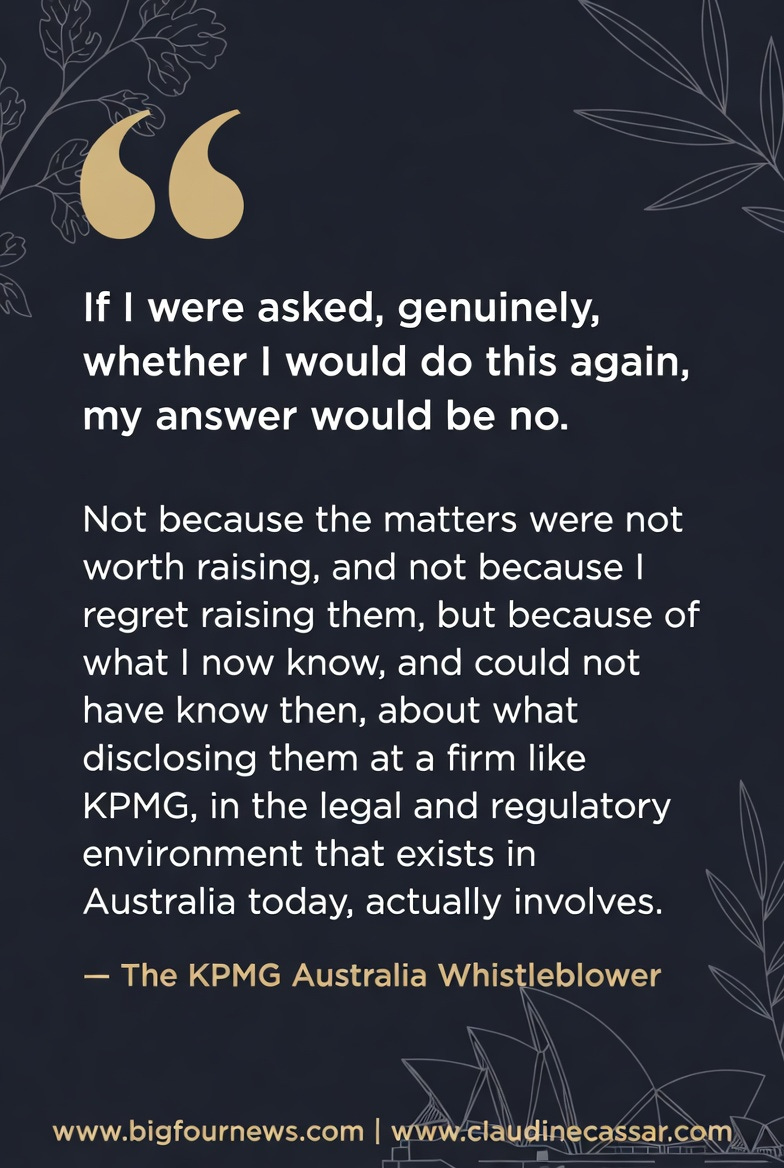
No wonder the whistleblower has stated publicly that the experience has left him regretting coming forward, and that knowing what he knows now, he would not blow the whistle again. He has paid a very bitter price for trying to do the right thing.

Q: You have also criticized the leadership response during the parliamentary hearings. What concerns you most about how KPMG Australia’s senior figures have conducted themselves?
The testimony before Parliament showed senior figures repeatedly characterising serious misconduct — including the misuse of confidential client information and retaliation against whistleblowers — as mere “carelessness” or a failure to “meet expected standards.”
They also tried to hide behind legal professional privilege. Chair Martin Sheppard, told the inquiry he had “agonised” over the decision but ultimately withheld important documents on privilege grounds.
So a firm that misused its clients’ confidential information is now invoking the strictest protections for its own documents! At the same time, it lectures about “procedural fairness” and “unfair prejudice” to individuals while they did not hesitate to spy on the whistleblower’s laptop, marginalise him and destroy his career.
They are using exactly the same playbook used by PwC Australia during the Tax Leaks scandal three years ago: downplay the issues, contain the damage, and avoid full accountability. That strategy backfired spectacularly, yet KPMG appears to be repeating the same mistakes. Clearly, no meaningful lessons have been learned.

Q: What do you believe genuine accountability should look like in this case?
Genuine accountability requires more than changes at the top after prolonged resistance. While the resignations of Yates, McPherson, Hoggett, Rogers and Sheppard are a step in the right direction, they are not enough on their own. The entire partnership must accept responsibility for the culture that allowed these issues to develop and persist.
In addition, genuine accountability requires lifting unnecessary barriers to scrutiny where they have been used to shield information from proper oversight, and ensuring that future whistleblowers are supported properly rather than marginalised.
At a minimum, this means publicly acknowledging the full extent of what occurred, ensuring those responsible face appropriate consequences, and implementing independently verified reforms with clear timelines and measurable outcomes.
There should also be restitution and proper support for the whistleblowers whose careers the firm has damaged — at least three individuals over the past three years were subjected to extreme retaliation for speaking up about malfeasance they witnessed at KPMG Australia.

Q: The scandal has raised serious questions about KPMG Australia’s ongoing commercial relationships with government and other major institutions. How do you view the scale of these relationships and the risks they create?
The scale is enormous and the risks are profound. KPMG Australia is on track to earn approximately $653 million from the Commonwealth Government this financial year alone. The firm is the largest provider of consulting services to Defence Australia. This means a firm currently under intense scrutiny for allegedly misusing confidential client information and retaliating against whistleblowers continues to hold privileged access to highly sensitive government data and decision-making processes.
The situation is untenable.
Associate Professor Schmulow, thank you for your time and for sharing your analysis so candidly. Your perspective has been invaluable.
Who is Associate Professor Andy Schmulow?
Associate Professor Andy Schmulow is an internationally recognised expert in financial regulation, with particular expertise in Twin Peaks regulatory models, conduct risk, corporate governance, and consumer financial protection.
He is an Associate Professor in the School of Law at the University of Wollongong, Australia, and a Visiting Associate Professor at the Nelson Mandela Institute in the Oliver Schreiner School of Law at the University of the Witwatersrand in Johannesburg. He is also the Founder and CEO of Clarity Prudential Regulatory & Consulting Pty Ltd.
Schmulow has advised governments and regulators at the highest levels. In 2017, he was invited by South Africa’s National Treasury to serve on its Independent Committee of Experts to advise on the drafting of the Conduct of Financial Institutions Bill. In 2018, he provided research findings to the Australian Royal Commission into Misconduct in the Banking, Insurance and Superannuation Industry (the Hayne Royal Commission), which contributed to Recommendation 6.14 — the establishment of a Regulator Board of Oversight. This recommendation was later enacted in the Financial Regulator Assessment Authority Act 2021.
Internationally, he was invited by the World Bank and CGAP to lead the development of a consumer financial well-being indicator framework for the South African government. The framework is now being rolled out to countries covering approximately 1.5 billion consumers. In 2022, he was invited to address Members of the European Parliament on a White Paper he co-authored on an EU Ethics Oversight Authority. In 2023, he delivered keynote addresses in Tokyo, Brasilia (to the Brazilian Ministry of Finance), and London (to Members of the House of Commons and House of Lords).
He is a co-editor of the Cambridge Handbook of Twin Peaks Financial Regulation (2021), the world’s first book-length, multi-disciplinary, and cross-jurisdictional analysis of Twin Peaks and hybrid regulatory regimes. He is admitted as an Advocate of the High Court of South Africa and as an Australian Lawyer (non-practising) in the Supreme Court of Victoria. He also serves as a Member of the Secretariat for the UK House of Commons and House of Lords All-Party Parliamentary Group for Personal Banking and Fairer Financial Services.
Schmulow’s research and commentary frequently examine regulatory and governance failures in the accounting and financial services sectors, with a particular focus on the conduct of major firms such as KPMG.
This is part of Big4News’ continuing coverage of the KPMG Australia Audit Leak Scandal and the Expert Voices Series
KPMG Australia Audit Leak Scandal

The KPMG Australia scandal that erupted publicly in March 2026 represents one of the most significant integrity crises to hit the Big Four in Australia since the PwC tax leaks affair. At its core are allegations—first raised internally by a whistleblower in 2024 and later amplified through parliamentary privilege—that senior partners misused highly conf…
Expert Voices

This section features candid interviews with whistleblowers, legal experts, and financial professionals who have direct experience with the inner workings of Deloitte, PwC, EY, and KPMG.
About Claudine Cassar

I’m a corporate anthropologist and former Deloitte equity partner. I sold my technology business to Deloitte in 2016 and led the Malta Consulting team for five years. I now write Big4News, providing independent, clear analysis of PwC, Deloitte, EY, and KPMG — free from corporate spin.
Find me on LinkedIn, X, Instagram, or my author website. You can also email me.
Feel free to reply to this newsletter — I read every reply.