


Key Takeaways:
The Chartered Accountants Australia and New Zealand (CA ANZ) Professional Standards Scheme allows massive consulting and advisory work to be covered by low liability caps originally intended for traditional accounting services
Lyon argues the current system shifts risk to clients, shareholders, and the public while weakening accountability — and his Supreme Court case seeks to change that
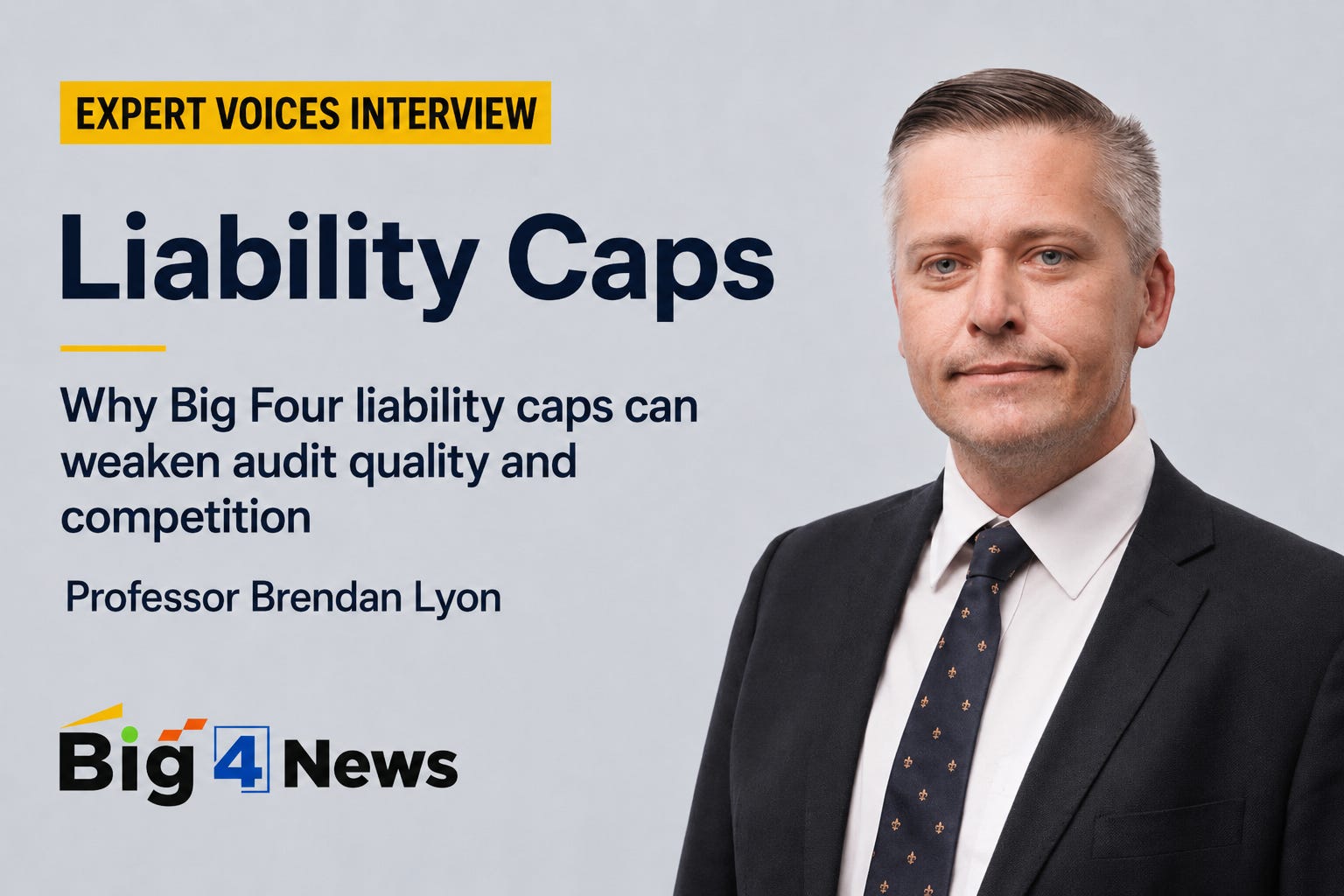
Professor Brendan Lyon is a former KPMG Australia partner and whistleblower who exposed serious conflicts of interest and potential misconduct in the firm’s work on the New South Wales Transport Asset Holding Entity (TAHE) project. His disclosures triggered significant parliamentary scrutiny of Big Four practices in Australia.
Despite facing substantial personal and professional repercussions, Lyon has remained a leading advocate for greater accountability in the accounting and consulting industries. He currently serves as Professor of Practice at the University of Wollongong, where his teaching and research focus on professional ethics, regulatory policy, and the incentive structures shaping the Big Four.
Lyon is also pursuing a high-profile public interest case in the NSW Supreme Court challenging the scope of liability protections under the Chartered Accountants Australia and New Zealand (CA ANZ) Professional Standards Scheme.
Detailed bio at the end of the article.
1. Overview of the Case
Can you summarise, in straightforward terms, what your NSW Supreme Court case is seeking to achieve and why you decided to bring a public-interest challenge against the Professional Standards Council’s approval of the CA ANZ scheme?
My case asks the Supreme Court to decide whether a scheme intended to cap legal liability of qualified accountants providing public accounting services can lawfully cap the liability of non-accountants providing non-accounting services.
In application the CA ANZ scheme allows the Big Four and similar firms to operate as a type of unregulated limited liability company outside of the Corporations Law.

2. The Catch-all Clause
The 2007 expansion of the CA ANZ scheme introduced Category 3 services — effectively a catch-all for any services which are not Category 1 or Category 2.
How significant is this broad wording in your view, and what problems does it create for accountability when applied to the wide range of consulting and advisory work performed by Big Four firms?
The ‘catch-all’ nature of Category 3 is central to how the Big Four firms function.
Ordinarily partners have unlimited personal liability for damages caused by any partner in the firm, creating a strong incentive to monitor conduct and standards.
The CA ANZ scheme removes this deterrent by capping liability at a million dollars in most instances, regardless of the damages caused.
When the downside is capped to around a thousand dollars per partner and the upside are partner salaries in the millions, it is little surprise profit trumps principle.

3. Unfair Competitive Advantage
One of the central arguments in your recent paper with David Johnstone (“Watchdog or Show Dog? Incentives and Competitive Advantages of the Big 4 under Australia’s Professional Standards Acts” published in the Australian Business Law Review) is that the liability caps give professional services firms that also perform statutory audit work a significant advantage over pure consulting or advisory firms that do not have access to the same protections.
Could you explain how this competitive distortion operates in practice and why you believe it is unfair?
The major competitive advantage provided by the scheme is its absolute liability cap.
Audit-consulting firms have absolute liability capped at $20 million while ‘pure’ consultants do not — meaning competitors ‘bet the company’ on high risk jobs, while the Big Four do not.
This sees the Big Four able to price and bid more aggressively, because they do not face the same commercial and existential risks as their competitors.

4. Impact on Standards and Behaviour
The scheme was originally justified as a quid pro quo: limited liability in return for demonstrably higher professional standards and better consumer protection.
In your assessment, has that bargain been kept – particularly considering your personal experience as a whistleblower, and developments such as the PwC Tax Leaks and the very recent KPMG confidentiality breach scandal?
My examination of the CA ANZ disciplinary decisions register suggests little enforcement of standards among the Big Four and other major firms, with disciplinary effort apparently focused on small firms and sole practitioners.
In the TAHE matter I blew the whistle on, there are extensive public records evidencing serious misconduct by KPMG’s leadership, but CA ANZ’s five‑year investigation focused on a single individual and ultimately found no misconduct.
In the PwC tax leaks scandal, CA ANZ did not obviously investigate or meaningfully sanction the dozens of partners copied on the emails exposed in the Senate.

5. The “Rationally Ignorant” Public – and Who Actually Bears the Cost
Your paper notes that the public has remained ‘rationally ignorant’ of how Australia’s professional standards liability-capping schemes operate and the advantages they confer on the largest firms.
The caps have been presented as a reasonable protection that ultimately benefits consumers or society. However, as your analysis shows, when a Big 4 firm’s negligence causes losses that exceed the statutory caps ($75 million for Category 1 audit and financial accounting services, and $20 million for both Category 2 receivership/liquidation services and Category 3 “any other services”), the excess cost is typically shifted onto the client’s shareholders, investors or other affected parties rather than being borne by the firm or its partners.
Why do you believe it is important for the public to understand that these caps can work against their interests in this way, rather than in their favour? And do you see your court case as helping to close that information gap?
By ‘rationally ignorant’ we mean the community at large is not aware of the special liability arrangements over the Big Four, do not understand how it can impact them, and have no visibility of CA ANZ’s disciplinary processes — so they cannot make informed judgements of the effect on the public interest or professional standards observed by accountants.
The Professional Standards Council exists to do these things on behalf of the community but given where we are at, there are obvious questions about how effective it has been.
The liability scheme caps the rights of any person to recover their full damages against a scheme member, with caps that are lower than the face value of many Big Four contracts.
It is absurd that liability for a $100 million consulting or advisory contract is capped at $20 million and reduced in practice to one million dollars when the potential damages are likely to be 10 or 20 times fees or more.
This matters enormously to ordinary Australians because many of the largest clients of the Big Four — including major superannuation funds — manage the retirement savings of millions of people. When negligence or poor advice leads to losses that exceed the liability caps, those excess costs ultimately flow through to reduced returns in super accounts. In effect, everyday Australians bear the financial consequences through diminished retirement savings, while the partners responsible face almost no personal downside. The system quietly transfers risk from highly paid professionals onto the retirement nest eggs of workers across the country.

6. Thin Capitalisation and the Reality of Big 4 Leverage
Your paper highlights that the Big 4 operate a high-cost, thinly capitalised model that depends on relentless revenue growth. With recent reports showing KPMG Australia holding over $550 million in debt (around $815,000 per partner) and facing covenant pressure, how do you see the liability caps interacting with this leveraged structure?
As partnerships the Big Four have no retained earnings, so each year becomes a race to earn money faster than accruing expenses.
While the CA ANZ scheme effectively removes partner liability for damages, every partner remains jointly and severally liable for debts or losses ‘to their last shilling and last acre’. With capped liability for any service provided to seek profit, the Big Four operate with an obvious incentive to prioritise sales and income above all else.
The only time partner assets are truly on the line is if they fail to generate enough fees. How those fees are earned becomes a matter of practical indifference.

7. International Comparison
Is the Australian model — in which a professional standards scheme approved for chartered accountants effectively caps liability for multidisciplinary firms across almost any type of consulting work — unique, or do comparable arrangements exist in other major jurisdictions? If the latter, how do those systems differ?
Other common law economies have typically allowed the Big Four to adopt Limited Liability Partnership (LLP) structures, effectively a partnership-corporate hybrid that imposes financial reporting, managerial duties and the like.
Allowing the local Big Four to transition to LLPs will be attractive to them because it would maintain the current tax benefits over corporate competitors.
In looking to ‘new’ legal forms for the Big Four in Australia, policymakers should question first if those firms are any different to large consulting companies.
If not, they should be formed as corporations with the same laws and taxes that bind their competitors.
The Big Four and similar large audit-consulting firms are an obvious place to increase tax revenues while removing an unfair competitive advantage.
8. Personal Motivation and Experience
As a former KPMG partner who blew the whistle on conflicts of interest in a major government engagement, how has that experience shaped your decision to challenge the scheme through the courts rather than through other channels?
Parliamentary inquiries have been crucial to surfacing the serious misconduct of the Big Four but government responses have gone nowhere.
The Big Four are significant political donors, are entrenched across the public sector and act as a ‘shadow’ public service leaving governments badly placed to act.
The legal case concerns specific and narrow statutory construction, but success would have general and wide effects on the incentives and conduct of the Big Four and similar firms.
Just one large claim resulting in partner capital calls would see very different attitudes to risk and conduct enforced by the partners themselves.
9. End Game and Desired Outcomes
If the court rules in your favour, what practical changes would you like to see?
More broadly, what is your ultimate goal with this litigation — is it limited to narrowing the scope of the current CA ANZ scheme, or do you hope it will trigger wider reform of how liability, accountability, and the audit-consulting model are regulated in Australia?
The case only deals with the liability protection. Australia still has a problem with audit quality and conduct, and like all countries is battling the dual role of the Big Four as consulting lapdogs and audit watchdogs.
As well as our unique protection against claims, Australia is also unusual in its absence of a government regulator of public company audit firms.
Self-regulation has obviously, consistently and egregiously failed so I think Australia needs to address that and examine carefully any systemic risks that have been created in recent decades.
10. Regulatory Changes
Looking beyond this specific case, what regulatory or structural changes (for example, around audit-consulting separation or stronger external oversight) do you believe are ultimately necessary to restore public confidence in the Big 4’s role?
Audit is a public good required in the public interest. Consulting and advisory are private goods that advance the sectional interest of a client.
For decades the Big Four have argued their audit quality is better because their multidisciplinary skills deepen the sophistication of their audits.
There is no evidence of this, just repeated instances around the world of audit being used as a trojan horse to reap higher fee consulting engagements.
We need to see a clear policy process that results in new laws that define the limits of what and how audit firms can operate, how they are regulated, and the constraints on other services, similar to Sarbanes Oxley.
We have a serious problem and it needs a serious response in law and practice.
Interviewer’s Closing Comment
Thank you, Brendan, for this candid, detailed, and insightful discussion. I know that you are very busy at the moment, so I truly appreciate you taking the time to answer my questions.
For readers who want to support this important public interest litigation, Brendan has established a dedicated fundraising campaign on Chuffed. Every contribution helps cover legal costs and advance the case for greater accountability in the profession. The platform also accepts anonymous donations.
Support the campaign here:
https://chuffed.org/project/167311-making-the-big-four-accountable-a-landmark-public-interest-case-for-public-integrity
NB: Big4News has no financial interest in the fundraising campaign and receives no commission or payment from donations.
Whether or not the NSW Supreme Court ultimately rules in your favour, your challenge — together with your teaching and research at the University of Wollongong — is already helping to expose critical questions about liability, incentives, and professional standards in Australia. This conversation is a significant contribution to the ongoing scrutiny of the Big Four.
Editor’s note: CA ANZ’s position: CA ANZ says the scheme is a risk-management and consumer-protection framework, with liability limits graduated according to the type and value of the engagement. Its explanation of the scheme is available here.
Who is Professor Brendan Lyon?
Professor Brendan Lyon is a former KPMG Australia partner, whistleblower, and leading advocate for greater accountability in the accounting and consulting professions. He is currently Professor of Practice in the Faculty of Business and Law at the University of Wollongong, where he focuses on professional ethics, regulatory policy, incentive structures in professional services firms, and the intersection of business, law, and public interest.
Lyon joined KPMG in 2018 after a successful business career and was admitted as a partner at the relatively young age of 39. In 2021, while advising Transport for NSW on the controversial Transport Asset Holding Entity (TAHE) — a structure created to shift billions of dollars of rail infrastructure costs off the NSW state budget — he refused to alter findings that highlighted serious flaws in Treasury modelling, safety risks, and conflicts of interest. His refusal to change the report led to significant internal pressure at KPMG. He was ultimately forced out of the firm in what he has described as a constructive dismissal.
The personal and professional consequences were severe. Lyon has publicly stated that speaking out cost him at least $2 million in lost earnings and legal costs. He endured internal investigations, ongoing character attacks, and extreme stress that caused him to lose 27 kilograms in weight over roughly 10 months. Despite this, he has repeatedly said he would do the same again without hesitation.
Following his departure from KPMG, Lyon was appointed as the first Professor of Practice in the University of Wollongong’s Faculty of Business and Law. In this role, he brings real-world experience from the private sector into teaching and research, with a particular emphasis on socially responsible business practices and regulatory reform.
He has given evidence to multiple parliamentary inquiries, including the NSW upper house inquiry into the use of consultants and the federal Senate inquiry into consulting firms. He is also the lead litigant in a high-profile public interest case in the NSW Supreme Court challenging the scope of liability caps under the Chartered Accountants Australia and New Zealand (CA ANZ) Professional Standards Scheme — arguing that the current framework unfairly shields large multidisciplinary firms and distorts competition and accountability.
Lyon co-authored the paper “Watchdog or Show Dog? Incentives and Competitive Advantages of the Big 4 under Australia’s Professional Standards Acts” with Professor David Johnstone, published in the Australian Business Law Review. He continues to speak and write publicly on the need for structural reform of the Big Four model in Australia.
Sources & Key References
Lyon, B. & Johnstone, D. “Watchdog or Show Dog? Incentives and Competitive Advantages of the Big 4 under Australia’s Professional Standards Acts.” Australian Business Law Review.
Sydney Morning Herald (6 September 2023). “Speaking out cost Brendan $2 million. But he says he’d do it again.”
University of Wollongong (2023). “Light after darkness” – Profile of Professor Brendan Lyon.
Chuffed.org – Fundraising campaign for Professor Lyon’s public interest litigation: Support the campaign
NSW Supreme Court – Public interest proceedings challenging the CA ANZ Professional Standards Scheme liability caps (Brendan Lyon v Professional Standards Council & Ors).
Chartered Accountants Australia and New Zealand (CA ANZ) – Professional Standards Scheme documentation.
Parliamentary evidence and inquiries:
This article is part of Big4News’ Expert Voices Series
Expert Voices

This section features candid interviews with whistleblowers, legal experts, and financial professionals who have direct experience with the inner workings of Deloitte, PwC, EY, and KPMG.
About Claudine Cassar

I’m a corporate anthropologist and former Deloitte equity partner. I sold my technology business to Deloitte in 2016 and led the Malta Consulting team for five years. I now write Big4News, providing independent, clear analysis of PwC, Deloitte, EY, and KPMG — free from corporate spin.
Find me on LinkedIn, X, Instagram, or my author website. You can also email me.
Feel free to reply to this newsletter — I read every reply.