


Key Takeaways:
Governance exists to help organisations perceive reality more clearly and exercise better judgement. Rules and processes are only simplified maps, not the terrain itself
The foundational question for any governance system is “In whose interest?” Every framework makes a moral choice that privileges some stakeholders over others
The most dangerous environments are those in which awkward questions are no longer asked. Cognitive diversity, independent information channels, and external perspectives are essential for genuine oversight
Christopher Bennett has had a wide-ranging international career as a director, senior executive, researcher, consultant, writer and teacher. He has held directorships and senior management roles across multiple countries and sectors, including engineering construction, electronics, oil and gas, consulting, banking and finance. Full bio at the end of the article.
In this interview, he speaks with Claudine about the deeper questions behind corporate governance: who governance is really for, why formal structures can fail, and how independent directors should navigate the terrain of power, incentives, relationships and information control.
He frames the underlying challenge as follows:
Corporate governance is usually discussed as though it were a property of organisations: a system of boards, committees, controls, and accountability. While that is a helpful model, I have come to believe that perspective is incomplete.
Governance only makes sense when we view organisations in relationship with the environments in which they exist. Every organisation is continually shaped by customers, markets, employees, regulators, technology, culture and society — and its decisions shape that environment in return. Good governance helps organisations navigate this relationship by improving the quality of organisational judgement.
From this perspective, governance is not simply about directing and controlling organisations. It is about enabling them to perceive change, exercise sound judgement, and adapt ethically and effectively to an evolving world. Rules and processes are essential, but they are only simplified maps, not the terrain itself.
Directors, executives, employees, regulators, customers, the community, and whistleblowers each see the organisation from a different vantage point. Good governance is not merely about balancing competing interests — it is about creating the conditions in which these different realities can be brought together, tested, and understood.
The model I suggest is: Seeing (gathering perspectives), Making sense (integrating them into a coherent picture), Judgement (deciding what ought to be done), and Adaptation (acting and learning from the consequences).

So, turning to the specific questions:
You have written that many governance debates begin with proposed solutions before examining the assumptions underneath them.
What assumptions about corporate governance do you think most need to be challenged?
“Best practice” is often misleading. Corporate governance codes and policies tend to assume that all organisations operate in similar environments, when in reality they don’t. These rules can be a useful starting point, but they must be adapted to the specific context of the company.
I think we often assume governance is primarily about controlling organisations. We rely on the Cadbury definition — or some descendant of it — “Corporate governance is the system by which companies are directed and controlled.” But perhaps its deeper purpose is helping organisations perceive their environment accurately and adapt effectively.
You often return to the question: who is corporate governance actually for?
Why is that such an important starting point?
The most important question in considering any social system (and businesses are one subset of social systems) is: “In whose interest?” If we don’t start with a clear understanding of in whose interest corporate governance should operate, that is where we are trying to get to – we are very unlikely to end up in the right place.
I know some will say, “Well, the board should balance the competing interests” — that’s true but the answer to “how” the interests should be balanced will vary depending on organisational context.
Others will take the Friedman position that boards should only consider maximising shareholder value and legislated issues. That is simpler to implement but means that the interests of many stakeholders are not considered. Ignoring the interests of groups of stakeholders may damage the organisations’ societal “licence to operate” — and that is potentially a big problem for the organisation, after all I remember when the Big Four were the Big Five!
Every governance system embodies values. There is no neutral governance. Every governance framework embodies a moral choice. It always privileges someone’s interests over someone else’s; Shareholders, Partners, The public, Employees, Future generations, but, in all cases “Someone”. The first task is to make those priorities explicit, only then can they be debated.
In a professional services firm such as a Big Four audit firm, who should governance ultimately serve: the partners who own the firm, the clients who pay it, the staff who work inside it, the regulators who oversee it, or the public that relies on its work?
The tempting answer is “all of the above.” But the deeper question is why society allows the firm to exist in the first place.
Institutions exist because society believes they perform an important function. Once that belief disappears, formal ownership becomes largely irrelevant.
Without public confidence there is no audit profession. So in this case, governance ultimately serves the continued legitimacy of the institution.
Governance is often defined by process — the system by which organisations are directed and controlled — rather than by purpose.
What is lost when governance becomes a matter of process rather than purpose?
Purpose determines process, not the other way around. The same governance process may be excellent in one organisation and harmful in another. The risk is that rules obscure underlying principles.
When organisations fail ethically, we rarely pay enough attention to the environment that rewarded or tolerated the behaviour. Ethical failures often represent organisations adapting perfectly to incentives that are inconsistent with their stated purpose.

Ethics and environment are inseparable: people shape institutions, but institutions also shape behaviour.
When organisations fail ethically, do we pay enough attention to the environment that rewarded or tolerated the behaviour?
Definitely not, we should spend more time on why an issue arises. We need to ask how it came about and what were the competing goals that led to the undesired outcome? The answer is often a conflict between environment, purpose, culture, incentives, and behaviour.
In large professional partnerships, where revenue, promotion, reputation, client retention and internal loyalty are all powerful forces, how might those incentives shape what people are willing to see, say, challenge or ignore?
Upton Sinclair said, “It is difficult to get a man to understand something when his salary depends on his not understanding it.”
The more incentives align with current organisational goals, the fewer alternative realities survive. If incentives reward behaviours other than those publicly espoused, the organisation eventually evolves not to notice uncomfortable truths.
Warning signs include lack of curiosity, early closure of debates, low psychological safety, bad news not travelling upwards, and situations where raising awkward questions becomes career-limiting. The most dangerous organisations are not those where people have no concerns — they are those where questions are no longer asked.
You have used the idea that directors need two kinds of map: one showing the route from A to B, and another showing the terrain.
In governance terms, what is the difference between the formal route map — policies, committees, charters and procedures — and the real terrain of power, incentives, relationships and information flow?
The formal map shows what should happen. The real terrain shows what actually happens. Boards need both maps and they need to update their maps continually.
Formal governance (the route) describes authority. Real governance describes influence (the terrain). Governance is a continual journey. The destination, the route and the terrain all need to be reviewed continually.
If management tells independent directors that a serious allegation has already been investigated and there is nothing further to see, what should those directors do?
See the reports.
Interrogate the interrogators.
Trust management — but verify its understanding.
Independent directors should never confuse assurance with evidence.
Former Big Four partners often move onto client boards and audit committees.
How should boards balance the value of their expertise against the risks of familiarity, loyalty, perceived conflict, or unconscious deference?
Understand why the client wants you. Consider how it will be perceived. Decide whether the purpose of joining is appropriate and defensible. The issue is not only conflict of interest — it is also the risk of unconsciously importing old assumptions.
In your work on Criminality and Business Strategy, you explore uncomfortable similarities between conventional businesses and criminal organisations.
What can corporate boards learn from that comparison about incentives, loyalty, silence and rule-bending?
The useful comparison isn’t about criminality itself; it’s about how all organisations adapt to incentives and environments.
Individuals and organisations adapt to incentives. The question for senior executives and directors is what is our organisation adapting to? Which can be rephrased as “what do we really” incentivise? Ask the staff and clients — they will tell you what really matters to your organisation.
If you were advising independent directors inside a complex professional services firm, what three changes would make independent oversight more real?
Greater cognitive diversity. Avoid appointing only those who share existing industry assumptions.
Better independent information channels. Don’t rely solely on management.
External perspectives. Actively talk to people outside the firm and sector.
Independent directors should constantly ask themselves, “What might we not be seeing?”
Christopher, thank you for your time and for sharing your analysis with such clarity. Your perspective on the behavioural realities of governance, the primacy of purpose over process, the dangers of misaligned incentives, and practical steps for independent directors to see beyond the formal map has been invaluable.
Who is Christopher Bennett?
Christopher Bennett has served on the faculty of the International Centre for Leadership in Finance (ICLIF, now part of the Asia School of Business), where he continues as an adjunct faculty member. He also serves on the faculty of the Australian Institute of Company Directors (AICD) and has delivered director development programs in Australia and several Asian and Middle Eastern locations.
He has worked as a Doctoral Researcher at Aston University Business School, studying cultural and behavioural aspects of decision-making by boards and top management teams, particularly in multicultural and complex multinational company groups.
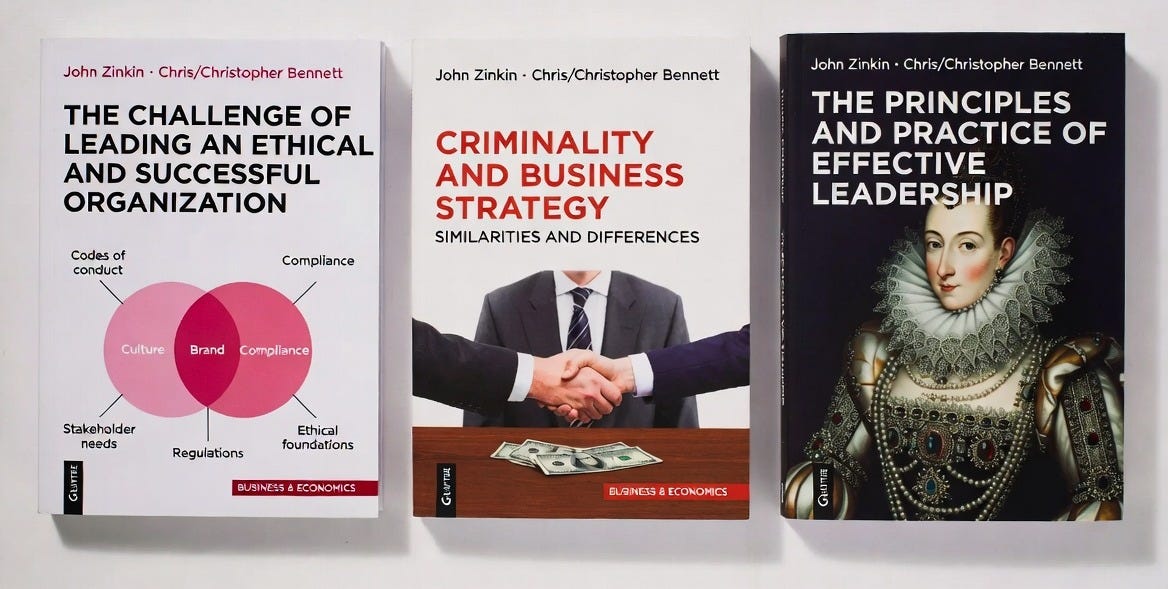
Bennett is the co-author, with Datuk John Zinkin, of several books on leadership, ethics and organisational behaviour, including The Principles and Practice of Effective Leadership, Criminality and Business Strategy: Similarities and Differences, The Challenge of Leading an Ethical and Successful Organization, and The Principles and Practice of Effective Diversity and Inclusion.
He also co-authored Governance of Company Groups (with Mak Yuen Teen, 2014), which analyses oversight challenges in complex corporate structures. He has also co-authored Directors Daze: The Lighter Side of Corporate Governance with Professor Mak Yuen Teen.
His teaching and facilitation work draws on case studies and behavioural perspectives to explore practical governance issues, including power dynamics, incentive structures, and decision processes in boards. Bennett continues to engage in research, writing, and executive education focused on board effectiveness and organisational behaviour.
This article is part of Big4News’ Expert Voices Series
Expert Voices

This section features candid interviews with whistleblowers, legal experts, and financial professionals who have direct experience with the inner workings of Deloitte, PwC, EY, and KPMG.
About Claudine Cassar

I’m a corporate anthropologist and former Deloitte equity partner. I sold my technology business to Deloitte in 2016 and led the Malta Consulting team for five years. I now write Big4News, providing independent, clear analysis of PwC, Deloitte, EY, and KPMG — free from corporate spin.
Find me on LinkedIn, X, Instagram, or my author website. You can also email me.
Feel free to reply to this newsletter — I read every reply.