


Key Takeaways:
KPMG told the whistleblower that an external investigation by Ashurst had already begun — Ashurst later confirmed this was not true.
Independent directors were told the allegations had been properly investigated and resolved; but they were given incomplete information.
Lendlease was told the accessed documents were of “low sensitivity” and gave KPMG “zero competitive advantage” — both claims were contradicted by the evidence.
KPMG publicly stated the allegations had “not been substantiated,” even after identifying inappropriate document sharing and disciplining partners.
The two external reviews (Ashurst and Allens’ Project Magenta) were far more limited in scope than KPMG presented to the whistleblower, directors, clients, and Parliament.
KPMG told the whistleblower that an external investigation had already begun, assured independent directors that the matter had been resolved as an HR issue, and told Lendlease that the accessed documents were of “low sensitivity” and offered “zero competitive advantage”. It later told Parliament and the public that external legal reviews had supported its internal findings. Many of these claims have since been contradicted by evidence presented to the parliamentary inquiry.
When the whistleblower reached out to KPMG International, the global organisation said its ability to intervene was limited by the legal independence of its Australian member firm.
Many of these claims have since collapsed.
Ashurst told Parliament that it had not been engaged to conduct an investigation. KPMG admitted that the much vaunted independent investigations lacked the necessary rigour. The documents dismissed as unimportant turned out to include confidential assessments of audit pitches submitted by EY and PwC. And KPMG’s global hotline policy expressly contemplated investigations under KPMG International’s auspices when allegations concerned a member firm’s senior leadership.
Not every inaccurate statement is necessarily an intentional lie. Proving that someone knew a statement was false requires evidence of their state of mind. Some of the claims examined below are demonstrable falsehoods. Others are reckless assertions, materially misleading half-truths or deceptions by omission.
This article tests each claim against the known facts—and reaches a verdict.
1. KPMG said an external investigation had already begun
The claim
On 25 November 2024, KPMG independent director Jane Hemstritch wrote to the whistleblower stating that the firm had “already commenced an external investigation” into his concerns.
He was directed to Ashurst partner Jane Harvey.
What the evidence shows
Ashurst had not commenced an investigation at that point.
The firm was not engaged until January 2025. More importantly, Ashurst later told Parliament that it had not been commissioned to investigate the substance of the whistleblower’s misconduct allegations.
When questioned about the fact that KPMG had claimed that the legal firm had conducted an investigation, Ashurst partner Jane Harvey explicitly told the parliamentary inquiry: “No, that was not correct.”
“No, that was not correct.”
Testimony by Ashurst partner Jane Harvey: June 19, 2026
She explained that the engagement involved legal advice associated with KPMG’s internal process and the employment or grievance issues surrounding the whistleblower.
Hemstritch appears to have passed on information given to her by KPMG management. She was therefore not the person responsible for the false assurance; she was one of the people misled by it.
Parliamentary documents later recorded the whistleblower’s account of being told that an external investigation had already commenced, while evidence at the hearing confirmed the different timing and scope of Ashurst’s engagement.
Verdict: A demonstrably false statement.
No external investigation into the whistleblower’s allegations had commenced when the independent directors and the whistleblower himself were told that it had.
The misrepresentation is aggravated by the fact that Hemstritch was put in a position where she unknowingly conveyed false information to the whistleblower with the credibility of independent oversight.

2. KPMG said Ashurst had investigated the allegations and supported its internal findings
The claim
KPMG repeatedly relied on Ashurst as an external legal check on its handling of the whistleblower’s allegations.
Even after the scandal became public, KPMG’s official statement of 29 May 2026 said:
“The external legal review supported the internal investigation.”
The clear implication was that external lawyers had examined the allegations and agreed with KPMG’s conclusion that they had not been substantiated.
What the evidence shows
Ashurst told Parliament that it had not been engaged to investigate the underlying misconduct allegations.
It had reviewed or advised on aspects relating to employment law, but it had not carried out the substantive external investigation that KPMG invoked when reassuring the whistleblower, its directors, clients, Parliament and the public.
KPMG’s statement is particularly significant because it continued to use Ashurst’s supposed external validation on the same day it admitted that its initial investigation had not been conducted with the necessary rigour.
Verdict: This was the central institutional misrepresentation of the scandal.
KPMG transformed a limited legal engagement into an external investigation that had supposedly examined and rejected the whistleblower’s claims.
This was not a minor error in terminology. The alleged Ashurst investigation became a pillar of KPMG’s defence. It was used to persuade multiple audiences that the allegations had already been subjected to independent scrutiny.
They had not.

3. KPMG described a public-interest disclosure as an employee grievance
The claim
KPMG treated the situation as an employment, workplace or grievance matter.
The institutional narrative was that the individual had workplace concerns, was already involved in an HR process and subsequently escalated allegations against the firm.
What the evidence shows
The whistleblower was reporting alleged misconduct by senior audit personnel, including:
misuse of confidential client information;
access to rival firms’ audit-pitch documents;
possible exploitation of that information during major audit tenders;
independence and conflict concerns;
failures by senior management to investigate; and
alleged retaliation after a protected disclosure.
These were not principally complaints about his employment conditions. They concerned audit integrity, client confidentiality, professional obligations and the conduct of senior leadership.
The HR framing allowed KPMG to redirect attention from the allegations to the whistleblower. Employment lawyers could manage the individual, his position, relocation and eventual departure, while the underlying conduct remained inadequately investigated.
The chronology also matters. The formal disclosure occurred in May 2024. The relocation ultimatum and threatened termination followed. KPMG later admitted that its treatment of the whistleblower and management of his concerns had fallen short.
Verdict: It was a materially false reframing.
There may have been employment issues surrounding the whistleblower, but they did not define the substance of his disclosure.
Presenting an audit-integrity complaint as an employee grievance made the whistleblower appear personally motivated and allowed KPMG to manage him instead of confronting the senior people he was reporting.

4. KPMG reversed the chronology to deny apparent retaliation
The claim
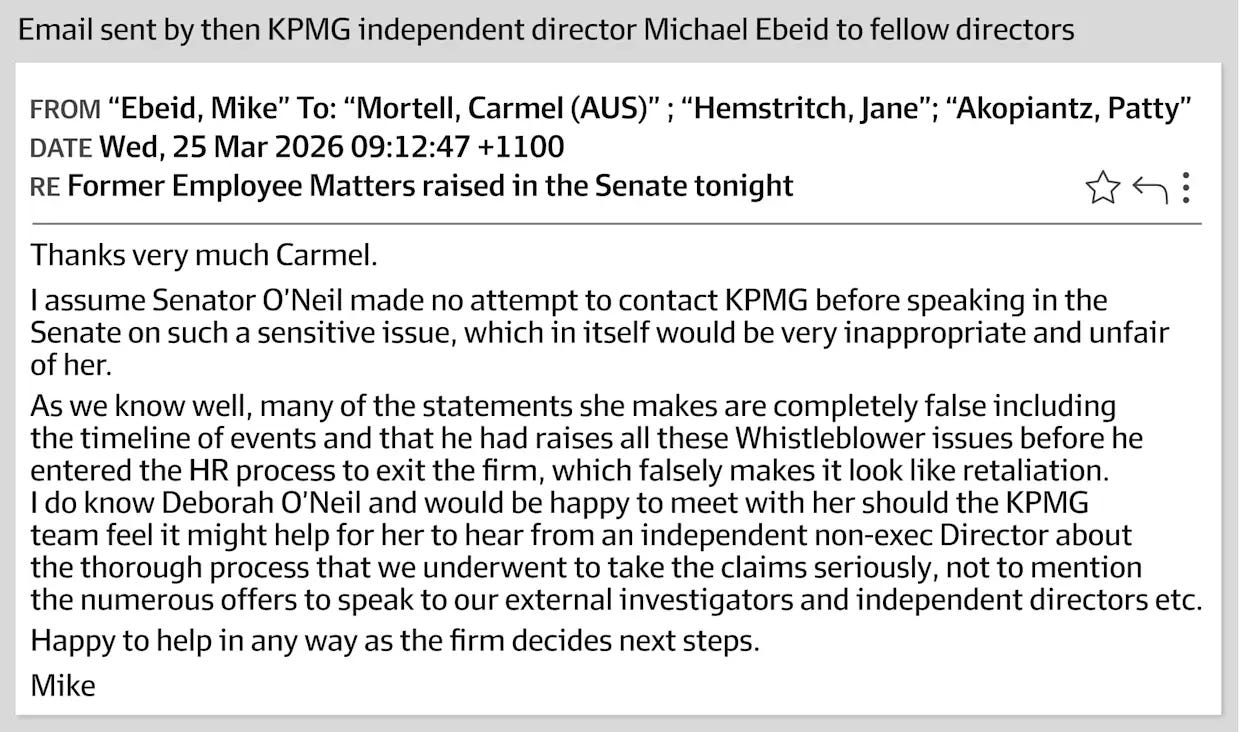
In an email following Senator Deborah O’Neill’s March 2026 Senate speech, Michael Ebeid said the senator’s chronology was false.
He claimed that the whistleblower had entered an HR process to leave KPMG before raising the whistleblowing matters, and that O’Neill’s version wrongly made the sequence look retaliatory.
What the evidence shows
The whistleblower made his formal disclosure in May 2024.
KPMG’s subsequent employment actions—including the alleged relocation ultimatum and the move towards termination—came afterwards. KPMG eventually apologised for its treatment of the whistleblower and acknowledged shortcomings in the way his concerns were handled.
Ebeid later apologised for his email, saying he had not known the full range of facts and would not have written it after receiving more detailed information.
Verdict: The chronology was false.
The statement was not merely a difference of interpretation. It reversed the sequence of the disclosure and the employment action.
Ebeid says he relied on incomplete information. That may explain his state of mind, but it creates another question: who within KPMG supplied the false chronology to one of the independent directors overseeing the firm’s response?
5. Ebeid said O’Neill’s statements were “completely false”
The claim
Ebeid told fellow directors that many of O’Neill’s statements were “completely false”, described her intervention as inappropriate and unfair, and offered to explain the “thorough process” KPMG had undertaken.
What the evidence shows
Ebeid was not an outsider relying only on a public statement.
He was one of the independent directors involved in overseeing KPMG’s investigation. He had read the Project Magenta report before attacking O’Neill’s account.
That report did not conclude that nothing had happened. It recorded that confidential Lendlease information had been displayed during preparation for KPMG’s Westpac audit pitch and confirmed significant parts of the underlying conduct, although it frequently classified the corresponding allegations as unsubstantiated.
Ebeid may not have known about all the evidence found later. But he knew that the Allens review had identified conduct broadly consistent with important parts of the whistleblower’s account.
Verdict: A misrepresentation of the facts, with a serious question over whether it was knowing.
The public evidence does not conclusively prove Ebeid’s subjective intent.
But “completely false” was indefensible given the information already available to him. He had read a report identifying relevant misconduct and had participated in the governance structure overseeing it.
At minimum, he made a categorical accusation without an adequate basis and despite access to evidence pointing in the opposite direction.

6. KPMG management told its independent directors that the matter had been investigated and resolved
The claim
Independent directors were given the impression that management had investigated the allegations, found no substance in them and brought the matter to a proper conclusion.
What the evidence shows
The supposed external Ashurst investigation did not exist in the form described.
KPMG later acknowledged that its original internal investigation lacked the necessary rigour. Separately, Ashurst said it had never conducted the substantive external investigation that management had described.
The firm’s subsequent Allens investigation challenged earlier conclusions, senior leaders resigned and independent directors said they had relied too heavily on information supplied by management.
Former independent director Mike Baird’s evidence indicated that directors had been told the matter was effectively an HR issue and had been resolved, only to discover that management’s account was inadequate.
“The presentation from management was that ‘we don’t think there’s any substance to what’s been raised’. Now, were we too trusting in that position? Clearly, we were. [And] that trust stayed until we got to April.”
Testimony by Mike Baird: June 19, 2026
Verdict: Management gave KPMG’s own governance body a false assurance.
The independent directors could not provide effective oversight if the executives they were overseeing misrepresented the existence, scope and outcome of the investigations.
KPMG later cited the involvement of independent directors as evidence of governance. But independence provides little protection when the information reaching the directors is false or materially incomplete.

7. KPMG said the allegations had not been substantiated
The claim
On 14 May 2026, KPMG publicly stated:
“Based on the evidence identified to date, the allegations have not been substantiated.”
What the evidence shows
The same statement acknowledged that KPMG had identified inappropriate internal sharing of documents and had disciplined individuals.
By then:
KPMG knew that confidential material had been displayed internally;
its conduct processes had identified grounds for sanctions;
three senior people had been financially penalised;
the relevant client had received an apology; and
Project Magenta had confirmed important elements of the underlying events.
Later investigations found that KPMG personnel had accessed material relating to EY and PwC’s audit pitches on more than one occasion, further contradicting the firm’s earlier defence.
Verdict: A materially misleading statement.
KPMG appears to have relied on a narrow and legalistic definition of “substantiated”.
It could accept that documents were accessed and displayed, discipline partners and apologise to clients, while maintaining that the whistleblower’s allegation was not substantiated because every element—such as proof that the information changed a tender outcome—had not been established.
That distinction may have been technically constructed. It did not communicate the truth.
To an ordinary reader, “not substantiated” suggested that the alleged events had not been shown to have happened. KPMG already knew that significant parts of them had.

8. Yates told Lendlease that the documents were of “low sensitivity”
The claim
Former KPMG chief executive Andrew Yates told Lendlease that the information accessed by KPMG was of “low sensitivity”.
What the evidence shows
The material included confidential Lendlease board assessments of audit pitches submitted by EY and PwC.
Those documents could reveal what rival firms had proposed, how a sophisticated client assessed their pitches, the strengths and weaknesses Lendlease perceived, and the factors influencing its choice of auditor.
The information was later displayed during a meeting at which KPMG personnel were preparing for Westpac’s audit tender.
Lendlease chief executive Tony Lombardo told the parliamentary inquiry that this was not the picture KPMG had presented to him. He said:
“All I had was board papers that were assumed to be printed and stored in someone’s locker”
Testimony by Lendlease chief executive Tony Lombardo: June 19, 2026
Verdict: A clear falsehood.
Confidential board evaluations of rival firms’ audit pitches were not low-sensitivity documents.
The description minimised the seriousness of the breach and reassured Lendlease using language that was incompatible with the nature of the information.
9. Yates said the information gave KPMG “zero competitive advantage”
The claim
Lendlease was also told that KPMG had obtained “zero competitive advantage” from accessing the documents.
What the evidence shows
The documents contained information about competing audit firms’ proposals and the client’s assessment of them.
They were then displayed to KPMG personnel preparing for another major audit tender.
It may be impossible to quantify whether the material ultimately changed Westpac’s decision. But KPMG did not merely say that no causal impact had been proved.
It made the absolute claim that the information offered zero competitive advantage.
Verdict: One of the strongest direct falsehoods attributed to Yates.
Competitor intelligence does not have to determine an outcome to provide an advantage.
Knowing what rivals offered, how their pitches were evaluated and what mattered to another major audit client has obvious potential commercial value.
The categorical word “zero” transformed a defensive argument into a claim that the evidence could not sustain.
10. Yates told Lendlease the complaint had been investigated, while withholding its central allegation
The claim
When Yates raised the whistleblower matter with Lendlease chief executive Tony Lombardo, he said KPMG had investigated the issue and had not substantiated it.
What the evidence shows
Lombardo told Parliament that he understood the allegation to concern Lendlease board papers that might have been printed and stored in an individual’s locker.
He was not given the central allegation: that KPMG personnel had accessed Lendlease’s confidential assessments of rival audit pitches and used or displayed the material while pursuing work from other companies.
Lendlease was therefore reassured that an investigation had dismissed a limited allegation without being told about the more serious allegation most relevant to its interests.
Verdict: Deception by material omission.
The statement that KPMG had investigated “the matter” created an impression that Lendlease had been told what the matter actually was.
It had not.
KPMG disclosed the least damaging fragment of the complaint, withheld the allegation involving rival audit pitches, and then used the investigation’s conclusion to provide reassurance.
11. KPMG implied that the whistleblower prevented a proper investigation by withholding evidence
The claim
KPMG repeatedly emphasised that it had asked the whistleblower for evidence or further information on numerous occasions.
The implication was that the allegations remained unsubstantiated largely because he would not cooperate adequately.
What the evidence shows
KPMG had covertly searched the whistleblower’s work computer.
Documents setting out the substance of his allegations were found and circulated to senior people. KPMG knew which partners, clients, documents and audit tenders were implicated. Its own processes eventually identified enough evidence to sanction senior personnel.
The whistleblower was also seeking legal assurances and protection before providing more material to an organisation whose senior leadership he was accusing—and which subsequently treated his disclosure as an employment problem.
Verdict: A materially misleading half-truth.
KPMG may genuinely have requested more information repeatedly.
But it used that fact to imply that it lacked enough information to investigate, when it had already obtained detailed allegations from the whistleblower’s computer and possessed sufficient evidence to pursue obvious lines of inquiry.
The problem was not simply an absence of evidence. It was what KPMG chose to do with the evidence it had.
12. KPMG presented Project Magenta as independent and rigorous
The claim
KPMG relied on Project Magenta, conducted by Allens, as a further external investigation that had failed to substantiate the whistleblower’s allegations.
What the evidence shows
The investigation was external in the narrow sense that Allens was a separate law firm.
But KPMG’s board subcommittee approved and controlled its scope and methodology. Allens interviewed 14 senior KPMG partners and directors, with many interviews lasting approximately 30 minutes.
The review did not interview the whistleblower, junior staff, affected clients, rival audit firms or other relevant external witnesses. It did not conduct a comprehensive search of emails and digital records.
The report accepted the accounts of senior partners and, according to reporting on its contents, sometimes relied on their status and authority when assessing credibility. It nevertheless identified repeated misconduct and several events corresponding to the whistleblower’s allegations.
Verdict: Not a literal lie that Allens was external—but a deeply misleading claim of independent exoneration.
Hiring an outside law firm does not automatically create an independent investigation.
KPMG selected the investigator, paid it, approved its instructions, controlled the scope and relied largely on evidence from its own senior personnel.
Project Magenta may have delivered the work it was commissioned to perform. KPMG’s deception lay in presenting that limited exercise as robust independent validation that the whistleblower was wrong.
13. KPMG said it had treated the allegations seriously and conducted a thorough process
The claim
Before the collapse of its original position, KPMG said it had treated the allegations seriously, made substantial efforts to investigate them and followed a thorough process.
Ebeid used similar language when offering to defend KPMG’s response to O’Neill.
What the evidence shows
KPMG later admitted that:
the original investigation had not been conducted with the necessary rigour;
the management of the whistleblower had fallen short;
leadership action concerning the allegations had been inadequate;
previous conclusions were being challenged by new evidence; and
further investigation with an expanded scope was required.
The chief executive and national head of audit resigned as a direct consequence.
Verdict: KPMG’s claim of a thorough process was contradicted by its own later admissions.
A process does not become thorough merely because it generates numerous meetings, letters and legal engagements.
Much of KPMG’s activity was directed at managing the whistleblower, defending earlier decisions and protecting the institution. The core misconduct allegations remained inadequately investigated until external scrutiny forced the firm to reopen them.

14. KPMG International said it lacked jurisdiction or sufficient authority to investigate
The claim
When the whistleblower escalated the allegations to KPMG International, the global organisation declined to open its own investigation.
Its position relied partly on the separate legal status of KPMG Australia and KPMG International’s supposedly limited authority over the member firm.
What the evidence shows
The legal separation of KPMG member firms is real. KPMG International is not simply the corporate parent of KPMG Australia.
But its published hotline policy expressly says reports may concern:
any member firm;
auditing and professional obligations; and
the senior leadership of a member firm.
Most significantly, the policy states that when it is inappropriate for the member firm to investigate itself—for example, when allegations concern senior leadership—the investigation will be conducted under KPMG International’s auspices.
The Australian allegations concerned senior leadership, the head of audit, the treatment of a whistleblower and the integrity of investigations conducted by the same member firm. KPMG International nevertheless refused to intervene after receiving the concerns in 2025.
Verdict: Not established as a lie, but still an obfuscation.
KPMG International may have lacked the power to dictate every employment or disciplinary outcome within the Australian partnership.
It did not lack authority to commission or oversee an investigation under its own published framework.
The “no jurisdiction” position allowed KPMG to behave as a global organisation when selling services and protecting its brand, but as a collection of unrelated local firms when accountability arrived.
15. KPMG created the impression that affected clients had been properly informed
The claim
KPMG’s public responses suggested that affected clients had been notified and that the firm was addressing the confidentiality breaches responsibly.
What the evidence shows
Lendlease received a narrow and incomplete description of the allegation.
Other clients were not told promptly or were given limited information. At the parliamentary hearing, questions emerged about when Westpac, Dexus and Optus had been informed and what they had actually been told.
Meaningful disclosure often followed parliamentary exposure and media reporting rather than KPMG’s internal discovery of the conduct.
Verdict: A false overall impression created through selective and delayed disclosure.
KPMG could point to instances in which some communication occurred.
But partial notification is not transparent notification. Telling a client only the least damaging part of an allegation, or waiting until public exposure makes silence impossible, is not responsible disclosure.
16. Martin Sheppard said there were only three instances
The claim
When questioned about whether the confidentiality breaches represented a broader cultural problem at KPMG, chairman Martin Sheppard insisted there was no pattern of behaviour.
During the parliamentary inquiry on 19 June 2026, Senator Barbara Pocock asked Sheppard:
“Are we not looking at a repetitive pattern of behaviour?”
Sheppard replied:
“I think it’s three instances.”
Testimony by Martin Sheppard: June 19, 2026
What the evidence shows
A later Allens investigation identified additional occasions on which confidential material had been accessed or shared, including separate accesses to Lendlease material containing rival firms’ audit proposals.
The evidence therefore showed more incidents than Sheppard’s definitive answer suggested.
Verdict: False—but the evidence does not yet prove that Sheppard knowingly lied.
Sheppard’s answer was incorrect and prematurely definitive. There is currently no public evidence that he already knew about the additional incidents when he gave his testimony.

17. “I don’t see myself as a bad apple”- Andrew Yates
At the parliamentary hearing, Senator O’Neill asked Yates whether he and former audit head Julian McPherson were the “bad apples”, or whether the whole barrel was rotten.
“I don’t see myself as a bad apple.”
He said he saw himself as someone who had taken accountability for things that went wrong and did not believe that KPMG was full of bad apples.
What the evidence shows
Yates led KPMG Australia while:
the whistleblower’s audit-integrity disclosure was reframed as an employee grievance;
the whistleblower’s computer was repeatedly searched;
an independent director was told that an external investigation had already commenced;
Ashurst’s limited legal role was presented as an investigation of the allegations;
KPMG’s independent directors were given false or incomplete assurances;
Lendlease was told that rival audit-pitch documents were of low sensitivity;
Lendlease was told that those documents gave KPMG zero competitive advantage;
the central allegation was withheld when Lendlease was first notified;
sanctions recommended against senior partners were delayed;
Project Magenta was used to dismiss allegations despite confirming important underlying conduct; and
Parliament and the public were told that the allegations had not been substantiated.
Verdict: Not a factual claim that can be objectively classified as a lie—but an extraordinary failure to recognise responsibility.
Perhaps Yates sincerely does not believe he was a bad apple, but the facts indicate otherwise. That said, he is right in that this was not a case of a bad apple or two - it was about the entire orchard.
This is part of Big4News’ continuing coverage of the KPMG Australia Audit Leak Scandal.
KPMG Australia Audit Leak Scandal

The KPMG Australia scandal that erupted publicly in March 2026 represents one of the most significant integrity crises to hit the Big Four in Australia since the PwC tax leaks affair. At its core are allegations—first raised internally by a whistleblower in 2024 and later amplified through parliamentary privilege—that senior partners misused highly conf…
About Claudine Cassar

I’m a corporate anthropologist and former Deloitte equity partner. I sold my technology business to Deloitte in 2016 and led the Malta Consulting team for five years. I now write Big4News, providing independent, clear analysis of PwC, Deloitte, EY, and KPMG — free from corporate spin.
Find me on LinkedIn, X, Instagram, or my author website. You can also email me.
Feel free to reply to this newsletter — I read every reply.