


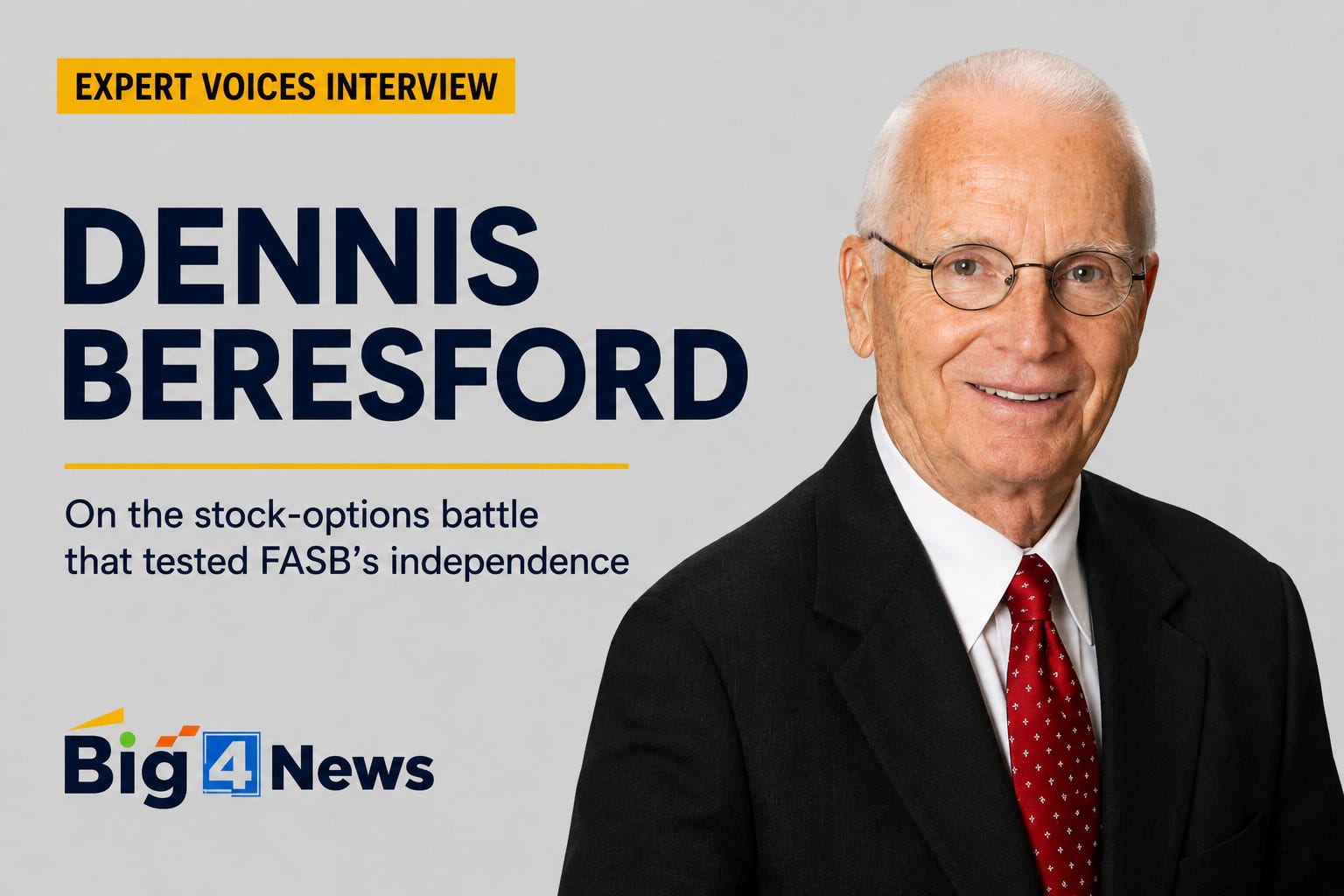
The battle over how American companies accounted for employee stock options was one of the defining tests of independent accounting standard-setting in the 1990s.
In June 1993, the Financial Accounting Standards Board (FASB) proposed requiring companies to recognise the fair value of employee stock options as a compensation expense. It was a technical proposal, but the public reaction was extraordinary.
Technology companies and business organisations mounted an intensive campaign against the change. More than 4,000 employees of Silicon Valley companies reportedly attended a rally opposing the proposal, while corporate leaders lobbied members of Congress.
FASB ultimately received 1,786 comment letters on its exposure draft, including approximately 1,000 form letters, and held six days of public hearings.
The Big Six accounting firms (Arthur Andersen, Coopers & Lybrand, Deloitte & Touche, Ernst & Young, KPMG Peat Marwick and Price Waterhouse) also opposed mandatory recognition.
The stakes were clear. Requiring companies to recognise the fair value of employee options as compensation expense would have reduced reported profits, particularly at technology companies that relied heavily on options to recruit and reward employees.
This episode is a major turning point in the book I am writing about the evolution of the firms that became today’s Big Four. The book explores the structural tension that still sits at the heart of the profession: accounting firms are appointed and paid by corporate management, yet their ultimate responsibility is to investors and the capital markets. I place the stock-options confrontation alongside the even more intense battle later fought between SEC chairman Arthur Levitt and the major firms over auditor-independence rules.
Dennis Beresford was at the centre of the first struggle. He chaired FASB as the Board attempted to defend an accounting treatment it believed would give investors a more faithful picture of employee compensation, while facing a political campaign that threatened the institution itself.
FASB ultimately adopted a disclosure-based compromise—not because it had concluded that recognising the cost was conceptually wrong, but because the Board feared that congressional intervention could threaten the future of private-sector accounting standard-setting.
I was therefore genuinely stunned when Beresford contacted me to say that he had been reading Big4News and found its coverage useful. I was even more honoured when he agreed to answer a detailed series of questions about the stock-options controversy.
His responses contain several vivid first-hand accounts: a FASB board member throwing an Ernst & Whinney pamphlet at him; Arthur Andersen leaders privately acknowledging that expensing options was theoretically correct while explaining that client pressure required the firm to oppose it; and Levitt’s highly unusual private meeting with the full FASB board.
Dennis Beresford
Dennis “Denny” Beresford chaired FASB from 1987 to 1997, leading the US accounting standard-setter through some of the most contentious reporting debates of the period. Before joining FASB, he spent 26 years at Ernst & Whinney, where he became a partner and national director of accounting standards. He later served as the Ernst & Young Executive Professor of Accounting at the University of Georgia and chaired the audit committees of several major public companies. A fuller biography and timeline of the stock-options battle appear after the interview.
Q&A
Question 1. In the mid-1980s, many major accounting firms supported reconsideration of the accounting treatment for employee stock options. By 1993, the firms generally opposed recognition of the expense.
What do you believe explains this shift? To what extent might it have reflected growing consulting revenues, pressure to retain important clients, or broader changes in the firms’ culture and commercial priorities?
Let me try to put this project in perspective. Sometime in the mid-1980s (I don’t recall the exact date), the AICPA’s Accounting Standards Executive Committee (AcSEC) wrote a letter to the FASB asking it to add a project to its agenda on accounting for employee stock options. (AcSEC included representatives of each of the Big 8 accounting firms as they existed in the 1980s: Arthur Andersen, Arthur Young, Coopers & Lybrand, Deloitte Haskins & Sells, Ernst & Whinney, Peat Marwick Mitchell, Price Waterhouse and Touche Ross. Two mergers in 1989 later reduced them to the Big Six.)
The main reason for that request was that the accounting for employee stock options varied depending on the form of the option. For example, normal stock options granted at market price did not result in any compensation expense under existing GAAP (APB Opinion 25), while stock appreciation rights (SARs), an alternative form of option based on share price but payable in cash, did result in compensation expense.
Compensation specialists were engineering options to produce benefits like SARs, while appearing in form more like normal stock options. The AICPA hoped to have the FASB update GAAP so there weren’t so many arguments between firms and clients about how to account for various forms of options. I assume that the firms didn’t anticipate that FASB would develop an approach under which all employee options required expense recognition.
I should add that during this time, employee stock options were becoming increasingly common. Many companies were providing stock options to most of their employees. And in Silicon Valley some start-up companies gave stock options as the main form of compensation.
As the FASB began developing its proposal, corporations became alarmed that they might have to record large amounts of compensation expense and significantly reduce net income. They probably blamed their accounting firms for having raised this issue with the FASB. The firms started studying the FASB’s tentative conclusions and determining how to respond, including how to educate their clients without accepting responsibility for new accounting expense recognition.
I can best illustrate the tension surrounding this project with a personal experience. The day after I was elected FASB Chairman by the Financial Accounting Foundation (FAF) in mid-September 1986, I traveled to Connecticut to meet with the Board members and staff.
Starting with Chairman Don Kirk, I met individually with each of the seven Board members. Most were reasonably cordial even though they had expected the FAF to name an existing Board member as the new Chairman rather than an “outsider” like me.
When I got to the office of Board member Ray Lauver, he invited me to sit on a couch. He then went to the other side of his office, picked something up, returned and threw it at me, shouting, “This is the biggest piece of shit I’ve ever seen!” I looked at the thrown object and saw that it was an Ernst & Whinney pamphlet concerning the employee stock-options project.
Lauver then said something like, “How dare you agree to become FASB Chairman when you are responsible for this biased pamphlet that is obviously intended only to appease your clients?”
I explained to Lauver that the pamphlet merely laid out the Board’s tentative thinking on the project and encouraged companies to express their views directly to the Board. I also stated that it was a firm publication, and while I had participated in its development, the views were those of the firm, not just mine!
Question 2. To what extent, if at all, did the stock-options dispute represent an early public indication that the major firms were shifting away from their traditional public-interest auditing role and becoming diversified commercial enterprises whose priorities were increasingly shaped by growth, client retention, and cross-selling?
Rather than an early public indication that the major firms were shifting away from their traditional public-interest auditing role, the project was simply another step in an ongoing process in which major accounting firms were highly competitive and sometimes sought an advantage over other firms based on a unique interpretation of generally accepted accounting principles.
For several years, different firms among the Big 8 had been permitting aggressive interpretations of GAAP for certain transactions. It was often a situation where if a company’s current accounting firm wouldn’t permit certain accounting, they could find another firm that would permit it.
This environment was one of the reasons the FASB Emerging Issues Task Force was established in 1984. Thus, I think it was well before the stock options project that more of an emphasis on commercialism versus technical purity began occurring.
Question 3. How closely did the major firms coordinate their positions with technology companies, business groups, and other opponents of the FASB proposal?
For most projects, it would be difficult for the major firms to coordinate their positions on accounting matters with technology companies, etc. because different clients had different positions on the proposed accounting.
To coordinate their position with clients, the firms would have to survey all those clients. In most cases, the firms would find that while many clients might favor a certain position, other clients would favor the opposite one. If the firm took the position of the majority, they would obviously irritate those in the minority. Also, most standards involve several sub-issues so various clients would usually take different positions on those details.
I can be more precise by describing how it worked in my former role at Ernst & Whinney. Our process for developing comment letters on FASB proposals was to convene a task force of partners from our eight regions to obtain their thinking on the proposal. At least some of those partners were no doubt influenced by what they thought their clients believed. But for the most part, those partners were more concerned with what they believed was truly the best financial reporting outcome in the circumstances, as well as pointing out the challenges they would face in auditing such accounting results.
My firm, like most other major firms, encouraged all clients to comment directly to the FASB. We did so by developing booklets outlining the key features of FASB proposals, as well as pointing out areas that we thought would be controversial.
I should add here that there were at least some reasonable arguments against recognizing expense for employee stock options. Use of the Black-Scholes option-pricing model was considered problematic by many, given that it was designed to measure the value of traded stock options, not employee options that could not be sold or transferred to other individuals. Also, many argued that there was no expense at grant date for options granted at market price as the options were not in the money at that time. Further, many saw options as an equity transaction between shareholders and employees – sort of like a dividend to employees. They felt that including the dilutive effect of options in earnings per share sufficiently recognized the transfer of value from owners to employees. The FASB considered all those arguments and rejected them, of course.
There were also “economic consequences” concerns expressed by many corporations and others. Some felt that emerging companies, such as many in Silicon Valley, would be adversely affected by large compensation expense charges. Many more established companies suggested a direct relationship between new compensation expense charges and stock prices; arguably, if net income were reduced, stock prices would decline by a similar percentage and that would hurt shareholders. The FASB also considered these contentions but determined that its role was to produce accounting standards that would properly report economic events and transactions, not try to create desirable economic outcomes.
Question 4. Did you receive any indications—publicly or privately—that the firms were concerned about losing important audit clients or consulting and advisory work if they supported FASB’s position?
Almost all the comment letters received from individual corporations or business organizations were opposed to recording expense for normal employee stock options. All the major accounting firms made their opposition clear early. And I’m sure concerns about negative client reactions played at least some role in the accounting firms’ responses. I do recall one specific situation that makes this clear.
Arthur Andersen had traditionally been more supportive of the FASB’s evolutionary improvement of accounting principles than other accounting firms. However, at some point during the FASB’s consideration of the accounting for stock options, I received a phone call from Ed Jenkins, at that time the senior technical accounting partner for Andersen. He asked if he and the firm’s head of the audit practice, Dick Measelle, could meet privately with me. That was an unusual request, but I had high regard for Ed and told him I would be happy to do so.
They traveled from Chicago to the FASB’s offices and met with me shortly thereafter. Ed and Dick explained that they thought expensing stock options was the correct accounting theory. They went on to point out that Andersen had been very supportive of FASB proposals in general. But they then said that Andersen engagement partners were receiving so much pressure from clients on this project that they would have to submit a negative comment letter like all the other firms. They said they hoped we wouldn’t hold this against Andersen going forward.
Question 5. What practical impact did the firms’ opposition have on the campaign? Did their professional authority give technical legitimacy to arguments that might otherwise have been viewed primarily as attempts by companies to protect their reported earnings?
I don’t think the firms’ opposition was critically important. The reality is that the FASB received almost no support for its exposure draft requiring expensing stock options. Corporations, accounting firms, and regulators were negative toward the exposure draft. The few letters from investors indicated that this was not an important issue for them.
Warren Buffett published an op-ed late in our process supporting expense recognition. But it was too little and too late—no others were swayed by his view.
Question 6. At the time, did you regard the firms as exercising independent professional judgment, or increasingly acting as advocates for the companies they audited?
At the time I regarded the firms as generally exercising independent professional judgment. The stock options project was a clear outlier. In fact, at least some of the firms were embarrassed by their actions on the stock options project and that caused them to be more supportive of the FASB on later projects.
Question 7. What did the episode suggest to you about whom the major firms regarded as their primary constituency: investors and the capital markets, or the corporate executives who selected and compensated them?
I think this question presents something of a false choice. The accounting firms understood that their ultimate public responsibility was to investors and the capital markets. At the same time, they operated in a competitive marketplace in which corporate management selected and paid the auditor. Those two responsibilities were usually compatible, but the stock options project exposed a situation in which they came into tension.
My impression was not that the firms consciously abandoned their public-interest role. Rather, they found themselves under extraordinary pressure from clients who believed that expensing stock options would have severe economic consequences. In that environment, many firms placed greater weight than usual on the views of their clients when developing their positions.
One reason the project remains so memorable is precisely because it was unusual. On most accounting issues, the firms’ technical judgments were largely independent of client preferences. On this project, however, client concerns appeared to exert substantially greater influence than I had observed before.
Question 8. Arthur Levitt was sympathetic to FASB’s effort but ultimately urged the Board to back away because he feared congressional intervention might threaten FASB’s independence or survival. He later described that intervention as one of the most significant mistakes of his SEC chairmanship.
How did his advice affect the Board’s deliberations and final decision?
At Arthur Levitt’s Senate confirmation hearing, he was asked more than once about his position on accounting for stock options. At least some Senators wanted him to commit to stop the FASB’s project. His responses at that hearing were along the lines of “I recognize this is an important proposal and I plan to study it carefully.” But he resisted taking a position in advance. During the FASB’s deliberations, the four SEC Commissioners other than Levitt all spoke out at one time or another in opposition to the FASB. Levitt never did so.
When the FASB was in the final stages of redeliberating the exposure draft, Levitt met with me and asked to meet privately with all FASB Board members. That was a very unusual request and I’m not sure it ever occurred previously or subsequently.
In any event, we did have such a meeting. At that meeting, Levitt neither supported nor opposed the FASB’s position in principle. Rather, he stated that if the FASB went ahead with its expense recognition rule, he would not be able to support the FASB’s position. He said we would have to decide in our own best judgment what position to take, recognizing that Congress was likely to overrule any standard requiring expensing of options.
The reality was that by the time Levitt met with us, enough board members had already decided that congressional action was inevitable. The Board therefore decided that improving disclosures about stock options was a preferable alternative to inviting congressional action that would effectively doom the FASB’s role as an independent accounting standard-setting body. Levitt’s meeting with the Board reinforced but did not determine the FASB’s final action on Statement 123.
Question 9. FASB ultimately stopped short of requiring recognition and instead adopted a disclosure-based compromise. Looking back, what did that outcome reveal about the ability of commercial and political pressure to influence independent accounting standard-setting?
The disclosure-based compromise clearly demonstrated that a sufficient level of commercial and political pressure could influence independent accounting standard-setting. However, it also demonstrated that no matter what one believed was the best or most theoretically pure accounting answer, in the final analysis generally accepted accounting principles had to be generally acceptable.
In the 50 years of private-sector accounting standard-setting, the accounting for stock options stands out as an exception to the FASB’s independence rather than a signal that strong opposition will always carry the day. Legislative overrides have been introduced on at least a few other FASB proposals to no success. And the stock options project worked out fine over time as a later group of FASB board members were able to build on Statement 123 to reach the goal of expense recognition.
As with a few other projects, the FASB evolved a better result over time through interim steps that first improved disclosure and then improved accounting. Some of this can be attributed to improvements in option-pricing models and in their application to employee stock options. And some of this evolutionary approach can be attributed to how much change practice can accept at a given time.
As another positive outcome of the stock-options project, Levitt pressed the Financial Accounting Foundation to rebalance its membership—reducing representation from accounting firms and corporations, increasing representation from users, and strengthening its support for FASB’s independence.
Question 10. The compromise was followed by the dot-com boom, during which stock options became a major component of executive and employee compensation, and personal fortunes became closely tied to reported earnings and share prices. When the bubble burst, trillions of dollars in market value disappeared, causing substantial losses for investors and employees.
Do you believe the failure to require stock-option expensing contributed to distorted incentives, misleading measures of profitability or the earnings-management culture of that period? In retrospect, what does the major accounting firms’ opposition to the proposal suggest about their commitment to their public-interest responsibilities to investors?
I think it would be an overstatement to say that the failure to require option expensing caused the dot-com bubble or the earnings-management culture that developed during that period. Many factors contributed, including extraordinarily optimistic market expectations, rapid technological change, and compensation structures that emphasized stock prices.
However, the accounting treatment made stock options appear less costly than they really were. When compensation can be provided without reducing reported earnings, boards of directors naturally have a greater incentive to use that form of compensation. Better accounting would not have eliminated stock options, but it likely would have produced more informed decisions about their use.
Similarly, investors received less transparent information than they would have under expense recognition. Although Statement 123 significantly improved disclosures, recognition in the income statement generally communicates economic effects more effectively than footnote disclosure alone.
Looking back, I think the accounting firms’ opposition reflected an unusually difficult balance between their public-interest responsibilities and the intense concerns of their clients. I would not characterize the episode as demonstrating a wholesale abandonment of professional responsibility. Rather, I believe it demonstrated that even highly respected institutions can find it difficult to maintain complete independence when commercial and political pressures become overwhelming.
The fact that the accounting profession and the FASB ultimately supported mandatory expensing a decade later suggests that, over time, the profession recognized that expense recognition better reflected the economics of employee stock options.
Question 11. There appear to be parallels between the campaign against FASB and the Big Five’s later opposition to Arthur Levitt’s auditor-independence proposals: alliances with corporate clients, arguments about economic harm, intensive lobbying, and pressure through Congress.
Do you see the earlier stock-options campaign as an early indication of the approach later taken in the independence battle?
I do see similarities, although I would hesitate to describe the stock options project as the cause of later events. In both situations, it was widely argued that the proposed changes would have significant adverse economic consequences. In both cases, the SEC and the FASB found themselves facing not simply technical accounting debates but organized political campaigns.
The stock options project demonstrated that accounting standard-setting does not occur in a political vacuum. When proposed standards affect reported earnings, executive compensation, or capital markets in significant ways, interested parties naturally seek to influence the outcome through every available channel, including Congress. That lesson remains relevant today.
Question 12. You have previously expressed disappointment at the limited support FASB received from the major accounting firms during the stock options project.
Looking back, which institutions fulfilled their public responsibilities, which fell short, and what lessons should today’s standard-setters, auditors and regulators draw from the episode?
Looking back, I believe most of the participants acted in good faith, even when I strongly disagreed with their conclusions.
Corporate management understandably sought to minimize what they viewed as unnecessary damage to reported earnings.
Members of Congress responded to concerns expressed by constituents and employers in their states.
The accounting firms attempted to balance their technical judgments with intense pressure from important clients.
Arthur Levitt sought to preserve both better accounting and the long-term independence of the FASB under extraordinarily difficult political circumstances.
Nevertheless, I believe the institutions that most fully discharged their public responsibilities were those that continued to focus primarily on the quality of financial reporting for investors. The FASB ultimately compromised, not because it concluded that expense recognition was conceptually wrong, but because it believed that preserving independent private-sector standard-setting was itself in the long-term public interest.
The most important lesson is that independent accounting standard-setting requires more than formal independence. It also requires sustained support from regulators, investors, auditors, preparers, and trustees when standards become politically unpopular.
The stock options controversy demonstrated both the vulnerability and the resilience of the FASB. Although the Board was unable to achieve its preferred outcome immediately, it laid the intellectual foundation for the eventual adoption of mandatory expense recognition. In that sense, the project illustrates that meaningful improvements in financial reporting sometimes occur through evolution rather than immediate success.
A closing note from Claudine Cassar
Dennis Beresford’s account of the stock-options saga is extremely valuable. He describes a period in which accounting standard-setting came under extraordinary commercial and political pressure, while resisting the easier conclusion that the episode represented a wholesale abandonment of the profession’s public-interest role.
The deeper lesson is that formal independence is not enough. It must be defended when technically sound outcomes become commercially inconvenient and politically unpopular. The stock-options battle shows both how vulnerable an independent institution can become under concentrated pressure—and how a decision that falls short in the moment can nevertheless lay the groundwork for later reform.
I am grateful to Dennis Beresford for giving his time so generously and for revisiting this difficult episode with such candour and care.
How the Stock-Options Battle Unfolded
May 1984 — The accounting profession helps put the issue on FASB’s agenda
FASB adds stock-based employee compensation to its agenda after concerns are raised about inconsistent accounting treatments. The AICPA’s Accounting Standards Executive Committee, which included representatives of the Big Eight firms, had asked FASB to reconsider the existing rules.
September 1986 — Beresford is selected to lead FASB
Dennis Beresford is elected chairman of FASB and formally begins his term in January 1987. The stock-options project is already under consideration when he arrives.
August 1990 — FASB examines the boundary between liabilities and equity
FASB publishes a discussion memorandum on distinguishing liabilities from equity and on instruments containing characteristics of both. The project included consideration of employee stock options. Beresford says the Board hoped that greater conceptual clarity on the liability-equity distinction would provide a stronger foundation for resolving the stock-options issue.
June 1993 — FASB proposes mandatory expensing
The Board issues an exposure draft that would require companies to recognise the fair value of employee stock options as compensation cost.
Late 1993 to early 1994 — Opposition becomes an organised campaign
Technology companies, business organisations, the Big Six accounting firms and other opponents mobilise against the proposal. FASB receives little support from companies or the accounting profession, while opponents increasingly turn to Congress.
March 1994 — Public hearings and a Silicon Valley protest
FASB holds public hearings in Connecticut and California. More than 4,000 employees of Silicon Valley companies reportedly attend a rally opposing the proposal.
May 1994 — The Senate intervenes
The Senate adopts a non-binding resolution urging FASB not to change the existing treatment of employee stock options. It also adopts a separate resolution affirming that Congress should not legislate accounting standards or interfere improperly with FASB’s process.
1994 — Legislation threatens FASB’s authority
Legislation is introduced in both houses of Congress that would allow SEC registrants to disregard any FASB standard requiring recognition of employee stock-option expense. The proposed legislation would also require the SEC to conduct its own approval process before future FASB standards could take effect, threatening to replace independent private-sector standard-setting with direct regulatory ratification.
Late 1994 — Arthur Levitt meets privately with the FASB board
SEC chairman Arthur Levitt requests an unusual private meeting with all seven FASB members. He tells them that, if they proceed with mandatory expense recognition, he will be unable to support their position and Congress is likely to overrule the standard. Beresford says the meeting reinforced, but did not determine, the Board’s eventual decision.
December 1994 — FASB chooses a compromise
The Board decides to encourage, rather than require, companies to recognise the cost of employee stock options. Companies continuing to use the existing accounting method will instead be required to disclose what their profits would have been if the options had been treated as an expense.
October 1995 — Statement 123 is issued
FASB formally issues Statement No. 123, Accounting for Stock-Based Compensation. It establishes fair-value accounting as the preferable method but permits companies to retain the earlier treatment if they provide expanded disclosures.
December 2004 — FASB issues the mandatory-expensing standard
FASB issues Statement 123(R), requiring companies to recognise the cost of employee stock options and other share-based awards. The requirements generally take effect in 2005, completing the change Beresford’s Board had sought roughly a decade earlier.
Who is Dennis Beresford?
Dennis “Denny” Beresford is one of the most prominent figures in modern American accounting standard-setting. His career has spanned public accounting, technical standard-setting, academia and corporate governance, giving him an unusually broad perspective on the responsibilities of auditors, company directors and financial regulators.
Beresford graduated from the University of Southern California with a degree in accounting in 1961 and joined Ernst & Ernst, one of the predecessor firms of Ernst & Young, as an auditor in Los Angeles. After ten years in audit, he moved to the firm’s national office in Cleveland in 1971 and became a partner the following year. He was subsequently appointed national director of accounting standards, placing him at the centre of the firm’s work on emerging financial-reporting issues.
His involvement in accounting policy extended well beyond the firm. He chaired the American Institute of Certified Public Accountants’ Accounting Standards Executive Committee from 1979 to 1982, served on FASB’s Financial Accounting Standards Advisory Council and represented the United States on the International Accounting Standards Committee, the predecessor of today’s International Accounting Standards Board. In 1984, he became one of the original members of FASB’s Emerging Issues Task Force, which had been created to address differing accounting treatments before inconsistent practices became widespread.
Beresford was appointed chairman of the Financial Accounting Standards Board in January 1987 and remained in the position until June 1997. During those ten and a half years, he led the institution through some of the most contentious financial-reporting debates of the period and worked to defend FASB’s independence against pressure from companies, accounting firms and political interests.
Beresford also promoted greater engagement between standard-setters, academics, investors, companies and the accounting profession. The Accounting Hall of Fame credits him with leading FASB’s early internationalisation efforts and improving communication with the Board’s constituencies. It also records that he has written more than 100 articles for professional and academic publications and addressed more than 500 audiences, including visits to over 100 universities.
After leaving FASB, Beresford joined the University of Georgia’s J.M. Tull School of Accounting. He served as the Ernst & Young Executive Professor of Accounting from 1997 until 2013 and subsequently as Executive in Residence. His University of Georgia profile lists financial accounting, reporting and corporate governance among his principal areas of expertise.
His post-FASB career also gave him direct experience of corporate boards and audit committees. He served as a director of National Service Industries, Kimberly-Clark, Fannie Mae, Legg Mason and MCI, formerly WorldCom, and chaired a number of those companies’ audit committees.
His role at WorldCom was particularly significant. Beresford joined its board in July 2002, after the company disclosed massive accounting irregularities. As one of the three members of the board’s Special Investigative Committee, he helped oversee the investigation into how more than $9 billion in false or unsupported accounting entries had been recorded. The committee’s extensive Report of Investigation examined not only the mechanics of the fraud but also the failures of management, corporate governance, internal controls and external audit that allowed it to continue.
In 2007, Beresford was appointed to the SEC Advisory Committee on Improvements to Financial Reporting, where he represented the perspective of Fortune 500 audit committees. He later served on the board of the National Association of Corporate Directors and as a member of the Public Company Accounting Oversight Board’s Standing Advisory Group.
His professional honours include the AICPA Gold Medal for Distinguished Service, induction into the Accounting Hall of Fame and the Financial Executives International Hall of Fame, and an honorary doctorate from DePaul University. In 2012, the Journal of Accountancy named him one of its 125 people of impact in accounting. The National Association of Corporate Directors inducted him into its Hall of Fame in 2019.
Beresford’s career has therefore placed him on several sides of the financial-reporting system: as an auditor and Big Eight firm partner, as chairman of America’s principal private-sector accounting standard-setter, as an accounting professor, and as the chairman of audit committees charged with overseeing financial reporting on behalf of shareholders.
That breadth of experience makes his reflections on the stock-options battle particularly valuable. He was not observing the conflict from the outside. He led the institution at its centre.
This article is part of the Big4News series Expert Voices
Expert Voices

This section features candid interviews with whistleblowers, legal experts, and financial professionals who have direct experience with the inner workings of Deloitte, PwC, EY, and KPMG.
About Claudine Cassar

I’m a corporate anthropologist and former Deloitte equity partner. I sold my technology business to Deloitte in 2016 and led the Malta Consulting team for five years. I am the founder and editor of Big4News, which provides independent, clear analysis of PwC, Deloitte, EY, and KPMG — free from corporate spin.
Find me on LinkedIn, X, Instagram, or my author website.
Feel free to reply to this newsletter — I read every reply.