



Key Takeaways
Musaddiq Rehman alleges that he began developing an AI data platform independently before EY formally assigned him to lead its development and commercialisation. EY disputes the legal framework governing the dispute and is seeking to move most of the case into arbitration.
Filed EY notices show that it found Rehman had underreported working time, mishandled expense coding and used his corporate card for personal expenditure. Rehman disputes the characterisation of his conduct and says the investigation exposed wider inconsistencies in EY’s timekeeping and profitability systems.
The complaint quotes internal communications describing Rehman and the platform as commercially important, while EY later required him to leave because his relative contribution was not considered “sufficiently accretive.” The available evidence creates a question about how the firm measured and attributed value, but does not yet establish that its stated rationale was false.
The case remains at an early stage. No court has decided who owns the platform, whether retaliation occurred or whether most of the claims should proceed in court rather than arbitration.
At first glance, Rehman v. Ernst & Young is a dispute about who owns an artificial-intelligence platform.
Musaddiq Rehman alleges that, beginning in January 2024, he independently developed the components underlying what became EY’s AI-Ready Data Co-Pilot, using personal equipment and software licences and investing more than $6,000 of his own funds. According to his complaint, EY directed him on 9 July 2024 to lead the design and development of the platform, integrating and refining components that he says he had already created. EY Global later approved $2.3 million in FY2026 funding for platforms including the Component Suite; EY personnel worked on its further integration under Rehman’s direction; and the technology was demonstrated to clients. [Source: Original complaint, pp. 10–14.]
Just over a year later, on 6 August 2025, EY informed Rehman that he would be required to withdraw from the partnership, effective 30 September. This was when the ownership of the platform’s components became an issue, and he sued, alleging that the firm had retained and commercialised technology it had never properly acquired. [Source: Original complaint, pp. 1–5, pp. 20–22.]

Several weeks after his withdrawal took effect, Rehman filed two provisional patent applications describing the technical architecture he says he created. The applications do not independently establish the date of conception, ownership, novelty or patentability of the described inventions. They do, however, help delineate the technical subject matter over which Rehman is asserting ownership and which he alleges was incorporated into EY’s AI-Ready Data Co-Pilot. [Source: Provisional patent applications]
Viewed narrowly, one would be justified to view this court case as arising from an IP dispute. But upon closer reading, it becomes clear that the intellectual-property claim is simply the visible tip of the iceberg of this story.
A full timeline of the events discussed is provided at the end of this article.
An implicit partnership understanding
According to the original complaint, Rehman joined EY in 2010 and spent 15 years at the firm, most recently in its AI and data practice.
His formal title was principal. Rehman’s complaint quotes EY as having stated in separate litigation that a principal is the non-CPA equivalent of a partner. EY’s own separation materials also use “partner” collectively to include partners and principals. This article uses “principal” when legal status is relevant and “partner” when discussing the wider partnership culture.
Rehman says he began privately developing the AI & Data Component Suite in January 2024. By 9 July 2024, when he says EY first formally instructed him to lead development of its AI-Ready Data Co-Pilot, he says he had already built minimum viable versions of most of its eight components. Those components addressed data-schema creation, synthetic-data generation, data quality, knowledge graphs, harmonisation and other elements of the data lifecycle.
The original complaint and its exhibits do not contain a separately negotiated licence, royalty agreement or IP assignment specifically covering the Component Suite. EY has since relied on broader partnership agreements that it says govern Rehman and require arbitration. Rehman disputes the validity or application of those agreements.
The apparent absence of a separately negotiated IP assignment or licence specifically covering the Component Suite may have been an oversight. But there is another explanation that better fits the culture of partnership. Partners routinely bring ideas, methodologies, relationships and opportunities into their firms without negotiating a separate agreement for every contribution. They do so because they expect to share in the value created through the partnership’s systems of recognition, compensation and advancement.
The filed record does not show Rehman behaving like an outside inventor negotiating a separate commercial licence. Instead, it depicts him acting as a long-serving principal contributing an important idea within his own firm.
On that interpretation, the expected return was not a separate software payment, but recognition, commercial credit, compensation and a future within the partnership. The tacit arrangement was straightforward: EY would obtain a promising new platform; Rehman would become known and rewarded as the partner who originated and led it.
After EY’s alleged July 2024 directive, Rehman says EY personnel became involved in refining, integrating and commercializing the platform. He further alleges that EY Global later approved $2.3 million in FY2026 funding for platforms including the Component Suite. No underlying funding approval has yet been reviewed by Big4News.
The implicit understanding appears to have broken down when EY decided that Rehman’s relative contribution was, in the language of its separation communication, “not sufficiently accretive.” [Source: Separation email, see image below]
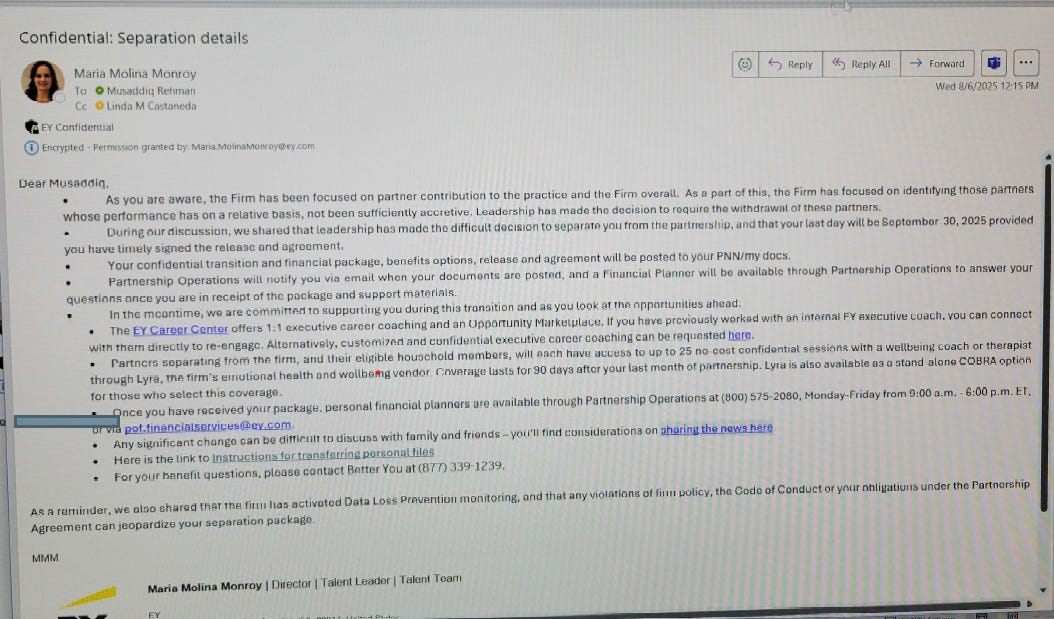
The ownership of the software in question only became legally and commercially problematic after EY ended Rehman’s position while, he alleges, continuing to develop and deploy the platform.
The deeper dispute is therefore not simply about ownership. It concerns the unwritten compact between a professional partnership and those who contribute their intellectual capital to it, and what happens when one of those partners begins exposing the distance between the firm’s formal rules and the practices insiders are expected to understand but leave unspoken.
Source note: The central allegations remain contested. This provisional analysis is based principally on Rehman’s original complaint, filed on 5 March 2026, and the exhibits attached to it. Internal communications reproduced only in the complaint have not been independently authenticated or tested through evidence or cross-examination. Where a statement is supported by a separately filed exhibit, that is identified. The author sent detailed questions to both EY and Rehman, inviting them to address the principal allegations and evidential issues raised in this article. Neither had responded by the time of publication.
A platform with commercial promise
Rehman’s original complaint quotes several internal communications suggesting that EY regarded both him and the technology as commercially important.
On 17 June 2025, an EY senior manager allegedly described the platform as ready for immediate use with clients.
“This is the solution that Musaddiq is leading. The solution is up and running and ready for demo with client immediately. I think it will become part of every data project next year.”
Email attributed to EY Senior Manager Amer Abed Rabbo, 17 June 2025, as quoted in the original complaint, p. 14.
A month later, an EY global director allegedly credited Rehman directly when discussing the funding and wider potential of the platform.
“Musaddiq was key SME when we got funding to build Data Fabric proposition. Built AI Powered Data copilot which I think very interesting for Global reach as accelerator.”
Email attributed to EY Global Director Emilio Jimenez Diaz, 17 July 2025, as quoted in the original complaint, p. 14.
Rehman says the platform was associated with at least $8.9 million in identified and contracting-stage engagements, together with a projected pipeline exceeding $300 million.
If the quoted communications are accurate and representative, they depict technology that was far from marginal to EY’s plans.
The Time & Expense investigation
According to the complaint, EY opened a Time & Expense investigation into Rehman on 28 January 2025. Rehman says the apparent trigger was a broader analysis comparing expense claims with days on which partners and principals had recorded no corresponding client time. He says six partners and principals were selected for investigation, and alleges that all six were between the ages of 44 and 51. On that basis he says he filed a charge of age discrimination with the Equal Employment Opportunity Commission.
The original complaint reserved those discrimination claims rather than pleading them as causes of action in the federal case. Standing alone, the age range provides limited support for his theory. Partners and principals are naturally concentrated in older age groups because it generally takes many years to reach those positions. Without knowing the age profile of the wider partner population, or of everyone whose records showed comparable discrepancies, it is impossible to tell whether the pattern reflects age-based targeting or simply the demographics of the group under review.
What EY concluded
On 7 April 2025, EY issued Rehman a Last Chance Notice. Rehman alleges that Sonia Sande declared the decision final on 10 April, with no internal appeal available; that statement does not appear in the notice itself.
EY said its investigation had determined, through evidence and Rehman’s own admission, that he had “regularly underrepresented the hours” he worked. The notice also accused him of submitting expenses against client codes on days when he had recorded no corresponding client time, directing his assistant to make the entries and then blaming her, and using his corporate American Express card for personal expenditure.
EY concluded that his conduct showed poor judgment and lacked integrity. It also said he had been dishonest in connection with the expense entries. The notice capped Rehman’s FY2025 rating at “Needs To Progress,” stated that the decision would affect his annual compensation and warned that further non-compliance could result in separation for cause.
The corporate-card issue should not be minimised. The filed materials do not disclose what the personal expenses were, their amount or frequency, whether they were accidental or repaid, or whether any were ultimately charged to a client. Until those facts are known, the Amex allegation remains a potentially substantive compliance issue.
The time-recording allegation is less straightforward.
EY was not accusing Rehman of inventing hours or charging clients for work he had not performed. It accused him of failing to record all the time he actually worked.
Underreporting client hours, often called “eating hours,” is a recognised problem in professional services. A 2010 experimental study found that audit managers gave their highest performance evaluations to staff who appeared to underreport time for a preferred client and were more likely to request underreporters for future engagements. The study concerned audit managers responding to hypothetical scenarios, not EY consulting principals, and it cannot establish what happened in Rehman’s case. It does, however, illustrate how formal accuracy requirements can coexist with incentives to protect budgets and margins. [Source: Agoglia, Hatfield and Lambert]
At partner level, the issue is different. In my experience as a former Big Four consulting partner, senior leaders were not expected to reconstruct in granular detail every hour spent reading, preparing, learning or thinking, particularly outside ordinary working hours.
That does not excuse inaccurate records, but it does mean that the practical content of a requirement to record every hour may be less self-evident at partner level than the notice suggests.
An email that reads as pointed compliance
The Last Chance Notice was a serious blow to Rehman’s career and internal standing. His rating was capped. His compensation was affected. His internal record now carried findings of dishonesty and lack of integrity.
He pushed back.
On 16 April, Rehman sent an email to Sonia Sande, EY’s Americas Consulting Talent Leader for Partner and Principal Matters. [Source: Rehman email, Exhibit D, shown below]
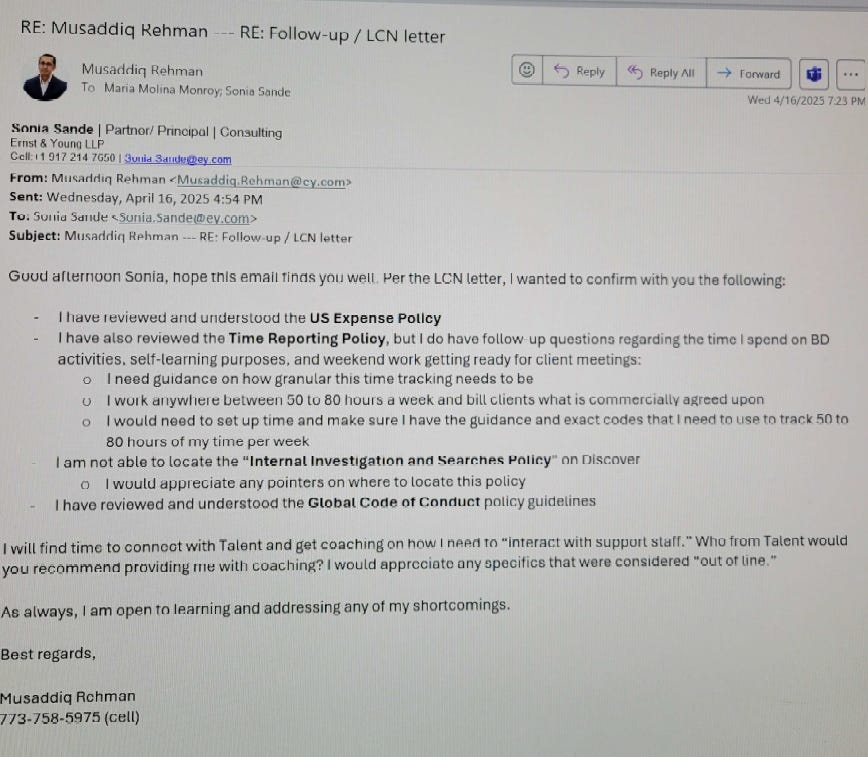
On its surface, the email was cooperative. Rehman said he was open to coaching and willing to address any shortcomings. But it can also be read as pointed compliance, the kind of formally cooperative response that exposes the impracticality of the demand being made.
He told EY that he worked between 50 and 80 hours a week, billed clients according to the commercial arrangement and needed precise instructions on how to record everything else: business development, self-learning, weekend preparation and other activities.
“I would need to set up time and make sure I have the guidance and exact codes that I need to use to track 50 to 80 hours of my time per week.”
Rehman’s email to Sonia Sande and Maria Molina Monroy, 16 April 2025.
The formal message was: I am willing to comply.
The underlying challenge was: Show me how.
EY had found that Rehman regularly underreported his working time, so Rehman was now asking the firm to identify the exact codes and procedures through which a partner should log every hour of business development, learning, client preparation and weekend activity.
He was also separating three concepts that firms sometimes allow to blur:
time actually worked;
time entered into the internal system; and
time ultimately charged to the client.
A firm can decide to invoice less than the total time recorded. That is a commercial decision. It does not follow that the underlying work did not occur.
According to the complaint, Sande’s response instructed him to establish “the true mix of BD vs paid delivery work” and acknowledged that “what we choose to invoice clients is a separate commercial decision.” [Source: Original complaint, pp. 16–17.]
Rehman’s email therefore did more than seek clarification. It created a record that complete compliance was not necessarily simple, because the categories and expectations were not self-evident.
When the defence became the problem
Every organisation has formal rules and tacit rules.
The formal rules are contained in policies, codes and official instructions. The tacit rules are learned by watching what is rewarded, what is punished and what colleagues understand without needing to say aloud.
Professional-services firms formally require accurate time recording.
They also reward clean margins, efficient engagements and commercially attractive numbers.
Those demands can coexist because insiders learn how to navigate the gap between them. They understand which activities are recorded, which are absorbed and which should not attract too much attention.
The stability of the system depends partly on the contradiction remaining implicit.
Rehman’s response to the investigation appears to have crossed the line that made it explicit.
He did not confine his defence to pointing out administrative shortcomings in the reporting system. According to the complaint, he told EY that the failure to record all hours was widespread among partners and principals, that labour and utilisation records did not reflect actual effort, and that engagement profitability was being calculated using commercially convenient rather than actual hours.
He also says he supplied a spreadsheet which, in his account, showed time or costs associated with internal meetings being charged against the travel budgets of SEC-registrant clients.
The investigation had started as an examination of Rehman’s conduct, but his defence raised questions about the reliability of the firm’s records, the meaning of its profitability figures and whether its rules were being enforced selectively.
Rehman was challenging the distinction between the official rule and the operational reality beneath it. He also disputed the absence of an appeal and submitted a further written rebuttal. According to the complaint, a representative of EY’s Partner Forum subsequently questioned whether the firm needed an appeal process and greater transparency around sanctions.
On 10 June 2025, Rehman escalated further by filing an internal ethics complaint against Traci Gusher and other leaders in EY’s AI and data practice. He alleged targeting, discriminatory treatment, governance failures, exclusion from leadership activities, disclosure of confidential details from the HR investigation and obstruction of a proposed move to EY’s Finance practice.
According to the complaint, EY investigated and dismissed the complaint on 23 July, finding no code-of-conduct violations. The underlying ethics complaint and investigation report have not been filed, so the evidence supporting the allegations and EY’s reasons for rejecting them are not available.
By his own account, Rehman had become more than a partner contesting a compliance finding.
He had become a persistent internal challenger who was accusing senior people and questioning the systems through which the firm assessed both conduct and contribution.
The platform begins moving away from him
Rehman says that on 10 July 2025, he was instructed to transfer knowledge of the platform to another EY professional. Ten days later, he objected that work already contained in the Data Co-Pilot appeared to be restarting under a different name.
“90% of what Kevin walked through is already built/designed in AI Data Co-pilot so surprised to see it being kicked off again under a different name/title.”
Email from Musaddiq Rehman to Zakir Hussain, 20 July 2025, as quoted in the original complaint, p. 18.
His supervisor, Zakir Hussain, allegedly replied that EY needed to examine what Rehman had already built, identify the overlap and determine how to scale and deploy it across the firm’s data businesses. The complaint reproduces a lengthy message in which Hussain referred to “what you had initiated with the copilot” and proposed reviewing how it could be extended and deployed “on as many of our projects as we can.” [Source: Original complaint, p. 18.]
This suggests that as Rehman’s relationship with leadership deteriorated, EY began distributing the knowledge needed to continue the work on the platform without relying exclusively on him.
Valuable to clients
The commercial evidence quoted in the complaint conflicts with the later explanation for Rehman’s removal.
On 2 September 2025, after EY had already told Rehman he would be required to leave, Managing Director David Looby allegedly wrote about three significant engagements at one client.
“The 3rd project is the one most at risk… Musaddiq was driving… Musaddiq has the client relationship… I would welcome Musaddiq as continuing to lead or if needed a new PP. The client is tricky to handle, so we need to be careful if we pick a new person.”
Email attributed to EY Managing Director David Looby, 2 September 2025, as quoted in the original complaint, pp. 14–15.
The same day, a client allegedly reported that three proposed replacements had failed to inspire confidence.
“We finished intro convos with the three suggested partners to replace Musaddiq—Initial thoughts, we would not say any of them hit the mark… The other two candidates were a hard pass.”
Client email quoted in the original complaint, p. 15.
If accurate and representative, these allegations suggest that he remained valuable in the areas most closely connected to the platform: subject-matter expertise, client relationships, demonstrations and business development.
“Not sufficiently accretive”
On 6 August 2025, EY informed Rehman that he would be required to withdraw from the firm. The communication did not link the withdrawal decision to a further breach of the Last Chance Notice.
It gave a different explanation.
“The Firm has been focused on partner contribution to the practice and the Firm overall. As part of this focus, we identified a group of partners whose performance, on a relative basis, has not been sufficiently accretive to their respective practices and the Firm overall. Leadership has made the decision to require the withdrawal of these partners.”
EY separation email to Rehman, 6 August 2025, Exhibit E, p. 1.
“Accretive” is corporate language for adding value.
The two sets of communications create an evident tension over how EY measured contribution.
On Rehman’s pleaded account, he was described as the “key SME” behind a funded platform that an EY global director regarded as having potential global reach as an accelerator; the solution was “up and running” and expected to become part of every data project; a managing director wanted him to continue leading a major client opportunity because he held the relationship; proposed replacements reportedly failed to impress a client; and EY was seeking to transfer his knowledge so that the platform could be deployed more widely. [Source: Original complaint, pp. 14–15 and 17–18.]
Yet the partner who says he originated and then led the work was told that his relative performance was not sufficiently accretive.
The power to define contribution
Rehman further alleges that EY’s internal dashboard had attributed approximately $5.7 million in revenue to him, but that roughly $1.3 million was placed in his permanent performance record on his final day. His access to the firm’s systems was terminated, he says, preventing him from preserving or challenging the underlying information.
The alleged discrepancy does not prove manipulation. Without the dashboard, the final record and EY’s credit-allocation methodology, it cannot presently be resolved.
That said, performance systems appear objective because they produce numbers, but at the end of the day it is the organisation that determines what those numbers mean, which activities count, who receives credit and which figure becomes the official record.
Why the case became about IP
On the record presently available, Rehman’s conduct appears consistent with that of a partner who expected the platform’s success to enhance his position within EY, as opposed to that of an outside inventor seeking a separate royalty.
He says he led its development, helped obtain funding, demonstrated it to clients and pursued related work. The expected return appears to have been the ordinary return associated with partnership: credit, influence, earnings and continued membership.
After EY removed him, his expected benefits evaporated. On this interpretation, the IP lawsuit is the legal form taken by a partnership grievance after the implicit understanding broke down.
The said and the unsaid
The most revealing aspect of Rehman’s case may therefore have little to do with software code.
It concerns the boundary between the said and the unsaid.
The stated rule was that partners must record their time accurately.
The tacit reality, Rehman alleges, was that senior people did not record everything they did and that the firm’s commercial systems were built around a more selective representation of effort.
The stated rule was that concerns could be raised through internal channels.
The tacit expectation may have been that challenges would remain narrow, private and containable.
The stated rule was that partners were rewarded for creating value.
The hidden question was who controlled the definition of that value once a partner became difficult.
The unresolved question
EY’s Last Chance Notice contains serious allegations, particularly concerning the management of expenses and the corporate card. Those matters require fuller explanation before any fair final judgment can be made.
Nor does originating a promising platform make a partner immune from legitimate performance or conduct scrutiny.
The pleaded communications and filed exhibits nevertheless raise unresolved questions about the factors that led to Rehman’s required withdrawal.
The firm appeared to regard the technology as valuable.
Its managers allegedly regarded Rehman as central to developing, demonstrating and selling it.
At least one significant client engagement appears, on the complaint’s account, to have relied heavily on his involvement and client relationship.
The complaint depicts EY as seeking to preserve and distribute knowledge associated with the platform.
Yet it removed him after determining that his relative contribution was not sufficiently accretive.
Those propositions can coexist, but it remains to be seen how EY weighed platform value, client value, conduct and overall performance.
At face value, the lawsuit asks who owned an AI platform. Underneath, it raises a more fundamental question about professional partnerships:
What happens when a partner stops observing the cultural boundary between what everyone understands and what nobody is supposed to articulate too clearly?
Rehman may ultimately fail to prove that EY retaliated against him or misappropriated his technology. The pleadings and exhibits nevertheless show a rapid sequence: a time-and-expense investigation, an adverse internal finding, wider complaints by Rehman, knowledge-transfer requests, separation and, eventually, an ownership lawsuit. Whether those events were causally connected in the way Rehman alleges remains for the litigation to determine.
The investigation began by pulling back the veil on Rehman. His response was to pull back the veil on EY.
Where the case stands
Rehman filed a first amended complaint on 7 April 2026. This article is presently based principally on his original complaint.
On 9 July, EY US and the individual defendants moved to compel arbitration of Counts I–VII and IX–XIII of the amended complaint and to dismiss Rehman’s Sarbanes-Oxley retaliation claim, Count VIII. EY argues that partnership agreements bind Rehman to arbitration and advances separate grounds for dismissing the SOX claim. These are defence arguments, not judicial findings. I did not identify a ruling on those motions in the public docket materials reviewed.
OSHA had previously closed Rehman’s administrative whistleblower complaint for lack of coverage. The agency said that its decision was procedural and did not determine the merits of concerns he might pursue through other channels.
Full timeline of events
Approximately June 2010: Rehman joins EY US and later serves as a principal in its AI and Data practice.
January 2024: Rehman says he begins conceiving and developing the AI & Data Component Suite using personal equipment, software licences and more than $6,000 of his own funds.
9 July 2024: Rehman says EY first formally directs him to lead the design and development of the platform EY called the AI-Ready Data Co-Pilot. He maintains that minimum viable versions of most components already existed by then.
28 January 2025: EY opens a Time & Expense investigation into Rehman. He says it follows a broader review of expenses claimed on days when partners or principals recorded no corresponding client time.
January to May 2025: Rehman says he raises concerns during the investigation about time-recording practices, engagement profitability and expense coding. He alleges that senior professionals did not record all hours worked and that this distorted labour and profitability records.
February 2025: Rehman alleges that EY Global approves FY2026 funding for platforms including the Component Suite. The complaint places the approved funding at $2.3 million.
7 April 2025: EY issues Rehman a Last Chance Notice. EY says its investigation found that he regularly underreported his working hours, submitted expenses against clients without corresponding time entries, blamed his assistant for entries he had directed, and used his corporate American Express card for personal expenditure.
10 April 2025: Rehman says EY declares the Last Chance Notice final and provides no internal appeal.
16 April 2025: Rehman emails EY asking for precise guidance on how to record between 50 and 80 hours of weekly work, including business development, self-learning and weekend client preparation.
16 April 2025: According to the complaint, Sonia Sande replies that Rehman should establish “the true mix of BD vs paid delivery work” and that what EY chooses to invoice clients is a separate commercial decision.
21 April 2025: Rehman submits a further rebuttal disputing the Last Chance Notice findings. He says the dishonesty finding lacked evidence of intent and raises concerns about expenses that were allegedly never credited to him.
13 May 2025: An EY Partner Forum representative allegedly questions whether the Last Chance Notice process needs an appeal mechanism and greater transparency around sanctions.
10 June 2025: Rehman files an internal ethics complaint against Traci Gusher and other AI and Data leaders. He alleges targeting, governance failures, discriminatory treatment, disclosure of confidential investigation details and obstruction of a proposed transfer.
17 June 2025: An EY senior manager allegedly describes the platform as operational, immediately ready for client demonstrations and likely to become part of every data project.
10 July 2025: Rehman says he is instructed to transfer knowledge of the platform to another EY professional.
17 July 2025: An EY global director allegedly describes Rehman as the key subject-matter expert involved when funding was obtained and refers to the AI-Powered Data Co-Pilot as a potential global accelerator.
20 July 2025: Rehman objects that approximately 90% of work being presented under a different name was already contained in the Data Co-Pilot. His supervisor allegedly replies that EY wants to identify overlap, extend the platform and deploy it across as many projects as possible.
23 July 2025: According to Rehman’s pleading, EY dismisses his internal ethics complaint, finding no Code of Conduct violations.
30 July 2025: Rehman alleges that his supervisor describes the platform to a group of principals as a “pipe dream” and says EY is not a product company.
1 August 2025: Two days later, the same supervisor allegedly tells a broader EY group that he looks forward to leveraging the platform across EY’s data engagements.
6 August 2025: EY informs Rehman that he will be required to withdraw from the firm because his performance, on a relative basis, has not been “sufficiently accretive” to the practice and the firm.
6 August 2025: Rehman says he files an EEOC charge challenging the Last Chance Notice and alleging discrimination. The discrimination allegations were initially reserved rather than pleaded as substantive causes of action in the original federal complaint.
15 August 2025: Rehman alleges that the platform receives favourable feedback during a client chief information officer workshop.
2 September 2025: An EY managing director allegedly says Rehman was driving a significant client project, held the client relationship and should continue to lead if possible.
2 September 2025: A client allegedly reports that proposed replacements for Rehman failed to meet expectations, describing two candidates as a “hard pass.”
30 September 2025: Rehman’s withdrawal from EY becomes effective.
30 September 2025: Rehman alleges that EY enters approximately $1.3 million in attributed revenue into his permanent performance record, although an earlier internal dashboard had shown approximately $5.7 million, and terminates his system access the same day.
5–6 November 2025: Rehman emails EY Partnership Operations requesting the latest partnership agreements, operating agreement and Code of Conduct.
November 2025: Rehman files provisional patent applications covering AI-powered data lifecycle management and master-data harmonisation.
November 2025: Rehman alleges that, during mediation, EY produces a document described as a 2023 partnership agreement that incorporates an earlier 2020 agreement. He disputes whether the agreements were validly supplied to or accepted by him.
5 January 2026: Rehman files a Sarbanes-Oxley whistleblower complaint with the Occupational Safety and Health Administration.
14 January 2026: OSHA closes the whistleblower complaint for lack of coverage. It says the information concerned internal timekeeping, billing, expenses and confidentiality rather than conduct within its whistleblower jurisdiction. OSHA expressly states that the decision is procedural and does not address the merits of other concerns.
5 March 2026: Rehman files the original federal complaint in the Southern District of New York, asserting trade-secret misappropriation, SOX retaliation and related state-law claims.
7 April 2026: Rehman files a first amended complaint.
20 April 2026: Judge Margaret Garnett adjourns the initial pretrial conference from 28 April to 23 June 2026 while service remains incomplete.
2 July 2026: EY’s later federal motion states that Rehman filed a related action in New York state court.
9 July 2026: EY US and the individual defendants move to compel arbitration of most claims and dismiss the SOX claim. EY argues, among other things, that the partnership agreements require arbitration and that Rehman’s reported concerns were not protected by SOX. These are defence arguments, not judicial findings.
This article is part of the Big4News Case Watch series. Case Watch tracks significant regulatory investigations, enforcement actions and litigation involving Deloitte, PwC, EY and KPMG, focusing on matters that shed light on internal culture, governance and accountability.
About Claudine Cassar

I’m a corporate anthropologist and former Deloitte equity partner. I sold my technology business to Deloitte in 2016 and led the Malta Consulting team for five years. I am the founder and editor of Big4News, which provides independent, clear analysis of PwC, Deloitte, EY, and KPMG — free from corporate spin.
Find me on LinkedIn, X, Instagram, or my author website.
Feel free to reply to this newsletter — I read every reply.
Trying to keep up with technology at Deloitte, PwC, EY and KPMG? Start here →
https://www.big4news.com/t/technology-and-ai