


A guest post by Kimberley Rowley, a strategic communications and change leader who has worked with senior leadership teams on transformation, culture change and organisational strategy. She is the founder of Resilient Mothers and U OK Mum?, initiatives focused on the structural challenges facing mothers at work. Full bio at the end of the article.
Key Takeaways
Family-friendly policies reveal little about what happens to employees after they use them.
Employers should track parental-leave uptake, retention, pay and progression for several years after parenthood.
Companies have become increasingly good at telling us how supportive they are of working parents.
Enhanced maternity and parental leave, flexible and hybrid working, staggered hours and carers’ policies are routinely promoted as evidence of a progressive workplace. They feature in recruitment campaigns, employee value propositions and help organisations compete for talent. However, the existence of a policy tells us very little about what happens to the people who use it.
Recent high-profile cases have brought this into focus. A proposed class action against Deloitte Consulting in the US alleges that employees taking parental, pregnancy or pregnancy-disability leave could be disadvantaged in performance ratings and compensation because they were assessed against colleagues who had worked for the full year.
The central allegation is therefore not that employees were prevented from taking leave, but that disadvantage could emerge afterwards through the systems used to assess performance and compensation. Deloitte contests the claims. In August, a federal judge refused to dismiss the proposed class action. No court has ruled on the merits, and the proposed classes have not been certified.
In the UK, an employment tribunal awarded former Goldman Sachs compliance executive Jonathan Reeves £1.45 million in July 2026, following an earlier finding that he had suffered sex discrimination and unfair dismissal arising from his dismissal while still on parental leave.
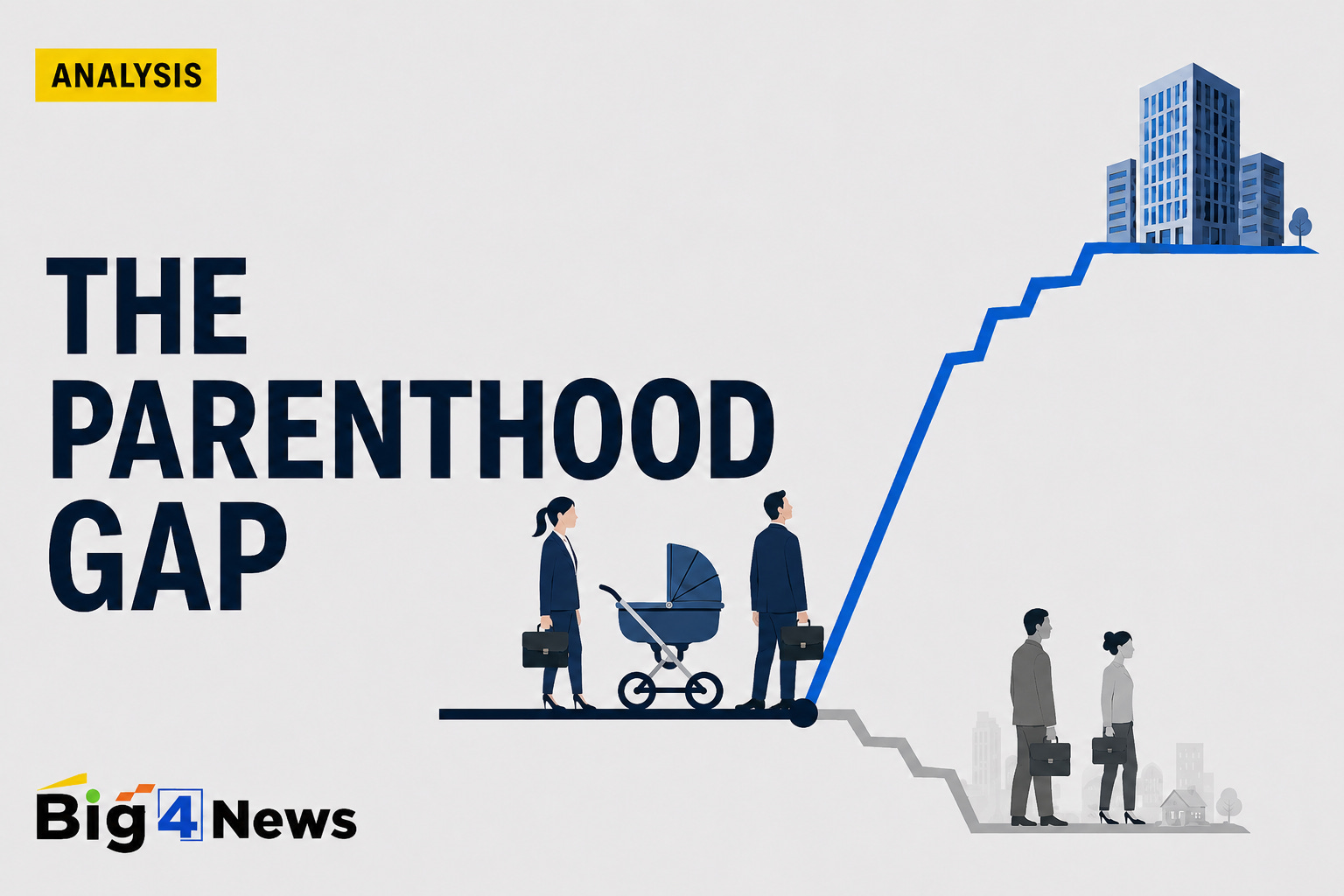
Different cases, different circumstances. One remains a contested allegation; the other resulted in a tribunal finding. But both highlight the same weakness in how we judge employers: we see the policy but rarely see the outcome. I believe that needs to change. Large employers should ultimately be required to publish what I would call the parenthood gap alongside the gender pay gap: parental-leave uptake by gender, return rates after maternity and parental leave, flexible-working applications and outcomes, and retention, pay and progression for several years.
By the parenthood gap, I mean a set of parenthood outcome measures rather than a single headline percentage.
The aim is not to produce another league table for its own sake. It is to find out whether policies promoted as evidence of a parent-friendly culture actually deliver for the employees who need them.
The motherhood penalty doesn’t end with maternity leave
There is already substantial evidence that becoming a mother has a long-term economic effect.
ONS analysis published in 2025 found that following a first birth, mothers in England experienced an average total reduction in earnings of £65,618 over the subsequent five years, compared with earnings one year before the birth. Five years after the birth, average monthly earnings were still 42% lower. ONS also found a sustained reduction in the probability of paid employment.
That matters because employers often focus on the immediate event: Did she return after maternity leave?
Return is important, but it is not enough to tell us whether the return was sustainable.
The impact can emerge much later. A mother may return successfully, then request to work four days a week, alter her start and finish times or work more flexibly because of childcare. She may spend months trying to make an arrangement work before eventually deciding that the role is no longer sustainable. Or she may stay but find that her hours, working pattern or caring responsibilities coincide with slower progression or lower earnings.
We should not assume that every later resignation or change in progression was caused by parenthood. But neither should we assume that a successful return means the policy worked.
The demand for flexibility is also gendered. Research by Pregnant Then Screwed and Women in Data found that mothers working full-time were 2.5 times more likely than full-time fathers to request flexible working after parental leave.
If employers want to know whether their policies are retaining talent, they need to follow what happens beyond the return date. I would start with measures at six, 12, 24 and 36 months.
Six months begins to show whether the return is working in practice. Twelve months takes the employee through a fuller business and performance cycle. Twenty-four months shows whether the pattern is holding and thirty-six months gives a much better view of delayed attrition, pay and career progression across several cycles.
That final measure matters. The person who leaves two or three years after becoming a parent may never appear in a maternity-retention statistic at all. Yet if the same pattern appears repeatedly across a workforce, it is something leadership should want to understand.
There is a risk that progressive policies become evidence of progress simply because they exist. At its worst, that can become a form of flex-washing: an organisation promotes itself as flexible and parent-friendly while providing little visibility of what happens to the careers of the employees who rely on those policies.
I am not suggesting that this is always deliberate. Sometimes an organisation introduces a policy with a clear objective and that objective gets lost. Sometimes a policy becomes standard within a sector because competitors offer it and candidates expect it. Over time, having the policy can become confused with achieving the outcome.
The more useful question is what the policy was intended to achieve. If enhanced parental leave exists to retain talented people after they become parents, then retention should be measured. If equal parental leave is intended to support gender equality, employers should know who uses it and what subsequently happens to the careers of mothers and fathers. If flexible working is intended to enable people with caring responsibilities to remain and progress, employers should examine applications, decisions and subsequent career outcomes.
At a national level, PwC is already applying this broader principle. Its Women in Work 2026 Index looks at outcomes including gender pay gaps, female participation, unemployment and full-time employment. PwC notes that the highest-performing countries tend to have parental-leave and childcare policies that support women’s continued participation and progression.
This is a different unit of analysis from the company-level reporting I am proposing, and it cannot tell us whether an individual employer’s parental policies are working. But the principle is instructive: policy should be judged partly by what happens after it is implemented.
PwC’s analysis also highlights Australia, where the gender pay gap fell from 14.2% to 10.7% between 2020 and 2024 alongside wider improvements in women’s labour-market outcomes and an increase in the proportion of parental leave taken by men to 20% in 2025.
The numbers do not prove that any one policy caused those outcomes. They do show the value of looking across several measures rather than treating the existence of a benefit as evidence of success.
The parenthood gap is not only about mothers
Women experience by far the larger aggregate career and earnings penalty associated with parenthood. But the consequences of the parenthood gap are not confined to women.
Jonathan Reeves’ case is important for that reason. Reeves took six months of parental leave under Goldman Sachs’ gender-neutral policy. A London employment tribunal later awarded him £1.45 million, following an earlier finding of sex discrimination and unfair dismissal arising from his dismissal while still on parental leave. Goldman Sachs said it was a market leader in paid parental leave, encouraged parents of either gender to take its 26 weeks of paid leave, and strongly disagreed with the tribunal’s decision.
The downstream consequences were striking. The tribunal accepted evidence that the stigma of the litigation significantly damaged Reeves’ subsequent job prospects. Interviews were cancelled, offers were withdrawn and prospective employers subjected him to greater scrutiny. He applied for 417 roles and reached interview stage for 43.
That individual case does not tell us how fathers fare across Goldman Sachs, nor would aggregate parenthood-gap reporting necessarily expose every case of discrimination. But it does demonstrate why the question cannot simply be whether fathers are technically entitled to parental leave.
We need to know whether men use it and what happens when they do. If fathers feel unable to take substantial leave without risking their progression, the consequences extend beyond those men. That reinforces a model in which women continue to absorb more care and, consequently, more of the associated career penalty. That is why parental-leave uptake by gender belongs in the reporting framework.
We have been here before
In 2016, the House of Commons Women and Equalities Committee recommended requiring large companies to report retention rates for women 12 months after returning from maternity leave and 12 months after making a flexible-working application. It specifically encouraged government to link that reporting with its work on the gender pay gap.
The Government did not take forward the reporting requirement in 2017, but one of its objections is worth revisiting. It acknowledged that retention reporting could support greater transparency but argued that knowing whether a woman remained with her employer would not tell us whether she had nevertheless been treated unfairly — for example, by being denied training or promotion opportunities.
I think that objection was right. Retention alone is too blunt. However, the answer is not to measure nothing. It is to measure more intelligently. And this is where the Deloitte allegations become particularly relevant. The claim is not that employees were unable to take leave. It alleges that disadvantage could appear elsewhere in the employment system: in performance ratings, compensation, progression and ultimately redundancy decisions. Those allegations remain contested, but they illustrate precisely why a retention figure on its own cannot tell the whole story.
That is why the parenthood gap I am proposing should include pay and progression alongside retention, and why the measurements should continue out to 36 months.
An employee can stay and still experience a career penalty. Therefore, we need data capable of capturing both.
Publication creates accountability
Large employers are likely already to hold much of this information: records of leave, formal flexible-working requests, pay, promotion, employment status and departures.
Qualitative evidence can sit alongside the numbers. Employee surveys, one-to-ones and exit interviews can help employers understand whether childcare, flexibility, manager behaviour or career concerns contributed to the patterns appearing in the data.
The point is not simply to collect more information. It is to connect information that currently sits in different parts of the organisation, identify where the friction occurs and then, crucially, publish the outcomes.
The precedent for mandatory transparency already exists. In Great Britain, employers with 250 or more employees on the relevant snapshot date are subject to annual gender pay gap reporting requirements.
A parenthood gap would be more complicated than the existing annual gender pay gap reporting framework. It would require an agreed methodology, safeguards for small cohorts and care around interpretation and causation. However, complexity is not an argument for opacity. I believe the Government should revisit the question of mandatory reporting and develop a consistent framework for large employers.
Companies do not, however, need to wait for legislation. If an organisation already promotes equality, flexibility, family support and talent retention as part of its employee proposition, it should have the confidence to measure whether those claims are borne out — and the integrity to publish what it finds.
The figures will not be perfect. Not every parent who leaves does so because of work. Not every flexible-working request can be approved. And no dataset will capture every individual experience. The question is whether an organisation knows what happens to the people who use the policies it promotes.
Policy is one thing. What happens to parents afterwards tells us whether the culture actually supports them.
The UK Government may ultimately need to require employers to publish that evidence. Until then, companies that genuinely stand behind their parent and carer policies should be willing to do it themselves.
Sources
1. Claudine Cassar, “Deloitte offers parental leave. A lawsuit alleges employees who take it are penalized,” Big4News, 24 July 2026. Joanne Barela alleges that Deloitte’s performance and compensation systems disadvantaged employees taking parental, pregnancy or pregnancy-disability leave by comparing their annual impact with colleagues who had worked the full year. Deloitte contests the claims; no court has ruled on the merits, and the proposed classes have not been certified.
2. Reuters, “Goldman Sachs ordered to pay male banker £1.45 million for sex discrimination,” 29 July 2026. A London employment tribunal awarded former Goldman Sachs compliance executive Jonathan Reeves £1.45 million after an earlier finding of sex discrimination and unfair dismissal arising from his dismissal while still on parental leave. Goldman Sachs said it strongly disagreed with the decision. The tribunal also accepted evidence that the litigation had damaged Reeves’ subsequent job prospects; he applied for 417 roles and reached interview stage for 43.
3. Office for National Statistics, “The impact of motherhood on monthly employee earnings and employment status, England: April 2014 to December 2022,” 3 October 2025. ONS estimated a cumulative earnings reduction of £65,618 in the five years following a first birth. Five years after birth, mothers’ monthly earnings were on average 42% lower than one year before the birth.
4. Pregnant Then Screwed and Women in Data, “Mothers are twice as likely as fathers to ask for flexible working after parental leave,” 6 April 2024. The research found that mothers working full-time were 2.5 times more likely than full-time fathers to request flexible working.
5. PwC, Women in Work 2026, March 2026. PwC’s index measures labour-market outcomes including gender pay gaps, female participation, unemployment and full-time employment. It notes that high-performing countries tend to combine stronger female labour-market outcomes with supportive parental-leave and childcare policies. Its Australia analysis reports that the gender pay gap fell from 14.2% in 2020 to 10.7% in 2024, while the proportion of parental leave taken by men reached 20% in 2025.
6. House of Commons Women and Equalities Committee, Pregnancy and maternity discrimination, First Report of Session 2016–17, HC 90, 31 August 2016, para. 115. The Committee recommended requiring large companies to report retention rates for women 12 months after returning from maternity leave and 12 months after applying for flexible working, and encouraged government to link this reporting to its work on the gender pay gap.
7. HM Government, Pregnancy and maternity discrimination: Government response to the House of Commons Women and Equalities Committee, January 2017. The Government did not take forward mandatory retention reporting, arguing in part that retention data alone would not reveal whether women who stayed had nevertheless experienced disadvantage such as being denied training or promotion opportunities.
8. UK Government, Gender pay gap reporting: guidance for employers. In Great Britain, employers with 250 or more employees on the relevant snapshot date are subject to annual gender pay gap reporting requirements.
About Kimberley Rowley

Kimberley Rowley is a strategic communications and change leader with experience helping organisations navigate transformation, culture change and complex stakeholder environments.
Throughout her career, she has worked closely with senior leadership teams to shape and communicate corporate strategy, organisational vision and values, and major programmes of change. Her work has given her a particular interest in the gap between what organisations say they value and how those values are experienced by employees in practice.
Kimberley is also the founder of Resilient Mothers and U OK Mum?, initiatives focused on the structural challenges facing mothers at work and the wider systems that influence women’s wellbeing, careers and economic participation.
Her work explores how organisations can move beyond well-intentioned policies towards better measurement of employee outcomes, particularly around parenthood, flexible working, retention and progression. She is especially interested in how communications, culture, leadership behaviour and organisational data can be used together to identify where policies are failing in practice — and how greater transparency can help employers build trust, retain talent and create workplaces that genuinely support parents and carers.
