


The contraction from the Big Eight to the Big Four was not one event. It was the result of mounting commercial pressures, globalisation, a succession of enormous accounting-firm mergers and, finally, the implosion of one of the most prestigious names in the profession.
The Big Eight come under pressure
In the 1970s the global audit firms found themselves caught in cross winds. On one hand they were under extreme pressure to reduce audit fees, while on the other audits were becoming more complex due to the evolving nature of their multinational clients.
Audits had become commoditised—the increased regulation by the Financial Accounting Standards Board (FASB, established 1973) of what went into an audit, and the procedures to be followed, had removed any differentiation between the outputs of the firms.
Clients had come to view auditors as interchangeable, and audits as not providing any real value to the business beyond regulatory compliance. This led to a price war, squeezing margins and creating the risk of an erosion in audit quality as firms scrambled to reduce audit costs to a minimum.
Whereas previously auditors could rest assured that once they signed on a client they were guaranteed their business for several years, companies were now no longer hesitating to change auditors, either to get a better deal, or, as was becoming more common, to shop around for a positive opinion when their current auditors were proving difficult about how aspects of their business were being accounted for.
At the same time, litigation was becoming an increasingly serious threat.
The recessions in the early eighties led to the firms paying close to $180 million in settlements between 1980 to 1985: Arthur Andersen-$137.1 million; Peat, Marwick $19.4 million; Ernst & Whinney $6.0 million; Deloitte, Haskins & Sells $5.0 million; Coopers & Lybrand $4.4 million; Price Waterhouse $3.5 million; Touche Ross $2.3 million; and Arthur Young $1.5 million.
While all this was happening, a new wave of acquisitions and mergers hit the markets, with half of the largest corporations in the US going through some form of restructuring.
However, unlike what had happened in the first decade of the twentieth century, these mergers did not generate new business for the audit firms—it led to them losing clients, because every time two firms merged, an audit was lost.
In what was proving to be the perfect storm for auditors, consulting was the north star.
While audit revenues stalled, or dwindled, advisory revenues were growing dramatically, driven in the main by implementation services for computer systems. The mergers that were impacting audit dollars created consulting fees for entities such as investment bankers, who were at the forefront of the restructuring wave.
Market pressures were intense, and to compete, the Big Eight sought to strengthen themselves by merging—not only to survive the storm in the US, but also to better serve their multinational clients, who increasingly required seamless cross-border audit, tax, and advisory services.
Global clients required global firms
Globalisation was another key driver for their expansion. To better serve their multinational clients—who increasingly required seamless cross-border services—accounting practices worldwide reconfigured into transnational firms through a series of mergers.
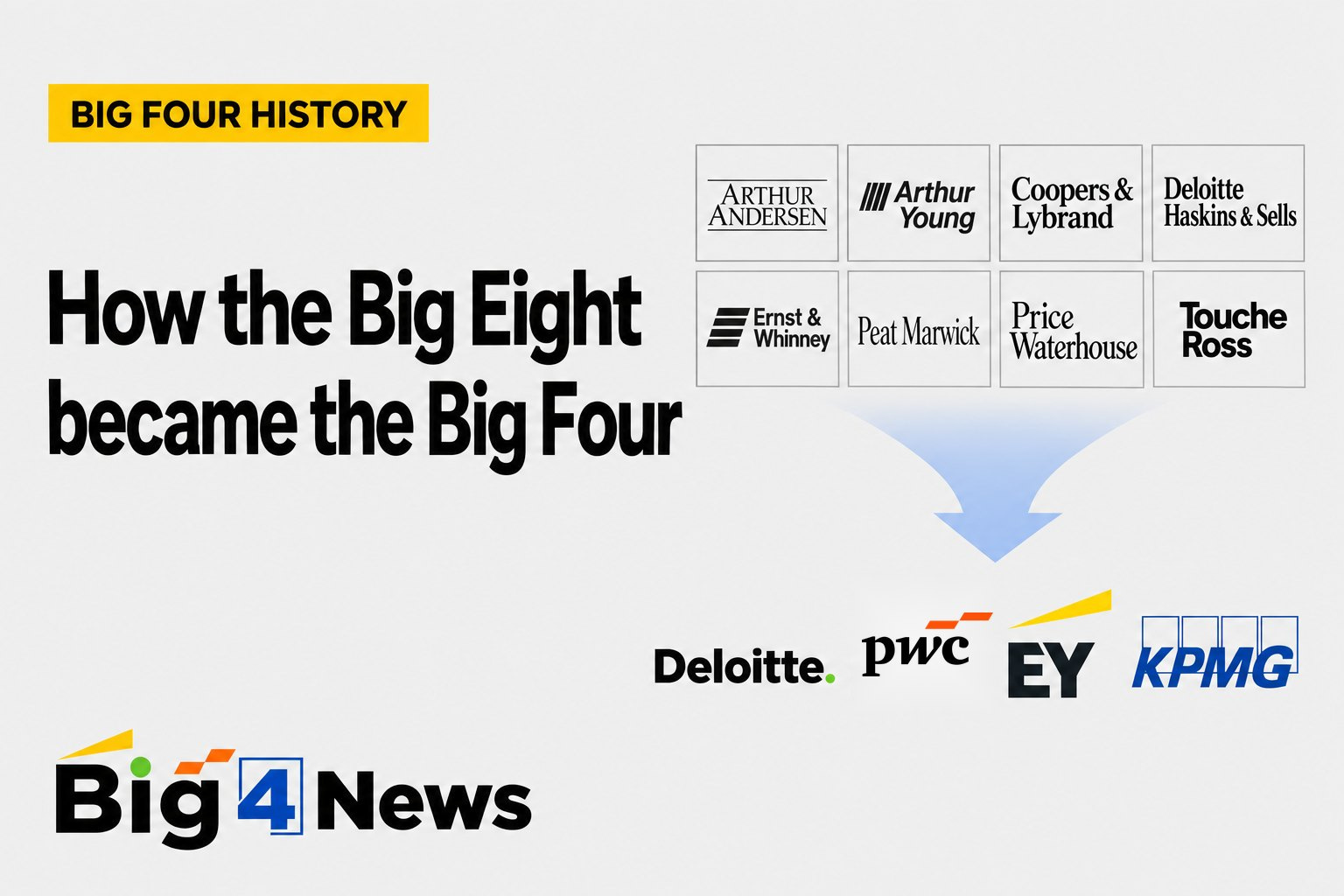
At the beginning of the 1980s, the US profession was still dominated by eight names:
Arthur Andersen
Arthur Young
Coopers & Lybrand
Deloitte Haskins & Sells
Ernst & Whinney
Peat Marwick
Price Waterhouse
Touche Ross
Within little more than a decade, four of those names would disappear through merger.
1987: Peat Marwick becomes KPMG
The first major change came in 1987, when Peat Marwick joined forces with Klynveld Main Goerdeler, an international accounting organisation with Dutch and German roots. The resulting firm became KPMG.
The transaction did not itself reduce the number of Big Eight firms, because Klynveld Main Goerdeler was not another member of the US Big Eight. But it transformed Peat Marwick into a much larger international network and produced one of the four names that survives today.
1989: the Big Eight become the Big Six
The decisive consolidation came two years later.
Ernst & Young resulted from the 1989 merger of Ernst & Whinney and Arthur Young. Deloitte & Touche was created through the 1989 merger of Deloitte Haskins & Sells and Touche Ross.
Those two mergers removed four Big Eight firms and replaced them with two. The Big Eight had become the Big Six:
Arthur Andersen
Coopers & Lybrand
Deloitte & Touche
Ernst & Young
KPMG
Price Waterhouse
The underlying economics had not changed. Audit remained strategically important but commercially difficult, while multinational clients increasingly expected their accountants to provide consistent services across multiple jurisdictions. Scale mattered. Geographic reach mattered. And the rapidly expanding consulting businesses gave the firms another powerful incentive to grow.
1998: Price Waterhouse and Coopers & Lybrand create PwC
For almost a decade, the Big Six remained intact. Then came another combination between two of the largest surviving firms.
PricewaterhouseCoopers was formed in 1998 through the merger of Price Waterhouse and Coopers & Lybrand.
That reduced six firms to five:
Arthur Andersen, which was founded in Chicago in 1913
KPMG, resulting from the 1987 merger of Peat Marwick and Klynveld Main Goerdeler
Ernst & Young, resulting from the 1989 merger of Ernst & Whinney and Arthur Young
Deloitte & Touche, created through the 1989 merger of Deloitte Haskins & Sells and Touche Ross
PricewaterhouseCoopers, formed in 1998 through the merger of Price Waterhouse and Coopers & Lybrand
Collectively, these firms were known as the Big Five.
By this point, consolidation had transformed the accounting industry. Eight dominant firms had become five enormous global organisations. But the final reduction would happen in a very different way.
The fall of Arthur Andersen
The move from five firms to four was not a merger.
On October 16, 2001, Enron issued its third-quarter earnings press release—with its shocking $1.01 billion non-recurring charge that turned reported recurring profits into a net quarterly loss of $618 million.
Two hours later Kenneth Lay announced during a conference call with investors and analysts that shareholders’ equity would be reduced by approximately $1.2 billion.
The genie was out of the bottle.
The very next day, the SEC opened an inquiry into Enron, requesting documentation explaining the write-offs. Two days later, the company informed their auditors that the regulator was investigating the special purpose entities set up by the Chief Financial Officer, Andrew Fastow.
The news set off plate tectonic reactions at Andersen.
David Duncan, the lead engagement partner for the Enron account, called an urgent meeting and initiated a massive document destruction and email deletion operation, claiming it was to comply with the firm’s document-retention policy. Instructions to destroy documents were also sent to audit teams working on Enron matters in Portland, Chicago and London.
The policy in question stated that only the information necessary and relevant to support the firm’s final audit opinion and conclusions should be retained in the engagement file. Everything else—including drafts, preliminary notes, superseded memos, duplicates, internal correspondence, and personal notes—were to be destroyed once the audit was complete.
Crucially, however, the policy contained an explicit exception: routine destruction must cease and no materials could be altered or deleted if litigation was threatened or pending, or if there was a reasonable anticipation of a regulatory agency investigation, government inquiry, or other legal action in which the files would be necessary or useful.
On November 8, the SEC served Andersen with a subpoena in relation to its work for Enron. The next day, Shannon Adlong, Duncan’s assistant, sent an email to the other administrative staff, saying: “stop the shredding.”
Meantime, Enron stock plummeted from $35.20 on October 15, to $0.26 on December 2, when the company filed for Chapter 11 bankruptcy protection.
For Andersen, 2002 was truly an “annus horribilis” as it grappled with an existential crisis that would ultimately prove to be fatal.
While the firm was still reeling from the collapse of Enron, it was hit by another two scandals in quick succession: Global Crossing and Qwest.
But it was the Enron document-destruction case that delivered the decisive blow.
On June 15, 2002, a federal jury in Houston convicted Arthur Andersen LLP of obstruction of justice, for corruptly persuading employees to destroy thousands of Enron-related audit documents after the firm learned of the SEC’s investigation into Enron’s accounting practices.
Arthur Andersen voluntarily surrendered its CPA firm licences and rights to practise public accountancy in all U.S. jurisdictions effective August 31, 2002. The firm imploded, with tens of thousands of employees losing their jobs and their pensions.
The US Supreme Court unanimously overturned Andersen’s conviction in 2005, but by then the firm was effectively gone.
The Big Five had become the Big Four.
From eight to four
The contraction can be summarised simply:
1980s — Big Eight
1989 — Big Six
1998 — Big Five
2002 — Big Four
Deloitte, PwC, EY and KPMG are the surviving products of more than a century of combinations between accounting practices across the United States, Britain and continental Europe.
The history of the Big Four is therefore, in large part, the history of the Big Eight—and of the commercial and regulatory forces that steadily concentrated the world’s largest-company audit market into fewer hands.
About Claudine Cassar

I’m a corporate anthropologist and former Deloitte equity partner. I sold my technology business to Deloitte in 2016 and led the Malta Consulting team for five years. I am the founder and editor of Big4News, which provides independent, clear analysis of PwC, Deloitte, EY, and KPMG — free from corporate spin.
Find me on LinkedIn, X, Instagram, or my author website.
Feel free to reply to this newsletter — I read every reply.