


Key Takeaways:
His formal authority as independent chair remains unresolved under the partnership deed
KPMG is allowing him to help select the next CEO while he is still unconfirmed
Clients, not the board, forced the removal of sanctioned partners
The same people who failed to govern the firm are now leading its “reset”
A credible recovery requires Ebeid to step aside and a genuinely independent process
KPMG Australia is aiming for a governance reset geared to rebuild trust, but many of the people at the forefront of that exercise were part of the events that led to the destruction of the firm’s ethical standing in the first place. And to top it all, Michael Ebeid, who has been earmarked to replace Martin Sheppard as the chair of the KPMG board, also lacks the formal authority (and one could argue, the moral authority) to carry it out.
The shadow of Project Magenta
In September 2025, a subcommittee set up by the KPMG board to look into selected allegations made by the whistleblower commissioned Allens to conduct an internal “investigation” into the claims, codename “Project Magenta.” The subcommittee defined the investigation’s scope and methodology and later received the Project Magenta report.
In total, the lawyers conducted 14 interviews with senior KPMG partners and directors, 12 of which reportedly lasted around 30 minutes. Allens did not interview the whistleblower, junior staff, affected clients, rival audit firms or other obvious external witnesses.
The problem is this: Michael Ebeid was a member of the subcommittee that oversaw Project Magenta and which had final authority over the scope and approach approved for the Allens investigation. He had also read the resulting report before defending KPMG’s response and attacking Senator Deborah O’Neill’s account of the scandal.
Nothing in the public record indicates that, after reading the report, Ebeid demanded stronger protection for the whistleblower, insisted that affected clients receive a complete account, or pressed for the genuinely independent investigation the circumstances required.
Instead, after O’Neill used parliamentary privilege to bring the allegations into public view, Ebeid sent fellow directors an email describing many of her statements as “completely false” and her conduct as “very inappropriate and unfair”.
He even offered to explain what he called the “thorough process” KPMG had undertaken.
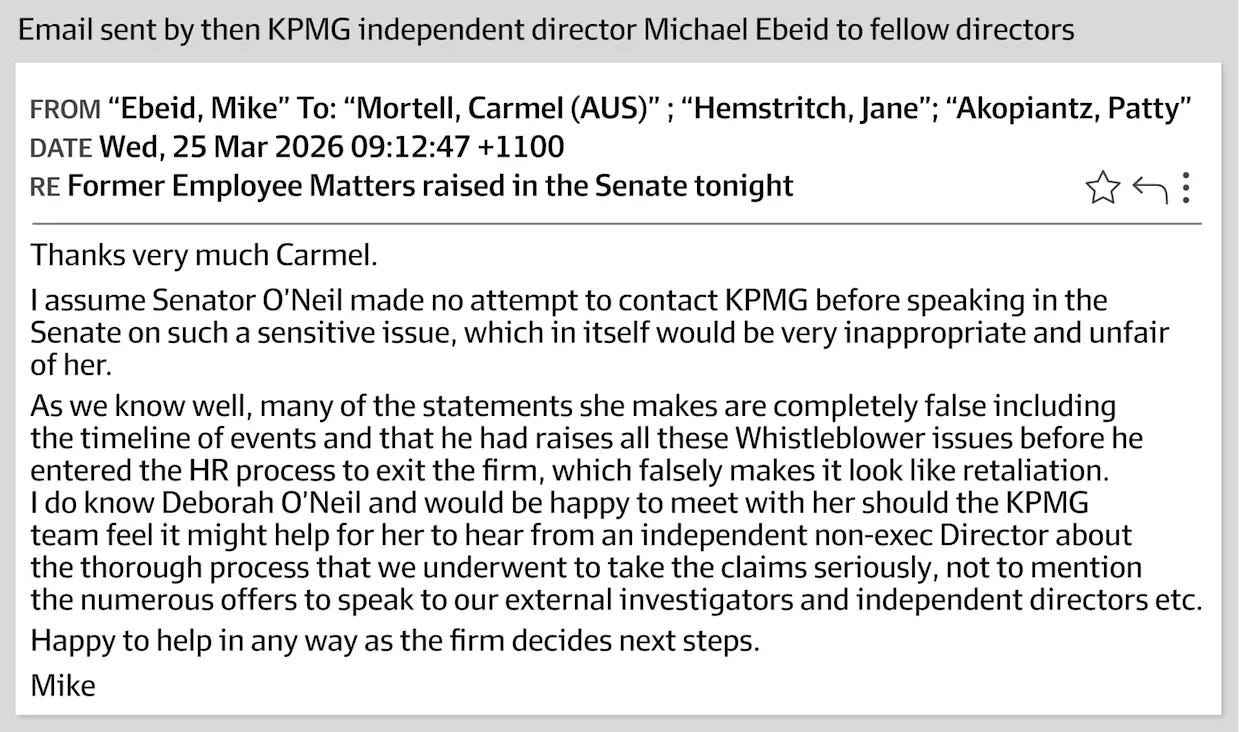
The email reads less like the intervention of an independent director than an attempt to defend—and align himself with—the executives he was meant to scrutinise.
Ebeid later apologised and said he had not possessed the full facts.
That explanation does not resolve the problem. Independent directors exist precisely because management’s version of events may be incomplete, self-serving or wrong. Their role is not to accept executive assurances and repeat them more forcefully. It is to test them.
As Christopher Bennett recently told Big4News, directors must understand both the formal governance map and the real terrain of power, relationships, incentives and information flow. Rules and committees are of little value if directors cannot perceive institutional reality or are unwilling to challenge the people controlling the information they receive.
Ebeid failed that test.
His elevation does not represent a clean break from KPMG’s failed governance. It rewards one of the directors who participated in defending it.
His position is therefore untenable.

KPMG’s partners are right to scrutinise—and entitled to resist
The partners questioning Ebeid’s formal appointment are performing the scrutiny that KPMG’s board failed to perform.
An independent chair must possess more than a résumé earned outside the partnership. Independence is also a matter of judgment, conduct and credibility.
Ebeid read the product of KPMG’s inadequate investigation. He knew that it had identified relevant misconduct. Yet he joined the institutional attack on the senator who exposed the affair and defended a process that has since been shown to have been deeply flawed.
The partnership is entitled to ask how that record qualifies him to oversee the reform of the same system.
Approving Ebeid merely because KPMG has already publicly announced him would repeat the pattern at the heart of the scandal: defending a predetermined institutional position rather than confronting inconvenient evidence.

An unconfirmed chair is helping to choose the next CEO
The governance problem becomes even more serious when Ebeid’s status is considered alongside KPMG’s search for a permanent chief executive.
KPMG publicly announced Ebeid as its incoming first independent chair even though its partnership deed did not provide for an independent chair. His appointment must first be legitimised through an amendment to the partnership agreement and approved by partners. Until then, he is effectively operating as a special adviser rather than an undisputed, formally installed chair.
At the same time, the firm is proceeding with the selection of its permanent chief executive.
The shortlist has reportedly narrowed to chief financial officer John Sams, Asia-Pacific head of tax and legal Ben Travers and national consulting leader Brad Miller. All three are internal candidates. They are expected to appear before a selection panel that includes Ebeid, after which the board will consider the recommended appointment.
But KPMG’s partnership agreement reportedly provides that the chair of the national board recommends the chief executive. Which is of course a problem, because the firm does not presently have an undisputed, formally installed chair. It just has a “special adviser.”
That creates an extraordinary governance question.
Ebeid is already participating prominently in the CEO-selection process and has publicly committed to accelerating it, despite his own appointment remaining unconfirmed. KPMG has not clearly explained where advisory influence ends, who will make the formal recommendation required by the deed, or how the process will be protected from challenge if partners reject Ebeid’s appointment.
The board has a deputy chair who can step into the breach, but the fact remains that KPMG appears to be moving into uncharted constitutional territory: an unconfirmed chair, operating under a partnership agreement that does not recognise his position, helping to install a chief executive before partners have approved the amendment required to legitimise his own authority.
This is governance by improvisation.
It makes KPMG look less like a serious professional institution than a cowboy outfit making up its constitutional arrangements as it goes along.

Clients imposed the accountability KPMG’s board avoided
The failure of KPMG’s board (which includes Ebeid) is perhaps most clearly exposed by their treatment of Eileen Hoggett, Paul Rogers and Kim Lawry.
By the time the facts surrounding the three partners had emerged, the board was no longer dealing with vague or untested accusations.
KPMG had accepted that confidential Lendlease material had been improperly accessed and displayed during preparations for its pursuit of Westpac’s audit. Hoggett, Rogers and Lawry had been financially sanctioned. Their conduct had become a matter of public record, client concern and regulatory scrutiny.
Yet KPMG’s leadership and board did not immediately force them out.
It imposed financial penalties and allowed senior figures implicated in the affair to remain inside the partnership, on important audit engagements and, in Lawry’s case, on KPMG’s national board.
Lawry was reportedly a well-liked and respected operator. She had worked at KPMG for around 30 years, was regarded as a strong advocate for women and had been considered a potential future chair.
None of that was relevant to the central governance question.
The issue was not whether Lawry was popular, talented or had given decades of service. The question was whether a partner sanctioned for viewing confidential information belonging to one client during the pursuit of another client’s audit could credibly remain on the board of an audit firm—and lead the very engagement KPMG had been pursuing when the information was viewed.
KPMG’s answer was apparently yes.
Until Westpac said no.
Westpac demanded that Lawry step aside from its $32 million-a-year audit. She then resigned from KPMG’s national board and partnership, with Brendan Twining replacing her as lead audit partner. Westpac nevertheless said that it intended to retain KPMG as its auditor.
The same pattern had already emerged around Hoggett and Rogers. Dexus moved to remove Hoggett and Rogers from relevant audit work, while Rogers was also removed from the Lendlease engagement. Their eventual exits followed growing pressure from the clients whose confidence KPMG had compromised.
That inversion is extraordinary.
An audit firm exists to challenge its clients.
In this scandal, the clients had to challenge the audit firm.
Clients should not have to decide whether an audit firm’s partners remain fit to hold positions of trust inside that firm. That is the board’s responsibility.
Due process matters. Removing an equity partner may require procedures under the partnership deed, and no board should dispense punishment without a proper evidential basis.
But due process does not explain why sanctioned partners remained on major audits or in governance positions after relevant misconduct had been established. KPMG could have suspended them from affected engagements, removed them from governance roles and commenced whatever compulsory-retirement or expulsion process its agreement required.
Instead, it waited until clients exercised an effective veto.
A board that cannot take obvious action against partners who have brought the firm into disrepute—until clients force its hand—has lost control of the institution it is meant to govern.
KPMG’s clients have become the disciplinary body its own board was unable or unwilling to be.

The formal board and the shadow partnership
This failure cannot be explained solely as a series of individual errors.
It reflects the structural difficulty of governing a large commercial partnership in which the people judging senior partners are also their fellow owners.
They share profits. They depend on one another’s client relationships. They operate within webs of friendship, sponsorship and internal alliance. They must weigh the reputational cost of inaction against the commercial and political disruption caused by removing powerful people.
This is the “shadow architecture” described in Big4News’ recent examination of Big Four whistleblower systems: the informal structure of economic incentives, personal relationships and institutional loyalties that can override formal policies, hotlines, conduct panels and independent-director arrangements.
On the formal governance map, KPMG had everything a responsible institution was supposed to possess: a board, independent directors, a general counsel, conduct panels, whistleblower procedures, external lawyers, multiple investigations and professional ethics policies.
On the real terrain, the whistleblower was managed as an employment problem, senior partners were treated deferentially, clients received incomplete or misleading accounts, investigators failed to speak to obvious witnesses, and consequences were delayed until events forced the firm’s hand.
KPMG did not lack accountability machinery.
It lacked the independence and will to use it decisively.
ASIC chair Sarah Court has now made essentially the same structural point. At the parliamentary hearing, she said that company-style governance overlays applied to partnership models did not provide a “meaningful check or oversight” of accounting-firm leadership. That assessment should carry considerable weight.
This scandal highlights a deeper problem. A large multidisciplinary partnership does not assess misconduct solely through the lens of audit integrity. It also considers revenue, client retention, partner politics, staff morale, leadership succession, internal loyalties and the commercial value of the people involved. Those incentives cannot easily be reconciled with the public-interest duties of audit.
The point is not that consultants are inherently less ethical than auditors. It is that the public-interest role of audit requires a different incentive structure from that of a commercial advisory business competing aggressively for growth.
Abdelhamid Taha’s recent analysis on Big4News of KPMG’s audits of Silicon Valley Bank, Signature Bank and First Republic Bank reached a related conclusion: when internal or client-controlled processes repeatedly fail to produce independent scrutiny or personal accountability, further policies and review structures are not enough. External architecture is required.
This is why further internal governance tweaks are unlikely to be enough. Former ACCC chair Allan Fels has argued that audit and consulting firms now need to go their separate ways. The KPMG scandal strengthens that case.

Staff will pay for leadership’s failures
While KPMG debates who will chair the firm and who should become its next chief executive, ordinary employees face the financial consequences.
The firm is reportedly preparing to eliminate several hundred positions. Sources cited by the AFR have suggested the eventual number could exceed 1,000, while partner remuneration may be reduced by as much as 20 per cent. KPMG has said that options remain under consideration and that final decisions have not been made.
This is where governance failure becomes personal.
The vast majority of KPMG employees had no involvement in accessing Lendlease documents, mishandling the whistleblower, commissioning inadequate investigations or misleading clients and directors.
Yet they may lose their jobs because senior leaders failed to confront those actions when they first emerged.
Partners who played no role in the scandal may also see their distributions reduced, their capital placed under pressure and the value of their careers damaged.
Big4News has previously examined how KPMG Australia’s roughly $557 million debt burden, declining revenue and exposure to client losses could amplify the crisis. What was previously a governance failure has now become an immediate employment and compensation story.
The people who delayed, minimised or defended the original failures may move on with their accumulated wealth and reputations bruised. But a substantial share of the cost and pain may be imposed on employees and partners who had no voice in the decisions that produced the crisis.
That is not accountability.
It is institutional loss-sharing after leadership failure.

KPMG must stop pretending this is a clean reset
A credible recovery cannot begin by pretending that the current leadership arrangements represent a clean break.
They do not.
Ebeid was part of the governance system that failed to challenge management, read the product of an inadequate investigation and then attacked the senator who exposed the affair.
The proposed chief executive is being selected from three internal candidates through a process in which the authority of the person helping to lead that selection is itself disputed.
Sanctioned partners remained on audit files and in governance positions until clients forced consequences.
And employees now face the loss of their jobs because the people at the top failed to act when doing so would have been far less costly.
KPMG should pause the chief-executive process.
It should resolve the legitimacy of its chairmanship before allowing that chair to participate in appointing the next chief executive.
Ebeid should step aside, and the firm should conduct a genuinely independent search for a chair who was not involved in its previous response to the whistleblower.
KPMG should publish the material findings of Project Magenta (the report was given to the Parliamentary Joint Committee but has not been made public), subject only to legitimate legal and privacy protections, and explain precisely which leaders knew what, when they knew it and what action they took.
It should also explain why clients had to force the removal of sanctioned partners when its own board did not.
Until it does these things, the firm’s reform programme will remain what so many Big Four responses become: new committees, new titles, new values language and new external reviews layered over the same underlying power structure.
KPMG’s crisis is no longer principally about whether confidential information was misused. Important parts of that conduct are now established.
The question is whether an institution that could not investigate itself, discipline itself or govern itself can credibly choose the people who will repair it.
So far, the answer is no.
This is part of Big4News’ continuing coverage of the KPMG Australia Audit Leak Scandal.
KPMG Australia Audit Leak Scandal

The KPMG Australia scandal that erupted publicly in March 2026 represents one of the most significant integrity crises to hit the Big Four in Australia since the PwC tax leaks affair. At its core are allegations—first raised internally by a whistleblower in 2024 and later amplified through parliamentary privilege—that senior partners misused highly conf…
About Claudine Cassar

I’m a corporate anthropologist and former Deloitte equity partner. I sold my technology business to Deloitte in 2016 and led the Malta Consulting team for five years. I now write Big4News, providing independent, clear analysis of PwC, Deloitte, EY, and KPMG — free from corporate spin.
Find me on LinkedIn, X, Instagram, or my author website. You can also email me.
Feel free to reply to this newsletter — I read every reply.