


Key Takeaways
Australia is considering 17 reform options to tighten oversight of major accounting and audit firms.
The review began after the PwC tax leaks scandal and regained urgency following the KPMG Australia confidentiality scandal.
The reputation of the Big Four in Australia has taken a beating in recent years, with two scandals involving the misuse of confidential information dominating the news for months and raising questions about whether the country’s largest accounting firms are adequately regulated.
First came PwC
The scandal centred on former PwC tax partner Peter-John Collins, who participated in confidential Treasury consultations on new measures designed to combat multinational tax avoidance. Despite signing confidentiality agreements, Collins shared confidential Treasury information with other people inside the firm.
Parliamentary investigations subsequently found that information was circulated within the firm’s international network and used to help PwC pursue business from companies affected by the measures.
The scandal engulfed PwC Australia during 2023, triggering parliamentary inquiries, leadership departures and the sale of its government consulting business. More importantly for the wider profession, it exposed an uncomfortable regulatory question: what happens when misconduct by regulated practitioners also exposes firm-wide governance and commercial incentives that existing individual and professional regulatory regimes do not fully reach?
Three years later, KPMG Australia provided another test
The current KPMG scandal began with allegations from an internal whistleblower that confidential audit-client information had been improperly shared inside the firm. The core allegation was that confidential Lendlease board material obtained through KPMG’s audit relationship was used in connection with pitches for the Westpac and Dexus audits. Parliament has since heard of a separate case involving confidential Optus information allegedly being shared with a team pursuing Telstra’s audit.
The controversy widened because of KPMG’s response to the whistleblower. The firm has acknowledged that its initial investigation was not conducted with the necessary rigour, while parliamentary hearings have examined both the information-sharing and the treatment of the person who raised concerns.
Chief executive Andrew Yates, audit head Julian McPherson, chairman Martin Sheppard and other senior figures subsequently resigned or relinquished leadership roles.
Together, PwC and KPMG have pushed an issue that once sounded largely theoretical to the centre of Australia’s debate over professional-services regulation: can conflicts and misconduct inside huge multidisciplinary partnerships be controlled through professional rules and internal governance, or does the structure of the firms themselves need to change?
The commercial consequences for KPMG continued. The firm announced that 27 partners and approximately 360 employees would leave under Project Vector, predominantly from Consulting and Business Services, amid a consulting downturn that the scandal had further complicated. Macquarie also abandoned its proposed appointment of KPMG as auditor, citing concerns about the firm’s capacity, culture and transparency.

The reform process started with PwC — then lost momentum
The current Treasury review did not begin with KPMG. Its origins lie in the PwC tax scandal three years earlier.
On 6 August 2023, at the height of the PwC controversy, the Australian government announced a package of measures that included a Treasury examination of the regulation of consulting, accounting and auditing firms to determine whether reforms were needed. The government said the PwC scandal had exposed shortcomings in the regulatory framework and raised questions about governance, transparency, executive responsibility and conflicts of interest at large professional-services firms.
Treasury followed this in May 2024 with a consultation paper explicitly entitled Response to PwC – regulation of accounting, auditing and consulting firms in Australia. That consultation examined the adequacy of governance requirements for large partnerships, professional standards and conflict-of-interest rules, transparency, regulatory enforcement, whistleblower protection and competition and resilience in the audit market. It ran from 3 May until 28 June 2024.
Public-facing momentum then faded, although Treasury continued working on the issue. On 27 March 2026, Treasury published consultation-outcome material through its Freedom of Information disclosure log: “Outcomes of consultation – Regulation of accounting, auditing and consulting firms in Australia”.
Three days earlier, on 24 March, Senator Deborah O'Neill had aired the KPMG whistleblower's allegations in the Senate. Over the following months the KPMG scandal became a storm of allegations, counter-allegations and headlines — and the questions first raised after PwC moved back up the political agenda. On 5 June, Assistant Treasurer and Minister for Financial Services Daniel Mulino made the connection explicit in an interview with ABC Radio National. Asked whether the regulatory framework needed to change, he said:
“I think that there was already a process under way but the allegations against KPMG have just heightened the urgency of this.”
Mulino specifically identified the interaction between ASIC’s Corporations Act powers and the partnership structures of the accounting firms as one of the matters the government needed to examine.
Less than a month later, the reform process was visibly moving again. On 1 July, Mulino and Senator Deborah O’Neill publicly launched the new options paper, putting measures including operational separation, structural separation, a lower partnership cap and stronger ASIC powers on the table. Mulino said the conduct exposed at PwC and KPMG meant the existing position was “simply not good enough”.
Treasury’s July 2026 options paper itself makes the continuity clear. It traces the review back to the government’s 6 August 2023 response to PwC and says that feedback from the 2024 consultation and “recent events” had confirmed gaps involving audit independence and ethics, audit-firm culture and values, firm-wide monitoring and internal controls, and the prioritisation of audit quality.
The second consultation moved beyond diagnosing the problem. Treasury put 17 possible reforms on the table, ranging from stronger licensing and enforcement powers to measures capable of fundamentally changing the structure of the Big Four.

The gap in ASIC’s powers
The Australian Securities and Investments Commission (ASIC) regulates corporate auditing. It registers individual Registered Company Auditors and Authorised Audit Companies, administers legally enforceable auditor-independence and audit-quality requirements, conducts surveillance and investigations, and can take enforcement action where auditors breach provisions within its jurisdiction.
The regulator confirmed it has formal investigations under way into the conduct of individual registered company auditors at KPMG, relating to the potential misuse of confidential information from Lendlease and the alleged misuse of confidential information from Optus.
However, its jurisdiction over unincorporated audit partnerships as entities is extremely limited. ASIC's enforceable audit powers are concentrated on individual Registered Company Auditors and Authorised Audit Companies, although some narrow statutory obligations also apply to audit partnerships.
That creates an important lacuna. An audit is affected by decisions made far above the individual engagement partner: how many people the firm assigns to audits, how partners are remunerated, how staff are trained, how conflicts are identified, how confidential information is controlled and what culture senior management creates around commercial performance and audit quality.
The significance of partnership structure also extends beyond formal regulatory jurisdiction. The financial architecture of large Australian partnerships — including partner capital, service entities, guarantees, borrowing and exit obligations — can influence where authority and financial risk sit inside a firm.
Treasury’s 2026 options paper says that, under the current framework, audit partnerships cannot be meaningfully sanctioned for many firm-level decisions affecting audit quality. Although some narrow obligations apply to partnerships, the legal accountability for audit performance remains focused heavily on the lead auditor. Treasury noted that this means key decision-makers who influence firm-wide quality and independence often sit outside the direct accountability applying to the individual auditor.
ASIC Chair Sarah Court put the problem more starkly during the parliamentary examination of KPMG in June. She told the committee that ASIC’s jurisdiction over audit firms, as opposed to individual auditors, was “extremely limited” and said the Corporations Act should extend further into large partnerships.
A more recent development illustrates the complexity of that jurisdictional gap. According to The Australian, ASIC is now probing various KPMG entities for alleged breaches of the Corporations Act’s statutory whistleblower protections, a development revealed in answers the regulator provided to questions on notice from Senator Barbara Pocock. This may give ASIC a different route into the affair through any KPMG entities that fall within the whistleblower regime, even though KPMG’s partnership itself falls largely outside ASIC’s entity-level jurisdiction.
The regulatory question Treasury is now confronting is therefore not simply whether auditors need tougher rules. It is whether regulators need greater authority over the firms that employ them and make the decisions that shape their work.
What Treasury is considering
Treasury’s paper contains 17 options, ranging from relatively incremental changes to potentially fundamental reforms of the Big Four business model. They include registering audit firms themselves rather than relying primarily on the regulation of individual auditors; imposing stronger governance requirements and increasing regulatory surveillance and transparency; reducing the maximum size of accounting partnerships; increasing penalties; and measures intended to make the audit market more competitive.
The most consequential options concern the relationship between audit and non-audit services such as consulting. Treasury is considering forms of operational separation as well as a more radical model under which entities could obtain audits only from firms that do not provide non-audit services, subject to possible limited exceptions where those services are required for the audit.
That is the option the Australia Institute wants the government to pursue.
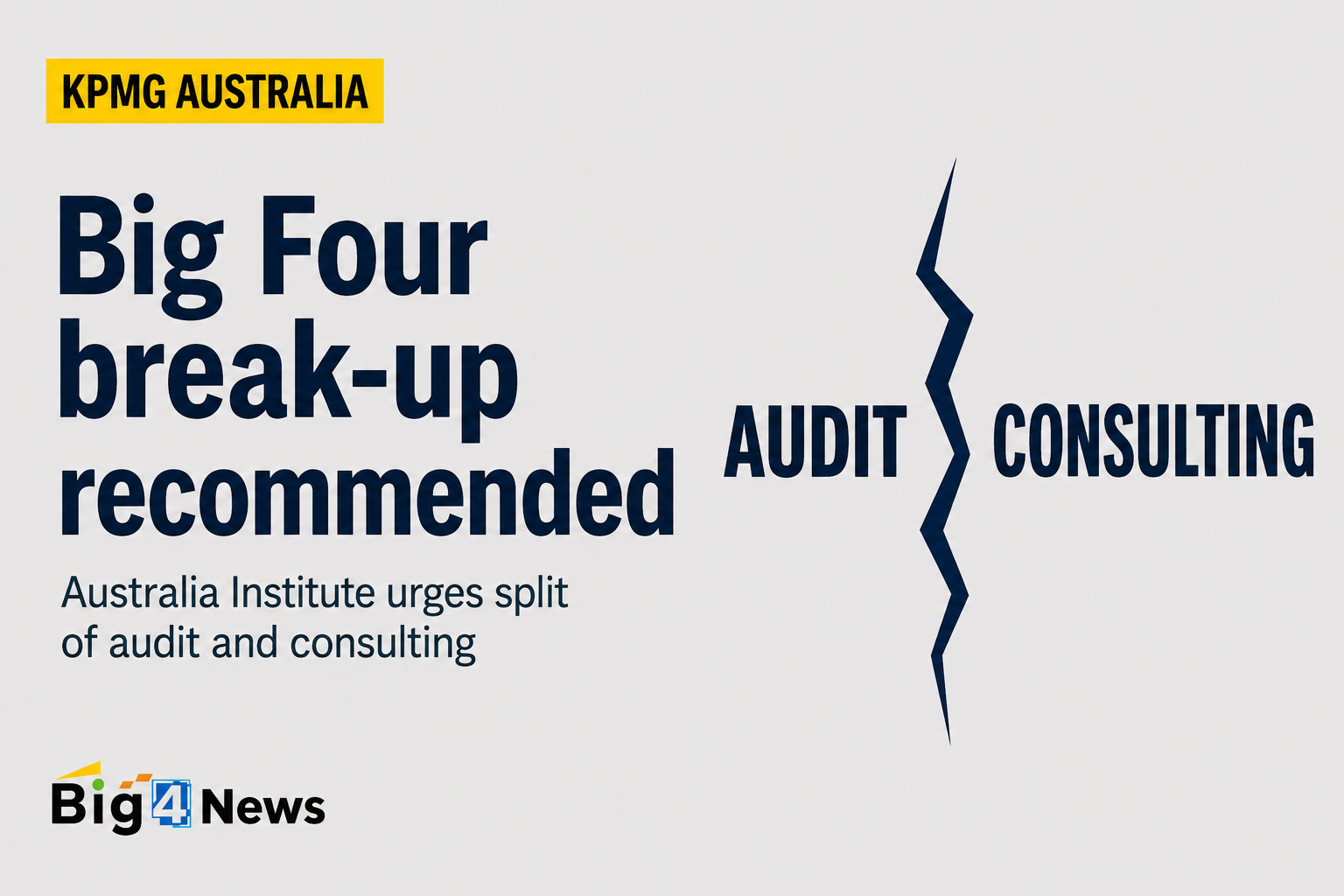
Australia Institute: break them up
The Australia Institute has come out in favour of the most interventionist end of that spectrum.
In a submission made public on 18 August, the Canberra-based think tank argues that the repeated scandals show that conflicts cannot be adequately managed through ethical rules, internal controls or operational separation.
Its principal recommendation is mandatory structural separation of audit and non-audit services. Audit and consulting would become separate entities with no financial relationship between them.
The Institute argues that merely prohibiting a firm from providing consulting services to its own audit client would leave other conflicts untouched. A firm auditing one company, for example, could still possess commercially sensitive information relevant to consulting work or pitches involving its competitors, suppliers or customers.
It is equally sceptical of operational separation. Although ring-fencing audit could create separate governance and remuneration arrangements, the Institute argues that both sides would still belong to the same commercial organisation and remain exposed to the same broader incentives and culture.
KPMG’s current scandal features prominently in that argument. The submission contends that the alleged movement of confidential information between teams demonstrates the weakness of relying principally on internal safeguards to manage information conflicts inside large multidisciplinary organisations.
“Conflicts of interest are baked into the big four by virtue of their structure,” said Josh Bornstein, the Australia Institute’s director of corporate regulation. He argues that a structural problem therefore requires a structural response.
Turn the partnerships into companies
In addition to breaking up the firms, the Institute is also recommending that major audit and accounting firms be required to incorporate, bringing them under the Corporations Act. If mandatory incorporation is not possible, it argues that major audit and accounting firms should instead be regulated in a similar way to corporations under the Corporations Act.
The proposal is intended to address precisely the regulatory gap identified by ASIC and Treasury: large accounting partnerships increasingly have chief executives, boards and sophisticated management structures resembling those of corporations, while their enterprise-level governance is not subject to the same statutory framework.
The Institute also points to whistleblower protection. A partnership is not a “regulated entity” for the purposes of the Corporations Act whistleblower regime, leaving significant gaps in statutory protection for people working within partnership structures — an issue Treasury itself identified in its 2024 review.
By contrast, the Institute is doubtful that simply reducing the number of partners would solve the problem. It argues that firms could respond to a statutory partnership ceiling by creating more senior salaried, managing-director or partner-like positions without materially reducing their overall scale or complexity.
Its three recommendations are therefore straightforward:
Mandate structural separation of audit and non-audit businesses.
Require major audit and accounting firms to incorporate and bring them under the Corporations Act.
If compulsory incorporation is impractical, regulate major firms in a similar way to corporations under the Corporations Act.
What happens next
Treasury’s consultation closed on 12 August 2026. The Australia Institute made its submission public on 18 August; its publication date does not establish when it was lodged with Treasury. The government has not yet selected any of the 17 options, and Treasury explicitly cautioned that their inclusion in the paper did not amount to government endorsement.
Treasury will now consider the submissions before providing further advice to government. There is no commitment that all — or any — of the more radical proposals will proceed. Mulino has said the government is approaching the consultation with an open mind, including on structural separation, but there is no indication yet which — if any — of the more radical options it will ultimately pursue.
Pressure on the existing model is also coming from outside the government’s reform process. On 7 August, the NSW Supreme Court granted former KPMG partner Brendan Lyon a protective costs order allowing his public-interest challenge to the CA ANZ Professional Standards Scheme to proceed with his exposure to adverse costs capped at $25,000. Lyon is challenging the validity of the scheme, including whether its liability caps can lawfully extend to non-accounting services provided within Big Four firms. The Court has not yet ruled on the merits of that challenge.
Together, these developments show that scrutiny of the Big Four in Australia is moving beyond individual scandals and towards the structures that govern how the firms operate, are regulated and are held liable.
This is part of Big4News’ continuing coverage of the KPMG Australia Audit Leak Scandal and Governance & Accountability.

About Claudine Cassar

I’m a corporate anthropologist and former Deloitte equity partner. I sold my technology business to Deloitte in 2016 and led the Malta Consulting team for five years. I am the founder and editor of Big4News, which provides independent, clear analysis of PwC, Deloitte, EY, and KPMG — free from corporate spin.
Find me on LinkedIn, X, Instagram, or my author website.
Feel free to reply to this newsletter — I read every reply.