


Dr Alexander Stein is a clinical psychoanalyst and founder of Dolus Advisors, a strategic consultancy that draws on psychoanalytic expertise to advise senior leaders and boards on decision-making, organisational culture, risk and ethical governance. Full bio at the end of the interview.
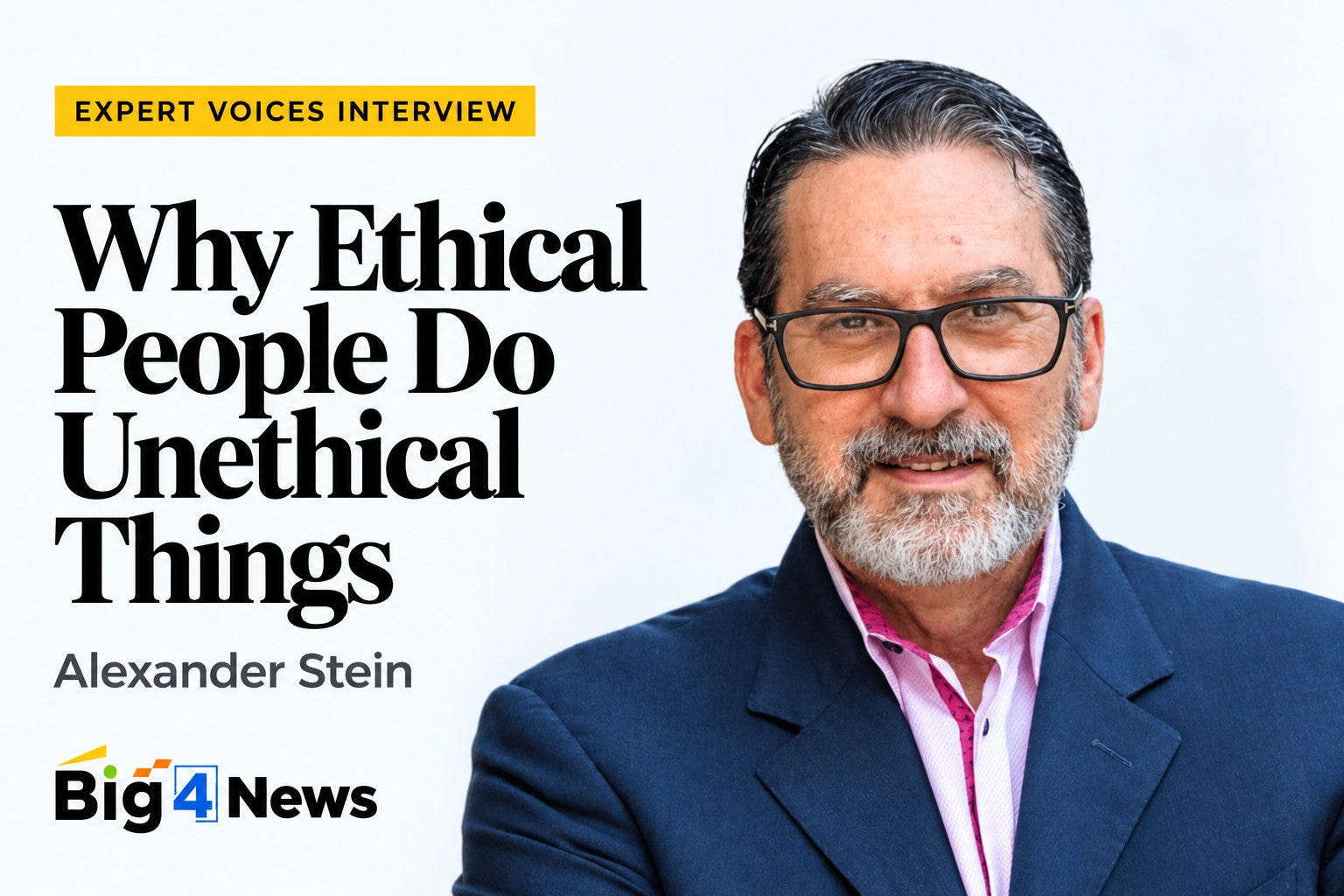
Why do intelligent professionals act against their own ethical principles? Why do colleagues remain silent about wrongdoing? And how do organisations committed to integrity come to tolerate or protect misconduct?
These questions are central to this Big4News interview with Dr Alexander Stein, a clinical psychoanalyst who advises senior leaders and boards on organisational behaviour and ethical governance.
Drawing on psychoanalysis, Stein explores how professionals reconcile questionable decisions with their moral self-image, why individuals respond differently to similar pressures, and how silence and complicity take hold. He also examines why organisations defend wrongdoing and why compliance frameworks may fail to prevent it.
These questions are particularly relevant to the Big Four, whose professional responsibilities demand independence, objectivity and the willingness to challenge powerful clients and colleagues. Commercial pressures, internal hierarchies and professional loyalty can complicate those obligations, sometimes contributing to serious professional and institutional failures.
Big4News is publishing the interview in four parts.
Part 1 challenges the assumption that integrity and dishonesty are opposing character traits. Stein examines how people preserve a positive moral self-image while engaging in questionable conduct, and how denial, rationalisation, organisational pressure and personal history shape their decisions.
The central question is: why can two people, facing essentially the same pressures and incentives, make fundamentally different ethical choices?
In this series:
Part 1: Why Ethical People Do Unethical Things
Part 2: The Psychology of Looking Away
Part 3: How Organisations Learn to Protect Wrongdoing
Part 4: Why Compliance Rules Are Not Enough
Key Takeaways
Ethical and unethical impulses can coexist within the same person.
Denial, rationalisation and cognitive dissonance can protect a positive self-image.
Commercial pressure interacts with personal history, relationships and workplace culture rather than mechanically determining conduct.
The Interview
How can ethical and unethical behaviour coexist in the same person?
You argue that integrity and corruption are not necessarily opposing personality types. How can a professional with a genuine sense of ethics nevertheless engage in conduct that contradicts those values?
The idea that ethical and unethical behavior – like goodness and evil – are opposites is an old, but still prevalent, myth. There is no unified theory or universal rulebook for the psychology of morality.
Human psychology is not binary or polar; a core aspect of mental functioning involves the management – or as is often the case, mismanagement – of the multiple concurrent, contradictory, conflictual, and incompatible thoughts, feelings, and impulses that characterize all of us.
There are many factors potentially driving reckless or ethically derelict behavior, poor judgment and ill-considered decision-making. These can include unresolved psycho-emotional issues, addictions and substance abuse, and impediments to self-regulation and social awareness. These factors among many others can impair reasoned assessments and judgment and lead to reckless or harmful behavior.
Some individuals engage in misconduct or destructive behavior to bolster a fantasy of omnipotence or are recapitulating a dynamic cycle from earlier life involving taunting or toying with a risk – perhaps one that promised punishment or praise – which is linked to an attempt to master and overcome or defeat it. For others, these behaviors can serve to deny or compensate against anxiety or depression (whether as a diagnosed disorder or an inability to modulate or evacuate such internal states).
No one person or group has a monopoly on morality or virtuousness. Mafiosi operate within a strict and proudly upheld code of honor. Philandering spouses, tax cheats, pious misanthropes, duplicitous grifters, liars, and sundry other corrupt individuals usually consider themselves – and are often regarded by others based on outward appearances and behavior – as genuinely upstanding and honorable. Education, intellect, social status, profession, wealth, and power provide no inoculation against being cruel, abusive, self-serving, or enacting any other outburst which might be harmful, unlawful, or breach strongly held ethical principles.
The truest determinant of authentic integrity is not a declaration or stance that valorizes piety, virtue, fairness, and empathy but the psychologically mature ability to modulate and emotionally process lacerating disappointment, inequity, and other traumatic disturbances without succumbing to indignation, vengeance, or otherwise unleashing an internal storm onto others.
How do people preserve an ethical view of themselves?
How can someone participate in questionable conduct while genuinely regarding themselves as an ethical professional? What psychological processes make this possible?
A popular aphorism states that integrity is doing the right thing even when no one is watching. Integrity, in that idealistic view, is a consolidated characteristic – a moral virtue enabling unwavering honesty, truthfulness, and principled action. But the maxim also gestures toward integrity as performative – a pretense that can be situationally adopted or dismissed at will. For some, ethics can be a settled code, while for others, an ever-changing pose.
Regardless, it is never static. It’s invariably in tension with or even under direct assault in situations that call on each of us to marshal internal resources in the service of making complex and often agonizingly challenging decisions. Even when our own ethical position is clear, ethically navigating the roiling complexity of real-world scenarios is rarely straightforward.
Consider the revisionist narratives people tell themselves before, during, or after committing some wrongdoing: ‘this won’t hurt anyone’, ‘nobody will notice/mind’, ‘it’s fine’, ‘I deserve this’, ‘they owe me’, ‘they brought this on themselves’, ‘it doesn’t matter’, ‘everything will be fine’ or a nearly infinite set of variations on that self-deceptive theme.
More than merely excuse-making, all of these are designed to self-justify actions even a moderately ethical person already understands should be staunched (or handled differently), not enacted. Such psychological maneuvers provide a self-administered analgesic to blunt the discomfort of contravening an otherwise sacrosanct and strongly held code of conduct and to preserve a wholesome self-image.
Willful blindness – self-deception – involves an array of phenomena, behaviors and mental states. We turn a blind eye or bury our heads in the sand; deny reality, remain selectively aware or consciously avoidant. All of these phrases and the attitudes they convey are borne of mechanisms in our minds – denial, negation, disavowal, suppression, repression, splitting, dissociation, among others – any of us might unconsciously use to protect ourselves from overwhelming feelings or memories. We unthinkingly turn a blind eye to feel safe, avoid conflict or reduce anxiety or emotional distress, but also, knowingly, to protect our reputation or escape accountability.
But where blindness serves multiple functions in numerous circumstances, wilfulness under law – important for considering and addressing institutional problems – implies a deliberate decision, not an unconscious maneuver to maintain emotional homeostasis.
Another relevant concept is cognitive dissonance. This is a psychological phenomenon where individuals or groups of decision-makers justify, explain away or suppress ethical discomfort for actions or beliefs to reduce internal conflict. People may rationalize or justify their actions or beliefs to appear more credible or avoid admitting to inconsistencies, or downplay involvement in or knowledge of wrongdoing by claiming they were “just following orders” or “didn’t know” the full extent of the situation or its likely consequences.
What happens between the organisational pressure and the decision?
Corporate misconduct is often attributed to incentives, hierarchy and commercial pressure. But these pressures do not mechanically determine behaviour. What happens psychologically between the pressure and the decision? Why might two people respond differently?
The atmospheric conditions of any environment will always be an influential factor in facilitating or mitigating various decisions and behaviors. Corporate policies that apply unremitting stressors – for instance unwavering demand for aggressive individual and team performance targets and departmental or institutional outcomes, intense intra- and interdepartmental competition, powerfully appealing incentives contingent on impossible goals, public shaming or other severe and/or unfair punishments for mistakes and underperformance – are all bound to amplify the likelihood of people taking shortcuts, side-stepping best practices, minimizing or ignoring controls or derisking protocols, and engaging in shenanigans (or worse).
Any and all of these will also stifle reporting and course-correcting which could pre-empt a crisis and, in addition, typically generate antagonism, cynicism, and disdain toward the organization, its leaders, and even colleagues and coworkers which can foster resentment, hostility, and indifference to duties of care and ethical conduct.
Organizations that impose these or other similar sorts of expectations on employees need to be cognizant of the likely behavioral consequences in ways analogous to safety requirements in high-risk environments (ie, chemicals, nuclear materials and other hazmats, aviation, construction, mining, auto manufacturing, surgery, etc) where stringent adherence to risk and safety protocols are matters not of ethics but life and death.
But pressure – a hold-over from the Fraud Triangle devised by Donald R. Cressey in the 1950s which established a triumvirate of simultaneous factors needed for an “ordinary” person to commit fraud: opportunity, rationalization, and pressure (or incentive) – is in my view and experience generally over-valued as a catalyst or cause in itself for wrongdoing, even if it’s also true that pressure can be a contributing element.
The dynamics at play aren’t attributable to simple physics – an organization generates a force that triggers a reaction in a person. Events invariably develop in an ecosystem of individuals, both within and outside the institution, whose actions continuously influence one another.
Their attitudes, biases, and decisions are shaped not only by obligations, incentives, rules, norms, and the like, but also by loyalty, reputation, authority, fear, personal identity, interpersonal relationships, and perhaps most significantly, psycho-history. Everything, in short, is co-generated by a complex constellation of individual and collective psychological predispositions in dynamic interaction.
Understanding why particular individuals behaved (or misbehaved) as they did and how and why patterns of wrongdoing cohered and persisted over extended periods requires attention to, examination of, human behavior and decision-making as part of the totality of conditions – people, policies, culture, attitudes, psycho-social dynamics – inside the organization.
Related reading
Other instalments in this four-part series:
Part 2: The Psychology of Looking Away
Part 3: How Organisations Learn to Protect Wrongdoing
Part 4: Why Compliance Rules Are Not Enough
Further reading on Big4News:
Mauro Botta on PwC, PCAOB inspections and the audit file problem
Big Four whistleblowers and the architecture of silence
About Dr Alexander Stein
Dr Alexander Stein is a classically trained clinical psychoanalyst with many years of experience treating patients in private practice.
He founded Dolus Advisors in the aftermath of 9/11. The consultancy applies psychoanalytic concepts and clinical expertise to challenging human-factor problems in organisations, working with senior leaders and boards to improve critical decision-making, mitigate risks, strengthen ethical governance and understand the psychological and social dynamics shaping institutional culture.
His work discussed in this interview includes advisory engagements with CEOs, executive teams and boards, as well as interdisciplinary work with fraud and asset-recovery professionals.
This article is part of the Big4News Expert Voices Series
Expert Voices

Expert Voices features interviews and guest contributions from former insiders, whistleblowers, academics, regulators and experienced practitioners. The series examines the structures, incentives and professional cultures behind events at Deloitte, PwC, EY and KPMG.
About the interviewer: Claudine Cassar is the founder and editor of Big4News, covering audit, consulting, regulation and governance across Deloitte, PwC, EY and KPMG.
Stein is right that pressure is over-valued in the Fraud Triangle - but the deeper issue isn’t just to add psycho-history to the model. It’s to notice which element of the Triangle is actually available to system designers. Rationalization and pressure involve individual psychology that’s largely opaque until after the fact. Opportunity is determined by structure, and structure is the one element you can close before knowing anything about which particular individual will face a pressure they can’t manage. That’s what makes the individual-psychology question both necessary and insufficient: even a complete map of why one person resists and another doesn’t leaves you unable to predict who the rationalizer will be before they rationalize.