


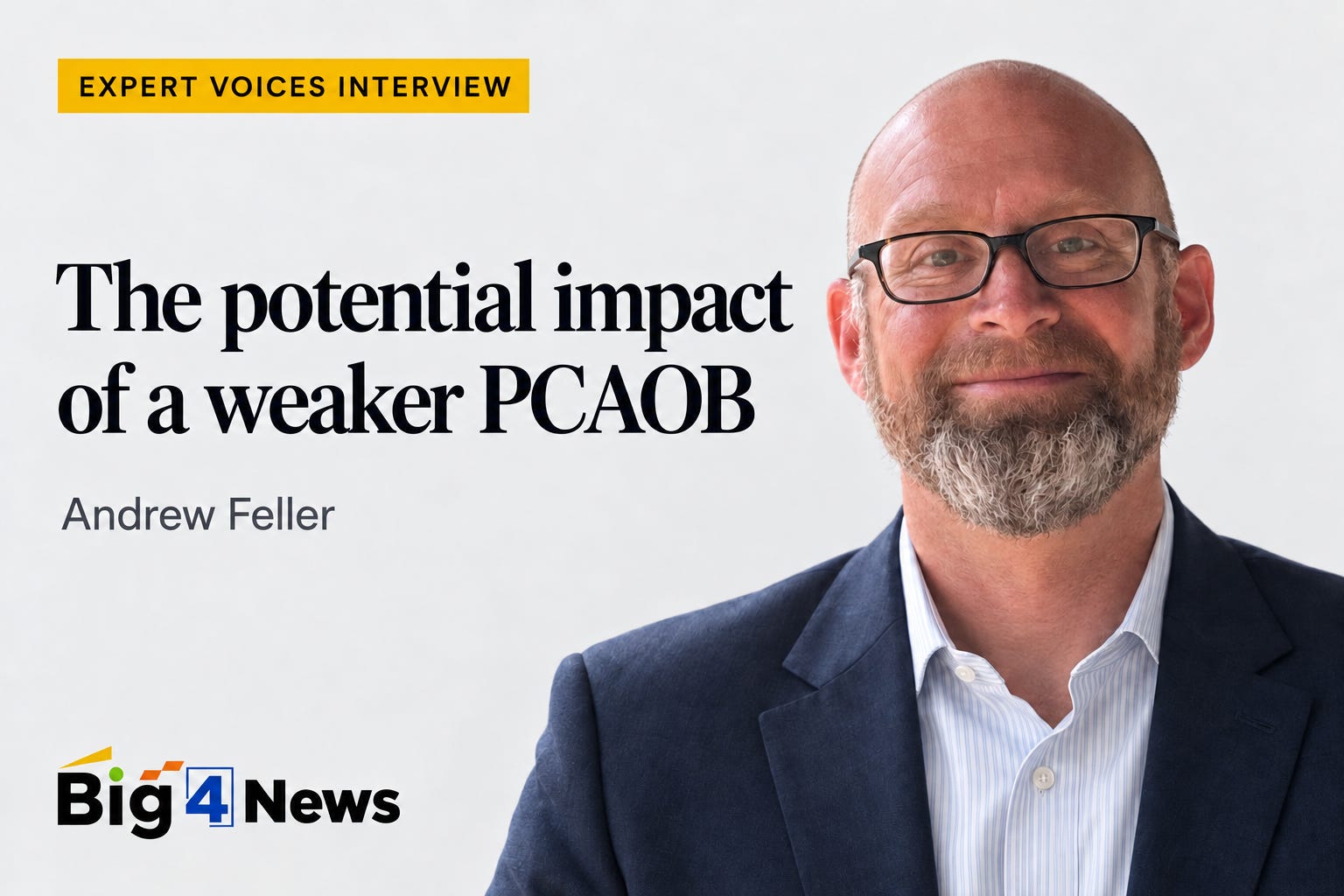
Andrew Feller is Of Counsel and Co-Chair of the Whistleblower Representation Practice Group at Labaton Keller Sucharow. He spent 15 years at the US Securities and Exchange Commission (SEC), where he was a founding member of the Complex Financial Instruments Unit and served as an adviser to Commissioner Allison Herren Lee, including during her tenure as Acting SEC Chair. Full bio at the end of the article.
Key Takeaways
Potential gaps in audit enforcement: Former SEC enforcement lawyer Andrew Feller warns that the SEC may lack the resources to pursue the negligence cases historically handled by the PCAOB if the latter’s enforcement role diminishes.
Specialist units can tackle more complex cases: Concentrating expertise within the SEC can improve investigative effectiveness and encourage enforcement staff to pursue technically challenging matters.
Audit failures are difficult to prove: Complex documentation, multiple layers of review and questions of professional judgement make it difficult to establish responsibility. Regulators often focus on auditors who ignored or rationalised warning signs.
Whistleblower rules may create blind spots: Feller argues that restrictions on auditor whistleblowers can make it difficult to report ongoing misconduct, potentially preventing regulators from intervening before investors suffer harm.
The future of audit oversight remains uncertain: A shift in enforcement responsibilities from the PCAOB to the SEC could change not only which regulator investigates misconduct, but also which types of audit failures receive scrutiny.
The oversight of America’s audit firms may be entering a period of significant change. The Securities and Exchange Commission (SEC) is strengthening its specialist enforcement capabilities, while the Public Company Accounting Oversight Board (PCAOB), the regulator established in the aftermath of Enron, is reconsidering how it inspects and supervises auditors.
The changes are part of a broader restructuring of US audit oversight that has been taking shape over several years. Proposals to abolish the PCAOB and transfer its responsibilities to the SEC date back to the first Trump administration. Although an attempt to dissolve the regulator through legislation failed in 2025, subsequent leadership changes, budget reductions and shifts in regulatory priorities suggest that the relationship between the two agencies is being redrawn.
In August 2026, the SEC announced the creation of a new Financial Reporting and Accounting Unit within its Division of Enforcement. Staffed by lawyers and accountants with specialist expertise, the unit will investigate accounting fraud, financial-reporting misconduct and violations involving auditors. The initiative promises greater technical expertise and investigative capacity in an area where cases can involve complex financial instruments, extensive documentation and difficult questions of professional judgement.
Meanwhile, the PCAOB is undergoing its own transformation. Under Chairman Demetrios Logothetis, who took office in February 2026, the regulator is reconsidering its inspection model, placing greater emphasis on firms’ systems of quality control while using individual engagement reviews to assess how those systems operate in practice. Its enforcement priorities are also changing, with greater emphasis on serious violations presenting substantial risks to investors.
These developments come at an interesting moment for the audit profession. The PCAOB’s latest inspection results show a substantial improvement among the Big Four audit firms. The proportion of inspected audits with significant deficiencies fell to 8% in 2025, compared with 20% in 2024 and 26% in 2023. EY recorded its best-ever result, with a deficiency rate of just 5%, matching Deloitte and outperforming PwC and KPMG. Although the PCAOB cautions that its inspection samples are not representative of firms’ entire audit portfolios, the improvement raises questions about what has driven it and whether changes to the inspection regime might affect future audit quality.
But greater specialisation at the SEC does not necessarily mean that every category of auditor misconduct will receive more scrutiny. The PCAOB has historically pursued cases involving negligent violations of professional standards, including failures that do not involve allegations of financial-statement fraud. If its enforcement role diminishes, will the SEC have the resources and appetite to pursue those cases?
There is also the question of whistleblowers. Audit professionals may be particularly well placed to identify misconduct, yet reporting concerns outside their firms can carry considerable professional risks. Restrictions within the SEC’s whistleblower programme may further complicate their ability to report suspected wrongdoing while it is still occurring.
As the division of responsibilities between the SEC and PCAOB continues to evolve, an important question remains: could changes intended to make regulation more efficient inadvertently leave certain forms of audit misconduct without effective oversight?
To explore these issues, Big4News founder and editor Claudine Cassar spoke with Andrew Feller, a former SEC enforcement lawyer and founding member of the agency’s Complex Financial Instruments Unit. Feller spent 15 years at the SEC, including advising Commissioner Allison Herren Lee on enforcement policy and whistleblower matters. He is now Of Counsel and Co-Chair of the Whistleblower Representation Practice Group at Labaton Keller Sucharow LLP.
In this interview, Feller discusses why audit cases are so difficult to investigate, how regulators distinguish professional judgement from misconduct, what specialist enforcement units can achieve, and why changes to the division of responsibilities between the SEC and PCAOB could leave gaps in audit oversight.
His central concern is that strengthening one regulator while reducing the role of another does not automatically preserve the same level of accountability. The question is not simply which agency investigates auditors, but whether certain forms of misconduct could ultimately escape effective scrutiny.
The Interview
What does a specialist enforcement unit actually change?
You were a founding member of the SEC’s Complex Financial Instruments Unit, and you described the new Financial Reporting and Accounting Unit as both “smart and long overdue”. The SEC has concentrated financial-reporting expertise before, including through the Financial Reporting and Audit Task Force created in 2013. From your experience, what does creating a formal specialist unit actually change? Does specialisation principally improve technical expertise and investigative efficiency, or can it also affect which cases Enforcement is willing to pursue?
You have to remember the context in which the specialized units were established. The SEC was under fire both for having missed the Madoff fraud and for being perceived to be behind the ball on investigating and prosecuting the causes of the financial crisis.
Against that backdrop, the specialized units were developed for three primary purposes: First, to concentrate people with an interest in and aptitude for particular types of investigations in one group; second, to investigate the thorniest, most complicated cases in that area; and third, to concentrate and develop knowledge and expertise in particular types of investigations in the unit so that they can serve as a resource for the rest of the Division of Enforcement.
All three goals are meant to be complementary. The mandate of a “task force” is far more diffuse, and while I think they have had successes over the years, to my mind, it’s not nearly as successful a model as a dedicated, persistent specialized unit.
I think history has shown the units can be very effective, especially when they have a clear mandate. The Asset Management Unit, for instance, has been incredibly successful at policing the private funds space and developed real technical expertise that has served the entire Division.
I think the answer to the last question is “both.” Specialized units are willing to take on harder cases because they have the expertise needed, and know how to call on the necessary resources. I think there can also be pride at work, wanting to show they can do more than run of the mill cases.
Why are accounting and auditing cases so difficult to investigate?
You have described accounting and auditing matters as particularly “thorny and byzantine”. What makes audit cases unusually difficult for enforcement lawyers to investigate and prove? In particular, how do investigators distinguish between a defensible professional judgement that later proves wrong, a deficient audit, and conduct serious enough to warrant enforcement action?
Accounting and auditing matters are notoriously complex and document heavy, and that’s even before you get to the questions of motive and intent that you flag in your question.
Valuation cases, for instance, almost always involve broadly plausible claims of defensible judgments being applied, and there are usually a massive number of potentially relevant data points to support both sides’ arguments.
Another thing that complicates auditor cases is that there’s typically an enormous amount of process involved in an audit, including multiple levels of review and an awful lot of box-ticking. So everyone points at someone else when something gets missed, and the investigator has to untangle that web of responsibility.
On the other hand, I do think the SEC does a good job of distinguishing between hard judgment calls and outright audit failures. GAAP and GAAS have a lot of requirements, and on the cases the Commission charges, you’ll often see that the auditor failed to satisfy a long list of those requirements. Similarly, when the issue is something like a failure to exercise professional skepticism, you usually see some evidence of an auditor ignoring or rationalizing a glaring red flag, rather than digging into it as they should.
When does failure to detect fraud become an audit failure?
The language surrounding auditors and fraud remains remarkably sensitive. The AICPA recently changed the introductory wording of a release describing auditors’ “responsibilities for identifying fraud or suspected fraud” to instead refer to their “responsibilities relating to fraud or suspected fraud”. Yet auditors are required to obtain reasonable assurance that financial statements are free of material misstatement caused by fraud or error.
When a major fraud is subsequently uncovered, how does Enforcement determine whether management successfully deceived a properly performed audit or whether the auditor failed to respond appropriately to warning signs? And where do provisions such as Sarbanes-Oxley Section 303, which addresses attempts to mislead or improperly influence auditors, fit into that allocation of responsibility?
As I mentioned, I think a lot of it has to do with the evidence that the staff uncovers relating to how the auditors reacted to red flags in the course of the audit. Obviously, anything that might have compromised the auditors’ independence or objectivity is also relevant to the analysis.
If there is evidence of an active plan to deceive an auditor, there’s going to impact how the staff assesses the auditor’s conduct, but, as you point out, the auditor still has some responsibilities there.
Who gets to define what society is entitled to expect from an auditor?
The “audit expectations gap” has been discussed for more than fifty years. When Carl Liggio coined the term in 1974, he distinguished between responsibilities actually imposed on auditors and responsibilities that users merely believed auditors had. But he also acknowledged that the profession itself had helped create some of those expectations — including through language that implied a greater degree of certainty and assurance than an audit could actually provide. Auditor responsibilities have also evolved over time through legislation, standards, court decisions and regulatory enforcement.
From an enforcement perspective, who ultimately determines what society is legitimately entitled to expect from an auditor? At what point does an alleged “expectations gap” cease to be a misunderstanding by the public and become a legitimate demand for a higher standard of professional responsibility?
That’s a big question, and probably above my pay grade. What I’ll say is that the role of an independent auditor is critical, and society has a right to expect both parts – independent judgment and a thorough review of an issuer’s books.
Auditing is demanding work, but it is also well paid, which is not irrelevant here. I think it’s useful for the audit profession to remind people of the limits of its abilities and responsibilities, but also critical that auditors fulfill the obligations they’ve taken on.
Does “lack of professional scepticism” sometimes give auditors too much cover?
Regulators frequently describe serious audit failures as involving a “lack of professional scepticism”. That is a recognised auditing concept, but the phrase can sound quite different from describing the underlying conduct — for example, accepting management’s explanation despite contradictory evidence, failing to investigate a warning sign, or signing an opinion without obtaining sufficient evidence.
From an enforcement perspective, does describing the problem as a “lack of professional scepticism” ever risk giving the auditor too much cover by turning identifiable acts or omissions into an abstract failure of mindset? Auditors may respond that regulators are judging difficult professional decisions with the benefit of hindsight. Having investigated these cases, where is the legitimate boundary between those two positions?
As I mentioned above, the SEC tends to focus on cases where there is evidence of an auditor ignoring or rationalizing away one or several red flag(s). I suspect this Commission has a little more sympathy for the argument you’ve described than some previous Commissions, but nevertheless, I think the SEC staff’s focus tends to be on the most egregious cases.
Why do you connect the new SEC unit with a diminution of the PCAOB?
When you welcomed the new Financial Reporting and Accounting Unit, you wrote that you were “sure” its creation had something to do with the discussion about a diminution of the PCAOB’s role. What made you draw that connection? What functions do you think may migrate towards the SEC, and what sort of role do you envisage for the PCAOB if that process continues?
SEC Chair Atkins, as well as some of the Republicans in Congress, have been fairly vocal about their skepticism of the PCAOB’s utility, especially in the enforcement space. I think they are trying to create a smaller, more inspection-focused PCAOB, one that has a collaborative relationship with the industry.
One way of doing that may be to reduce the PCAOB’s enforcement function to eliminate that overhang from its inspection activities. Creating an auditor and accounting specialized unit certainly raises the prospect that the Commission sees enforcement responsibility in the auditor space migrating to the SEC in the future.
If auditor enforcement moves towards the SEC, could that change what actually gets enforced?
If the SEC ultimately supplants a substantial part of PCAOB enforcement, are we simply changing which regulator brings the case, or could we also change the substantive threshold for intervention? The PCAOB has historically pursued negligent misconduct and failures to comply with professional standards even where there was no accompanying allegation of financial-statement fraud, while the current SEC leadership has placed greater emphasis on serious misconduct and “bad actors”.
Could some forms of audit failure therefore receive less scrutiny under that model? And, following SEC v. Jarkesy and the resulting questions surrounding the SEC’s use of administrative proceedings, does creating greater investigative capacity necessarily solve the separate problem of how contested cases against auditors can ultimately be pursued?
I think you’re exactly right. Just as a matter of resources, the SEC is likely not positioned to pursue the types of negligence cases against individual auditors that forms a big part of the PCAOB’s docket.
On the other hand, realistically, the SEC has historically taken the lead in investigating large-scale audit failures and frauds, so that wouldn’t be much of a change. I guess the hope is that they find a way to balance those roles so that there isn’t a hole in the enforcement coverage of the industry.
With respect to the impact of Jarkesy, it’s hard to know how that will change the enforcement landscape for auditors. I’m watching it closely to see how it shakes out, but it’s tough to make any predictions at this point.
Are the SEC’s whistleblower rules well designed for auditors?
You now represent whistleblowers after spending many years inside SEC Enforcement. Auditors can be among the people best placed to identify serious accounting or audit misconduct, but reporting it outside the firm can carry significant professional and career risks. There are also specific SEC rules governing when audit and compliance professionals can qualify as whistleblowers.
In practice, do those rules make it sufficiently possible for auditors to report serious misconduct to the SEC? How significant are fear of retaliation, damage to future career prospects and a culture of loyalty to the firm as deterrents? And if PCAOB inspection or enforcement activity becomes less intensive, could reluctance among audit professionals to report externally become a more important blind spot in US audit oversight?
Whistleblowers play an increasingly important role in the enforcement landscape as a result of several factors, including the reduction in resources for government enforcers, the AI explosion, and the growing size and reach of private markets.
The audit space is no exception – whistleblowers are critical to exposing the worst conduct by both large and small audit firms. You correctly note the enormous risk taken by whistleblowers, especially those who may have a senior position at a global audit firm. The whistleblower program exists precisely because of that risk, and the need to reward (or more appropriately, compensate) insiders and others who risk retaliation and ostracization to bring misconduct to light.
Auditor whistleblowers are subject to stricter eligibility rules than other whistleblowers under the SEC’s whistleblower program rules. In particular, the rules unfortunately make it hard for an auditor to blow the whistle on ongoing, rather than completed, misconduct.
I understand the motivation behind those rules, but I agree with you that they may have had the effect of creating a serious blind spot for regulators. Especially if the PCAOB does withdraw from some of its enforcement and audit-specific inspection activity, the SEC may need to consider whether the rules are properly calibrated to ensure that whistleblowers are able to bring the Commission timely, actionable information that can help prevent investor harm.
In the meantime, given the complexity of the whistleblower rules for auditors, I would encourage any auditor who is considering blowing the whistle to reach out to a specialized whistleblower lawyer to ensure that their interests are protected throughout the process.
Further Reading
US Audit Oversight and PCAOB Inspections
How the SEC and PCAOB Are Quietly Redrawing US Audit Oversight — A detailed timeline of the political, legislative and regulatory developments reshaping American audit oversight, including the creation of the SEC’s specialist accounting enforcement unit.
Mauro Botta on PwC, PCAOB Inspections and the Audit File Problem — In this Expert Voices interview, former PwC auditor and whistleblower Mauro Botta discusses the limitations of audit-file inspections, professional scepticism and the difficulties regulators face in identifying misconduct that may not be apparent from documented audit procedures.
EY Achieves Best-Ever PCAOB Inspection Results: 5% Deficiency Rate in 2025 — An examination of the striking improvement in the Big Four’s latest US audit inspection results and what those findings tell us about audit quality.
Investigations, Whistleblowers and Accountability
External Is Not Independent: How Client Control Constrained KPMG’s Whistleblower Probes — Veteran investigator Richard James examines the independence, scope and effectiveness of investigations into allegations of misconduct at KPMG Australia.
When Speaking Up Becomes the Risk — Corporate investigator Charles Cohen explores how organisations respond to whistleblowers, why the initial handling of allegations matters, and how commercial interests can influence investigations.
Pav Gill on Wirecard, Confide, and Why Whistleblowing Hotlines Are Not Enough — The Wirecard whistleblower discusses why reporting mechanisms can fail when organisations do not investigate allegations independently or protect those raising concerns.
KPMG’s Audits of Three Failed Banks: What the 2025 Minority Senate Report Reveals About Whistleblower Protections — Abdelhamid Taha examines allegations of audit and oversight failures involving Silicon Valley Bank, Signature Bank and First Republic Bank, and argues for stronger independent mechanisms for investigating whistleblower disclosures.
Who is Andrew Feller?

Andrew Feller is Of Counsel and Co-Chair of the Whistleblower Representation Practice Group at Labaton Keller Sucharow, where he represents whistleblowers before the US Securities and Exchange Commission (SEC), Commodity Futures Trading Commission (CFTC), Internal Revenue Service (IRS), Financial Crimes Enforcement Network (FinCEN), and Department of Justice (DOJ).
Feller has more than 25 years of experience in securities law, financial regulation, litigation and enforcement. He spent 15 years at the SEC between 2007 and 2022, serving as Senior Enforcement Counsel in the Division of Enforcement and as a founding member of the agency’s Complex Financial Instruments Unit and Retail Fraud Task Force.
From July 2019 to August 2022, he served as Counsel to SEC Commissioner Allison Herren Lee, including as Senior Policy Advisor during her tenure as Acting SEC Chair in 2021. In these roles, he advised on significant enforcement, litigation, whistleblower and regulatory policy matters, as well as SEC rulemaking initiatives. He subsequently served as Counsel to the Director of the Division of Enforcement.
After leaving the SEC, Feller became Associate General Counsel and Executive Principal at OCC, the US options clearing organisation, where he worked on legal and regulatory matters involving exchange-traded derivatives. He subsequently joined Kohn, Kohn & Colapinto as Senior Special Counsel and Co-Chair of its Securities and Commodities Whistleblower Group, before moving to Labaton Keller Sucharow in 2026.
Earlier in his career, he practised securities enforcement and litigation at K&L Gates and worked as a corporate attorney at Fenwick & West.
His experience spans complex financial instruments, securities fraud, corporate disclosure, regulatory enforcement and whistleblower protection, providing perspectives from both within government and private legal practice.
This article is part of the Big4News Expert Voices Series
Expert Voices

Expert Voices features interviews and guest contributions from former insiders, whistleblowers, academics, regulators and experienced practitioners. The series examines the structures, incentives and professional cultures behind events at Deloitte, PwC, EY and KPMG.
About Claudine Cassar

I’m a corporate anthropologist and former Deloitte equity partner. I sold my technology business to Deloitte in 2016 and led the Malta Consulting team for five years. I am the founder and editor of Big4News, which provides independent, clear analysis of PwC, Deloitte, EY, and KPMG — free from corporate spin.
Find me on LinkedIn, X, Instagram, or my author website.
Feel free to reply to this newsletter — I read every reply.