


Key takeaways
World War II expanded accountants’ expertise beyond auditing. Wartime demands exposed accountants to complex management systems, cost controls and mechanised data processing, laying the groundwork for post-war advisory services.
Computerisation created a new consulting market. From the 1950s, firms such as Arthur Andersen began advising clients on electronic data processing and computer systems, moving from examining financial records to helping design the systems that produced them.
Commercial pressures accelerated the shift towards consulting. During the 1970s and 1980s, audit-fee competition, litigation and corporate restructuring made advisory services an increasingly attractive source of revenue.
By the 1990s, consulting had become a major business—and a threat to auditor independence. Big Five management advisory and similar service revenues grew by an average of 26% annually between 1993 and 1999, raising concerns about firms auditing work performed by their own consultants.
The world’s largest accounting firms were established to examine the financial records of their clients. By the end of the twentieth century, they were earning billions advising those same companies on how to run their businesses. The transformation began decades earlier, when war, technology and changing commercial pressures opened up opportunities that extended far beyond traditional auditing.
When America joined World War II on December 8, 1941, an army of accountants mobilized to support the war effort.
“Accountants played their part in bringing about [the war’s] successful conclusion. In uniform and out, they did what was required of them to keep in working order the complex network of financial transactions, which might be described as the nervous system of a free-enterprise economy engaged in total war.”
— American Institute of Accountants, June 1945
Many young accountants joined the armed forces, often as finance officers in the Army Finance Department or Navy Supply Corps, where they managed payroll, procurement, and inventory. Others served in specialized Mobile Machine Records Units, which used punched-card equipment to process military information.
Older accountants served in critical civilian capacities within the War Department, which oversaw wartime finance; the War Production Board, which controlled industrial conversion to wartime production; and the Office of Price Administration, which took care of rationing and price controls. Government auditors also scrutinized the costs and financial records associated with wartime contracts.
Accountants also played a crucial role in industry, as factories all over the country shifted from producing civilian products, such as cars, to manufacturing tanks, fighter planes or munitions. They advised management on how to change their internal systems to pivot to war production and assisted them in tracking costs assiduously to maximize efficiency—both because of wartime shortages and to support cost-plus-fixed-fee contracts.
The experience that CPAs gained during the war widened their horizons. Their skills now extended well beyond accounting and audit, encompassing the design of efficient workflows, the collation of data from disparate sources, and the use of machines for mechanised data processing.
They had also greatly improved their expertise in tax matters and proved their worth as management advisers, building strong relationships with government departments and industry clients.
The post-war consulting boom
When the war ended, accounting firms were inundated with work. Many clients needed help to shift back to pre-war production as quickly as possible, to keep up with the post-war boom.
Clients were highly focused on controlling costs to improve profitability, and an obvious way to do so was to start using tabulating equipment for automated data processing, which could reduce the time required to perform certain tasks, such as the calculation of salaries, from days to just a few hours.
Audit firms became heavily involved in the implementation of punch-card systems in various business applications, such as payroll and inventory management.
This built upon the systems work they had already been offering before the war, contributing to the expansion of Management Advisory Services as a distinct service line.
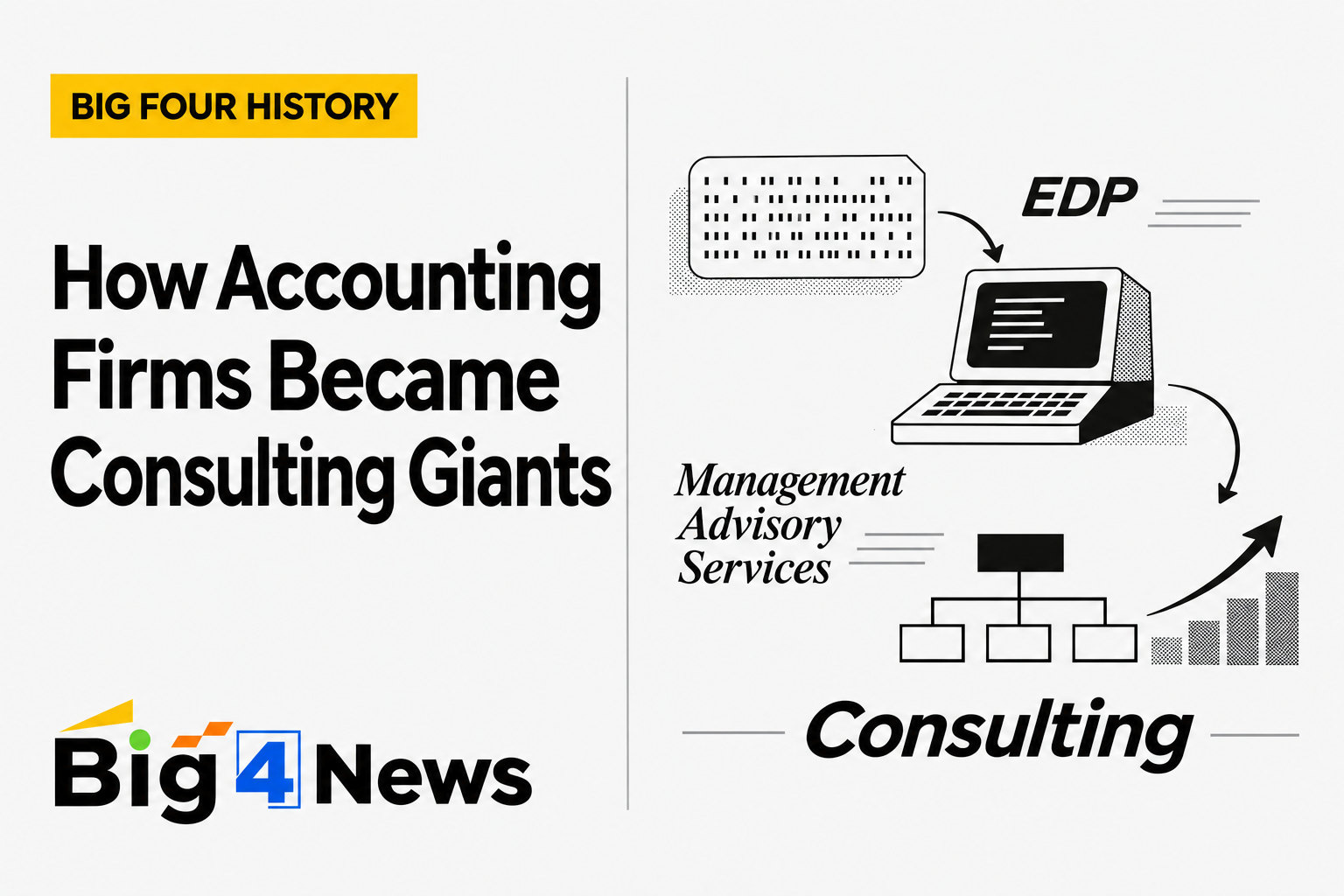
It also laid the foundation for their expansion into Electronic Data Processing (EDP) and computer advisory in the 1950s, which grew steadily over the following two decades.
Arthur Andersen and the computer revolution
One of the pioneers was Arthur Andersen.
In the early 1950s, the firm began advising businesses on the possibilities offered by electronic computers, which were only just beginning to enter commercial use.
In 1952, Arthur Andersen secured an engagement to study the feasibility of installing an electronic computer at General Electric’s Appliance Park in Louisville, Kentucky.
GE wanted to automate administrative functions at its enormous manufacturing complex. Its ambitions extended beyond traditional accounting tasks to inventory management and factory operations.
In 1954, GE installed a UNIVAC I computer at Appliance Park, one of the earliest commercial applications of electronic computing in the United States. Arthur Andersen personnel worked alongside GE employees and UNIVAC specialists on the implementation.
Arthur Andersen was no longer simply examining the records generated by a company’s systems. It was helping clients design and implement those systems.
This was the beginning of a business that would eventually become one of the largest consulting operations in the world.
Computers had created an entirely new market for accounting firms. Over the following decades, the commercial attractions of consulting would become increasingly difficult to ignore, particularly as the traditional audit business came under pressure.
Why consulting became the north star
By the 1970s the firms were under extreme pressure to reduce audit fees, just as they found themselves dealing with much more complex audits due to the evolving nature of their multinational clients.
Audits had become increasingly commoditized. As accounting and auditing standards became more formalised, clients increasingly viewed auditors as interchangeable, and audits as providing little direct value to the business beyond regulatory compliance.
This led to intense fee competition, squeezing margins and creating the risk of an erosion in audit quality as firms scrambled to reduce audit costs.
Whereas previously auditors could often expect to retain clients for several years, companies were now more willing to change auditors, either to get a better deal or, in some cases, to shop around for a more favourable accounting opinion when their current auditors were proving difficult.
And to top it all, investors and other stakeholders were getting increasingly litigious, suing the firms when companies went bankrupt—even in cases where the audit firms disputed responsibility for what had happened.
The recessions in the early eighties led to a wave of business failures and litigation that imposed substantial costs on the profession.
While all this was happening, a new wave of acquisitions and mergers hit the markets. However, unlike what had happened in the first decade of the twentieth century, these mergers did not necessarily generate new audit business. When two companies merged, one of their existing audit engagements could disappear.
In what was proving to be the perfect storm for auditors, consulting was the north star.
While audit revenues faced pressure, advisory revenues were growing dramatically, driven in the main by implementation services for computer systems.
The mergers that were threatening audit dollars were simultaneously creating a surge in consulting opportunities, as investment bankers and merged entities required restructuring support.
However, there were rumblings on that front, as these new service offerings faced increasing scrutiny from congressional inquiries such as the Metcalf Subcommittee, which highlighted their potential impact on auditor independence.
Market pressures were intense, and to compete, the Big Eight sought to strengthen themselves by merging—not only to improve their competitive positions in the US, but also to better serve their multinational clients, who increasingly required seamless cross-border audit, tax, and advisory services.
By 1998, the merger wave had reduced the Big Eight to five firms: Arthur Andersen, KPMG, Ernst & Young, Deloitte & Touche and PricewaterhouseCoopers.
Collectively, these firms were known as the Big Five.
Consulting becomes the growth engine
By the 1990s, consulting was no longer simply an extension of accounting and systems work. It had become a major business in its own right.
The timing could not have been better for the firms. Between 1995 and 2000, Big Five revenues skyrocketed, supercharged by the 1990s bull market and dot-com bubble.
Consulting generated billions in fees for services like Y2K preparation, technology implementation, e-commerce strategy and business restructuring. The firms were also expanding their tax and other advisory practices.
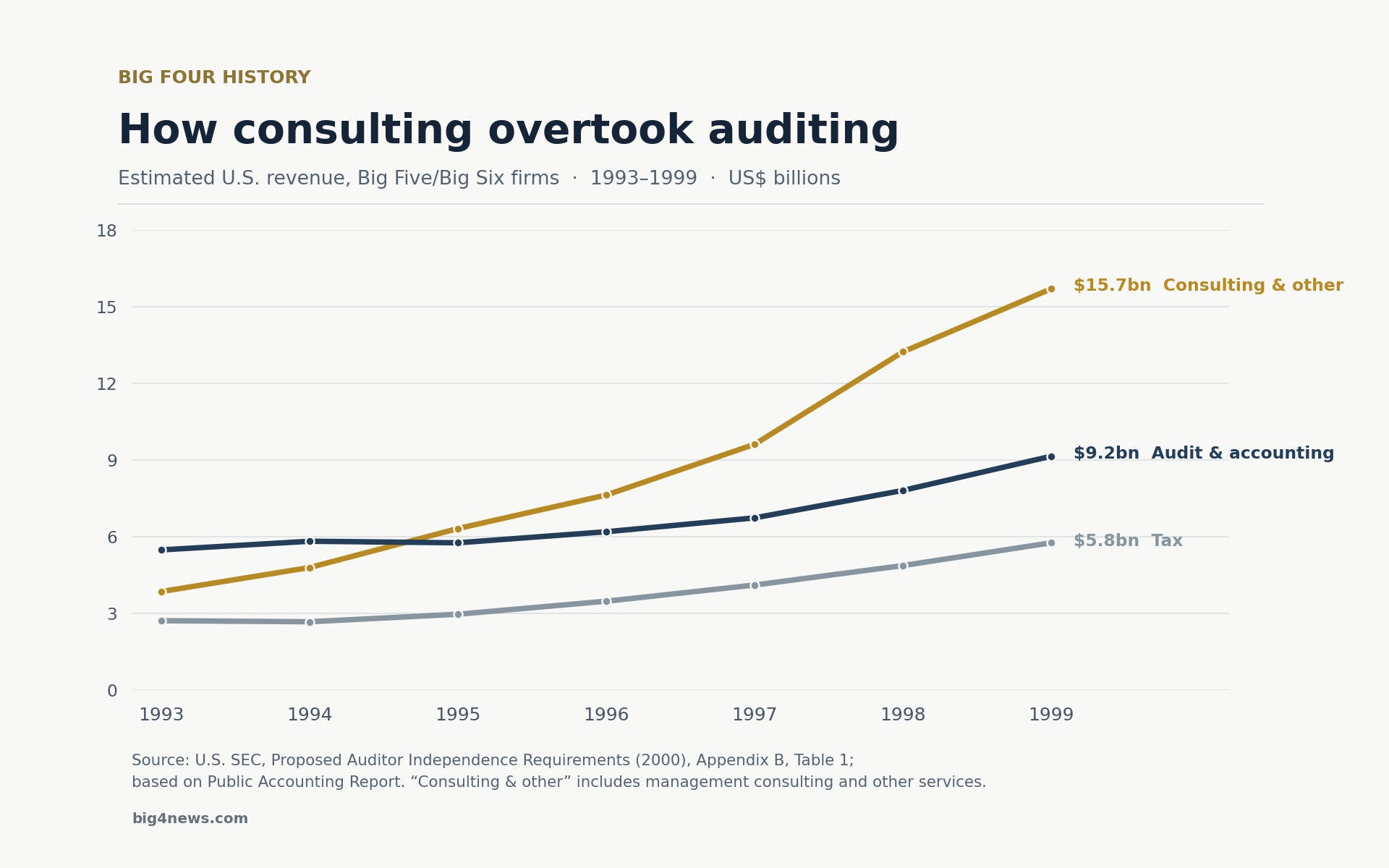
According to the US Securities and Exchange Commission (SEC), management advisory and similar services generated more than $15 billion in revenue for the Big Five in 1999, accounting for approximately half their total revenues.
Between 1993 and 1999, revenues from these services grew by an average of 26% annually, compared with 9% for audit and 13% for tax.
This aggressive expansion and leap in profitability reinforced a shift in the firms’ commercial priorities.
Partners were increasingly expected to cross-sell their firms’ new services, and their performance evaluations and compensation placed growing emphasis on how much business they brought in.
Business development abilities became increasingly important alongside technical competence. Partners evolved from conservative number crunchers, lauded for their technical knowledge and eye for detail, into consummate salesmen, wining and dining their clients.
The audit firms were now competing with strategy consulting firms and IT service providers—who were not encumbered by the same obligations to remain independent of audit clients.
To keep up with them, partners faced pressure to adopt more aggressive business development tactics, potentially transforming their interactions with audit clients from professional scepticism—the hallmark of the auditor’s profession—to strategic client appeasement.
When consulting threatened auditor independence
Big Five consultants were now heavily involved in the operations of corporate clients, advising on management decisions, strategy formulation and business systems.
This created obvious conflicts of interest when those companies were also audit clients, because auditors could find themselves having to examine and test work delivered by their own consulting colleagues.
One particularly glaring example involved the implementation of Enterprise Resource Planning systems such as SAP, Oracle or PeopleSoft—software solutions that integrate a company’s key processes, such as finance and HR, into a single, centralized platform.
Where the same firm also audited the company’s financial statements, the audit team could find itself relying on financial information produced by systems its colleagues had built and configured.
This created a textbook self-review threat.
By 2000, the expansion of consulting had become a central issue in the SEC’s examination of auditor independence.
The fundamental question was whether accounting firms could remain objective when they were simultaneously providing lucrative advisory services to the very companies whose financial statements they were supposed to scrutinize.
A profession that had built its reputation on independence had transformed itself into a global consulting industry.
References
The following historical studies, contemporary accounts and regulatory documents provide background and supporting evidence for this article.
American Institute of Accountants (1945). Journal of Accountancy, Vol. 79, No. 6, June 1945. Historical discussion of accountants’ wartime contributions. University of Mississippi archive.
Wootton, Charles W., and Carel M. Wolk (1992). “The Development of the Big Eight Accounting Firms in the United States, 1900 to 1990.” Accounting Historians Journal, 19(1). Read the study.
Allen, David Grayson, and Kathleen McDermott (1993). Accounting for Success: A History of Price Waterhouse in America, 1890–1990. Harvard Business School Press. Historical source for developments in audit competition, litigation and the accounting profession.
US National Archives (2000). “Top Secret: Recovering and Breaking U.S. Army and Army Air Forces World War II Codes.” Prologue. Documentary evidence concerning wartime machine-records operations. Read the article.
Engineering and Technology History Wiki. “First-Hand: The First Commercial Computer Application at General Electric.” Historical account of GE’s early computerisation project and Arthur Andersen’s involvement. Read the account.
US Securities and Exchange Commission (2000). “Revision of the Commission’s Auditor Independence Requirements.” Release No. 33-7919. Contains historical Big Five revenue figures and the SEC’s analysis of consulting-related independence concerns. Read the SEC rule.
US Securities and Exchange Commission (2003). “Strengthening the Commission’s Requirements Regarding Auditor Independence.” Release No. 33-8183. Addresses the independence implications of non-audit services and audit-partner compensation incentives. Read the SEC rule.
Related reading
The Rise of the Big Eight Audit Firms — How industrialisation, expanding capital markets and the growth of multinational corporations gave rise to the accounting firms that would dominate the profession.
How the Big Eight Audit Firms Became the Big Four — The mergers of the 1980s and 1990s that created the Big Five, followed by the collapse of Arthur Andersen.
Arthur Andersen and Enron: How a Big Five Accounting Firm Collapsed — How the relationship between Andersen and one of its largest clients illustrated the dangers of blurred boundaries between auditing and commercial interests.
Enron: How Paper Profits and Phantom Hedges Brought Down an Energy Giant — The accounting structures that concealed Enron’s losses, and the audit failures that accompanied its collapse.
Explore the full Big Four History collection
About Claudine Cassar

I’m a corporate anthropologist and former Deloitte equity partner. I sold my technology business to Deloitte in 2016 and led the Malta Consulting team for five years. I am the founder and editor of Big4News, which provides independent, clear analysis of PwC, Deloitte, EY, and KPMG — free from corporate spin.
Find me on LinkedIn, X, Instagram, or my author website.
Feel free to reply to this newsletter — I read every reply.